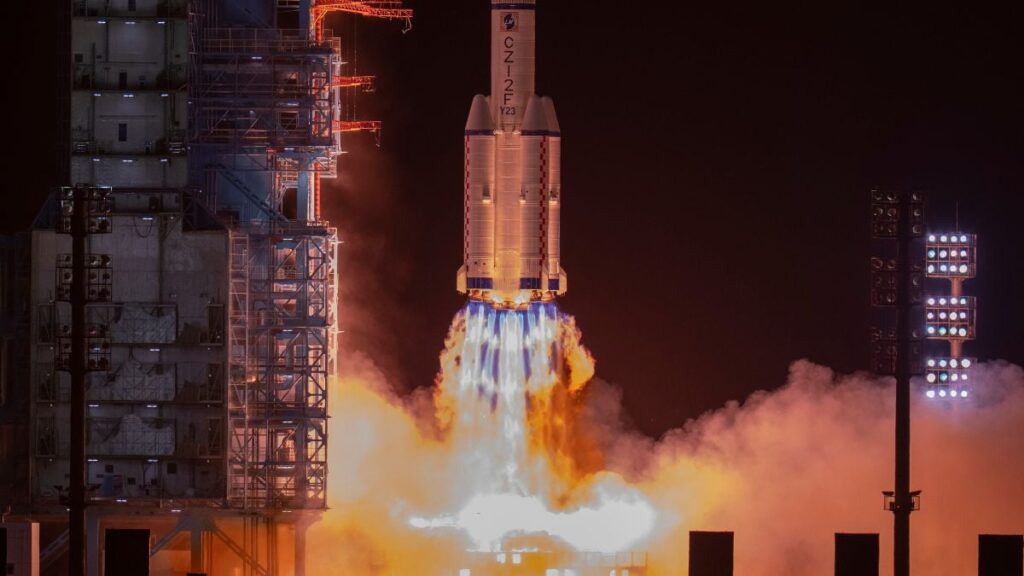
China has taken another step toward sending humans to the Moon
China has sent a new three-person crew to its orbital station Tiangong. For the first time in the history of China’s space program, one of the astronauts will remain in orbit for an entire year. The year-long mission is needed to understand whether the human body can endure the long journey to the Moon and back.
Launch of the Shenzhou-23 Spacecraft to Tiangong Station
The Long March 2F carrier rocket launched on the evening of May 24 from the Jiuquan Satellite Launch Center in the Gobi Desert. Approximately 10 minutes later, the Shenzhou-23 spacecraft separated from the rocket and entered orbit, and about 3.5 hours later successfully docked with the Tiangong station. According to Science Alert, the China Manned Space Agency (CMSA) confirmed that the astronauts are in good health.
The crew consists of three people. 43-year-old Li Jiaying became the first astronaut from Hong Kong — before joining the space program, she worked in the police force. The other two crew members are 39-year-old space engineer Zhu Yangzhu and 39-year-old former military pilot Zhang Zhiyuan, for whom this is his first spaceflight.
At the pre-launch ceremony, spectators gathered with flags, an orchestra played, and the astronauts saluted from the stage. The crew will conduct numerous scientific experiments aboard the station in the fields of medicine, biology, fluid physics, and materials science.

Crew of the Shenzhou-23 spacecraft
Why Will a Person Spend a Year in Earth’s Orbit
Until now, Tiangong crews have been rotated approximately every six months. Now one of the three astronauts will stay on the station twice as long — for an entire year. Who exactly that will be will be announced later, once the mission settles into its working rhythm.
All of this is necessary because a flight to the Moon and back is not a quick trip. And if we’re talking about building a lunar base, astronauts will spend weeks and months away from Earth. The year-long experiment in orbit will help understand how prolonged exposure to weightlessness affects the body and develop ways to protect crew health.
As astrophysicist Richard de Grijs noted, a year in orbit is a completely different operating mode for both technology and people compared to previous six-month missions. China is thus methodically building up experience in maintaining a permanent presence on its station.
What a Year in Weightlessness Will Do to the Human Body
Space is an environment for which the human body is completely unadapted. When there is almost no gravity, the body begins to change — and not for the better.
Here are the main problems astronauts face during long flights:
- Bone mass loss — without load-bearing stress, bones lose calcium and become brittle, similar to osteoporosis, only faster;
- Muscle atrophy — muscles that no longer have to fight gravity gradually weaken and decrease in volume;
- Radiation exposure — beyond Earth’s atmosphere, cosmic radiation affects the body significantly more;
- Sleep disturbances — circadian rhythms are disrupted because the station orbits Earth every 90 minutes and “day” and “night” alternate unusually quickly;
- Psychological fatigue — confined space, lack of familiar surroundings, and the inability to go outside weigh on the psyche
All of this is critically important to account for when planning lunar missions. If a person barely tolerates a year in orbit, then approaches to training, nutrition, medications, and spacecraft design need to change. Furthermore, as Richard de Grijs emphasized, the station must provide reliable water and air recycling, as well as the ability to handle medical emergencies far from Earth.
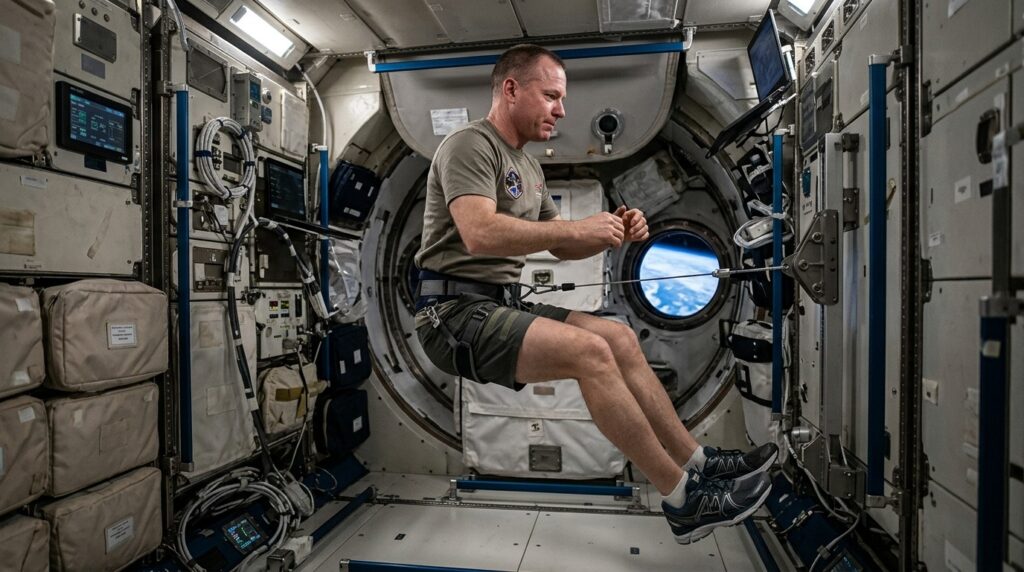
Exercise aboard the orbital station helps combat muscle and bone mass loss
China’s Lunar Program
China has a serious reason for developing its lunar program independently from everyone else. Since 2011, the United States has legally prohibited NASA from cooperating with Beijing. China was cut off from the International Space Station and, in response, built its own. Tiangong has been in low Earth orbit since 2021 and already receives regular crews.
Now the same logic applies to the Moon. While the United States develops the Artemis program with partners, China does everything on its own. By 2035, Beijing plans to create the first phase of the International Lunar Research Station (ILRS). Despite the word “international” in the name, the project is being developed under Chinese leadership.
At the same time, China does not intend to remain in complete isolation. Before the end of this year, Tiangong plans to receive the first foreign astronaut from Pakistan. This could mark the beginning of an expanding circle of partners.

Tiangong station in Earth’s orbit — the foundation of China’s crewed space program
It is worth noting that China’s space ambitions are backed by real achievements. In 2019, China’s Chang’e-4 became the first spacecraft in the world to land on the far side of the Moon. In 2021, a small rover successfully landed on Mars. Over the past 30 years, the country has invested billions of dollars in the space industry to close the gap with the United States, Russia, and Europe.
When Will China Land Humans on the Moon
The official goal is before 2030. And looking at the pace, this date appears quite realistic. Here is what has already been accomplished and what lies ahead:
- Tiangong station is operating normally and receiving regular crews;
- The Shenzhou-23 mission begins a year-long experiment with extended orbital stays;
- A test flight of the new Mengzhou lunar spacecraft is planned for 2026;
- By 2035, China intends to build the first phase of a habitable lunar base.
Each of these stages logically follows from the previous one. First, you need to learn to live in orbit for a long time. Then you need to test a spacecraft capable of reaching the Moon. Then comes the landing. And finally, a permanent presence.
The Shenzhou-23 mission is a test of the main limitation of any space voyage — the ability of the human body to endure extended time away from Earth. How this year-long experiment goes will largely determine how confidently China approaches its lunar landing in a few years.