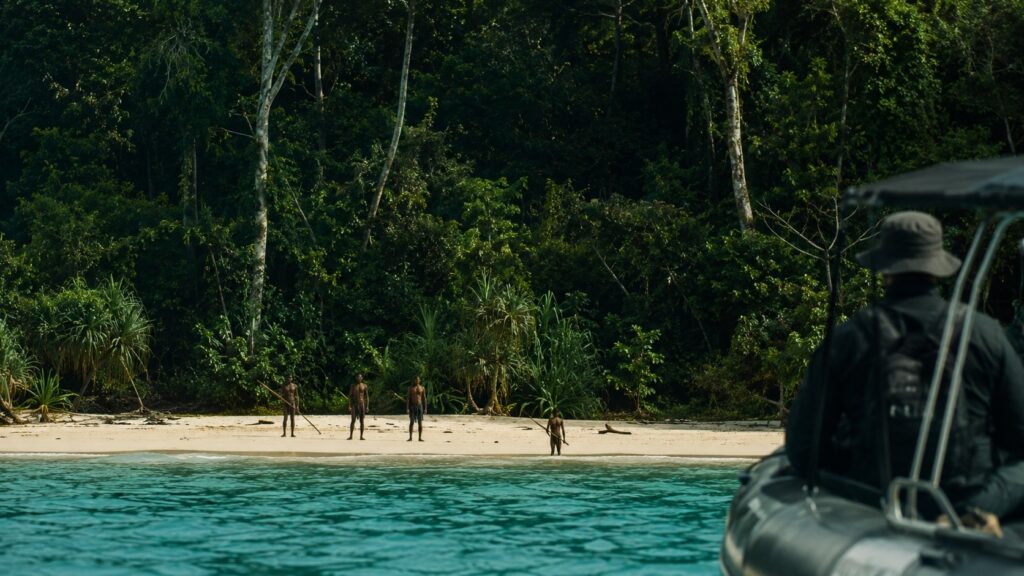
The most isolated tribe in the world does everything possible to keep outsiders away
On a tiny island in the Andaman Sea lives a tribe that has had no contact with the outside world for thousands of years. The Sentinelese greet any outsider with arrows, and they have good reasons for doing so. But in the 2020s, bloggers and adventure seekers are increasingly trying to reach the island. Meanwhile, an anthropologist who has personally met with the tribe says that complete isolation no longer protects them.
Who Are the Sentinelese and Where Do They Live
The Sentinelese are a people inhabiting North Sentinel Island in the Andaman archipelago. The archipelago belongs to India, although geographically it is located much closer to Myanmar and Thailand, in the Andaman Sea, part of the Indian Ocean. The island itself is small, roughly 10 kilometers across, covered in tropical forest and surrounded by coral reefs.
Remarkably little is known about the Sentinelese. According to Indian government estimates, about 50 people live on the island. They use narrow outrigger canoes, live in large communal huts, wear belts made of plant fibers, necklaces, and headbands. They hunt with spears, bows, and arrows. But scientists don’t even know something as basic as what they call themselves.
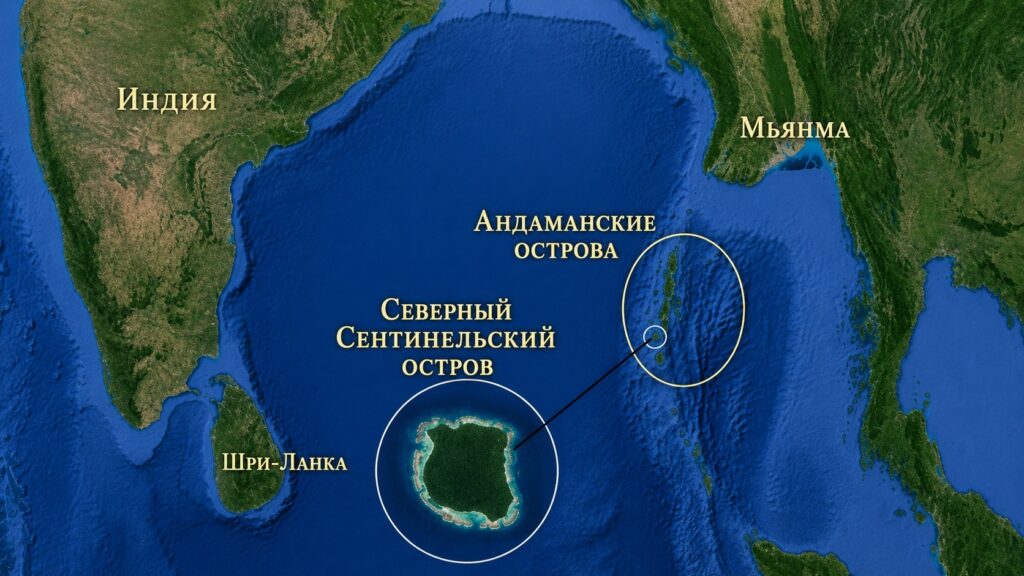
Sentinel Island on the map
According to Phys.org, anthropologist Anstice Justin, now 71 years old, is one of the last people to have officially visited the island as part of government missions from 1986 to 2004. He himself is from another indigenous group of the Andaman Islands.
Justin recounts that during his first visit in 1986, he waded through the shallow waters of the lagoon, past saltwater crocodiles, carrying a bag of coconuts as a sign of peaceful intentions. Smoke rose from the forest, and then people appeared.
Why the Sentinelese Island Is Closed to Outsiders
The Indian government has granted the Sentinelese the status of a Particularly Vulnerable Tribal Group and established a five-kilometer exclusion zone around the island. Entry into these waters is prohibited for everyone: fishermen, tourists, journalists, missionaries. Violators face arrest.
India’s official policy regarding the island can be summarized briefly: observe from a distance, hands off. This means remote monitoring without any attempts to make contact. The government ceased even limited contact missions after 2004.
The reason for this approach is the tragic experience with other indigenous peoples of the Andaman Islands. The advocacy organization Survival International points out that contact with the outside world had devastating consequences for other islanders: the population of the Great Andamanese peoples declined by 99%, primarily due to diseases brought from outside.
Why You Cannot Approach Isolated Tribes
Why can a common cold kill an entire people? It comes down to immunity. People living in large societies have encountered viruses and bacteria over millennia, and their immune systems have adapted. We endure flu, measles, and other infectious diseases with difficulty, but still survive because our ancestors had already encountered similar infections.
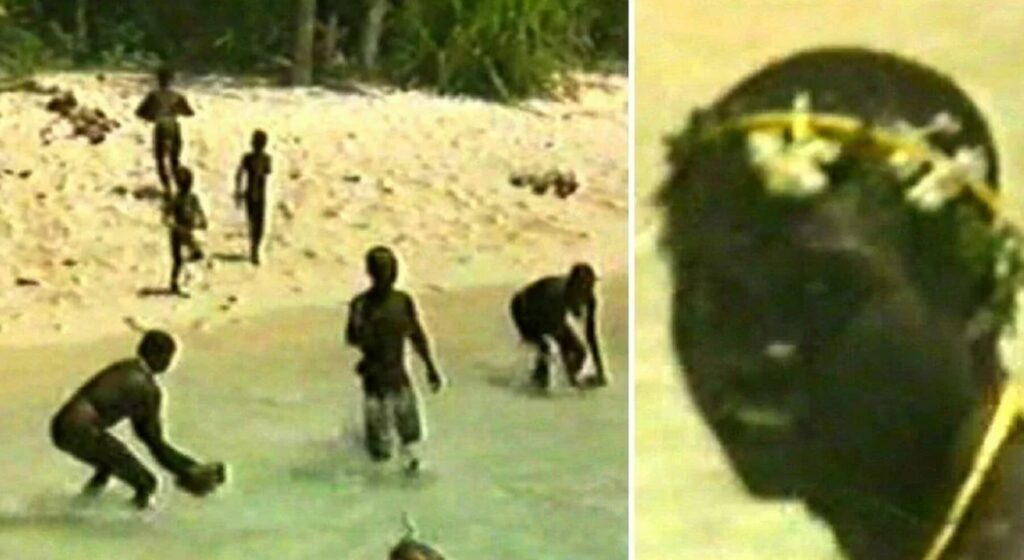
What the Sentinelese look like
Isolated peoples have no such protection. Their immune systems have never encountered pathogens that are commonplace for us. Even a simple cold can cause an epidemic with extremely high mortality in a group of 50 people. One sick visitor is enough, and the consequences could be irreversible.
This is precisely why Survival International categorically opposes any contact:
The Sentinelese have made it clear that they do not want communication with the outside world. Their arrows are the only means available to them to protect themselves from a threat whose scale they probably don’t even suspect.
How India Protects the Sentinelese Island
The main problem is that an exclusion zone on a map is one thing, but actual control over hundreds of square kilometers of open sea is quite another. It is impossible to completely prevent incidents, although police conduct surprise raids.
Nevertheless, violators appear regularly. In February 2025, police detained two fishermen who had entered the restricted waters. And in 2024, they arrested U.S. citizen Mikhail Viktorovich Polyakov, who landed on the island for five minutes with a can of juice and a coconut, all for a YouTube video. He was sentenced to 25 days in jail and fined 15,000 rupees (about $161).
Social media has made the problem much worse. Previously, only a narrow circle of specialists knew about the Sentinelese, but now anyone with a boat and a camera can decide that a visit to one of the most isolated tribes on Earth will bring them millions of views.
The punishment for violating the exclusion zone remains mild. Polyakov, who effectively invaded the territory of an isolated people, got away with three weeks in jail and a symbolic fine. And this is unlikely to stop the next fame-seeker.
Why the Sentinelese Tribe Is in Danger
There is a serious debate among experts. On one hand, there is the position of Survival International and many anthropologists: the Sentinelese have chosen to live without contact, and that is their right. Any intervention carries the risk of epidemic and cultural destruction.
On the other hand, there is the position of Anstice Justin, who visited the island more than 30 times. He says that complete isolation is a “fool’s paradise” that no longer works. The world around the island has changed: motorboats, drones, and bloggers willing to do anything for content have appeared. The Sentinelese cannot protect themselves from threats they don’t even know exist.
Justin says that in all his visits, he never saw hostility or aggression from the Sentinelese. The killing of American missionary John Allen Chau in 2018 was more of an exception — a reaction to an uninvited guest who violated every conceivable boundary.
In Justin’s opinion, strictly regulated meetings could at least give the Sentinelese a warning:
There are other people trying to disturb you.
But even he acknowledges that this is not about friendship or integration, but about minimal awareness.
Can the Sentinelese Tribe Be Helped
The most realistic way to protect the Sentinelese right now is not contact, but strengthening security. Patrols can be supplemented with satellite monitoring, radars can be used to detect boats in the exclusion zone, and penalties for violators can be toughened.
However, Justin raises a broader question:
A self-sufficient community survived for thousands of years, but under peaceful conditions, unlike the current situation where everyone is striving to become famous by seeing the Sentinelese.
He believes that in the long term, a completely isolated people may not survive in a world where boundaries are being erased.
This is not a call for forced contact. Rather, it is an acknowledgment that there are no perfect solutions. Leaving the Sentinelese alone means hoping that no blogger, fisherman, or missionary will break through the cordon. And any attempt to “help” carries the risk of bringing diseases to the island against which its inhabitants have no immunity.
For now, the balance between protection and non-interference remains fragile. About 50 people continue to live the way their ancestors lived thousands of years ago, a two-hour boat ride from a city of a hundred thousand. And the main question is not whether we want to get to know them, but whether we can guarantee that yet another person with a camera and a can of soda won’t reach them.