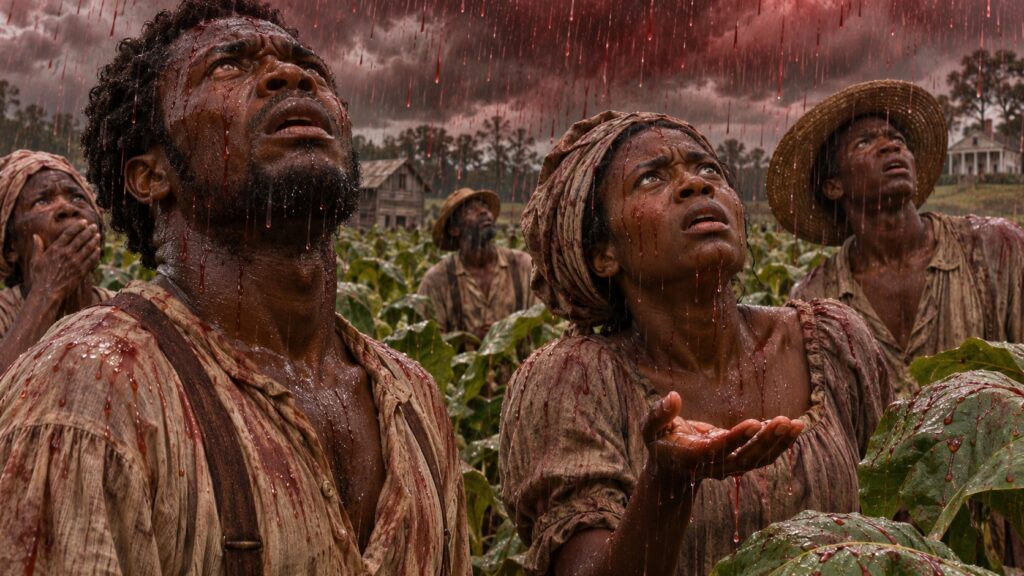
Enslaved people look on in horror at a blood rain
In August 1841, an unusual rain fell on a tobacco field near Lebanon, Tennessee. Along with red drops, small pieces of meat and fat came down from the sky. A scientist of the time examined samples and confirmed that they were animal tissue. How that tissue got into the sky is still not known for certain, and the episode has gone down in history as one of the strangest cases of “blood rain.”
What you need to know
- In August 1841, red drops and fragments resembling meat and fat fell on a tobacco field near Lebanon, Tennessee; a visitor estimated the strip of fallout at roughly 37–55 meters wide.
- Scientist Gerard Troost examined samples and concluded they were animal tissue of earthly origin; a report on the case was published in the American Journal of Science.
- Troost suggested strong winds may have lifted part of a decaying carcass into a storm cloud, but how the material actually reached the sky was never established.
- The case was later blamed on a hoax by the two enslaved people who first saw it, though a medical journal objected to that explanation as early as December 1841.
Red drops and pieces of flesh on a tobacco field
The first to notice the strange rain were two enslaved people working in the field. They heard drops striking the tobacco leaves and saw that the water was a deep red. Small pieces resembling meat and fat were falling along with it.
They carried the stained leaves to the farm’s owner, E. M. Chandler, who quickly told his neighbors. The farm almost immediately became an attraction: local residents wrote about the rain to relatives, and newspapers, including distant ones, reprinted the story.
People even came from other towns to see the site. One visitor, William Cooper, wrote in his diary that the fallen material gave off a revolting smell that hung over the whole area. By his estimate, the strip of fallen “rain” was roughly 37–55 meters wide. The story was recounted by Popular Science.
A scientist confirmed the material was animal tissue
To get to the bottom of it, samples were sent to Gerard Troost, a well-known scientist and collector of natural history specimens. When he opened the package, he immediately smelled rotting meat. After careful examination, Troost reached a firm conclusion: this was animal tissue, and of entirely terrestrial origin rather than anything “celestial.”
A report on the case was printed in the American Journal of Science. Troost also offered an explanation. In his view, a strong wind could have lifted part of a decomposing carcass into the air and carried it into a thundercloud, where it supposedly remained semi-liquid before falling back to the ground.
That answered the question of what had fallen, but not how it got up there. And for people at the time, the rain carried a meaning that mattered far more than any chemical analysis.
Why the rain recalled Nat Turner’s rebellion
Almost exactly ten years earlier, in 1831, in Southampton County, Virginia, an enslaved carpenter and preacher named Nat Turner began seeing signs. He spoke of strange lights in the sky and of drops of blood on corn, as if it were dew from heaven. He later found leaves in the woods marked with blood and took this as an omen.
Turner soon led one of the bloodiest uprisings of enslaved people in US history. Between August 21 and 23, 1831, he and his followers killed 55 white people. In response, local militias and lynch mobs killed an unknown number of Black people, both enslaved and free. Turner and some of his followers were sentenced to death and executed.
As a result, many people saw the blood on the tobacco leaves in 1841 as a repetition of those omens. White Southerners feared a new uprising. In the North, some saw the event as a rebuke from above to slaveholders. On September 10, 1841, the newspaper The Wisconsin Enquirer wrote that Northerners were comparing the Lebanon rain to the bloody drops that preceded Turner’s rebellion and regarding it as a warning to the Southern states.
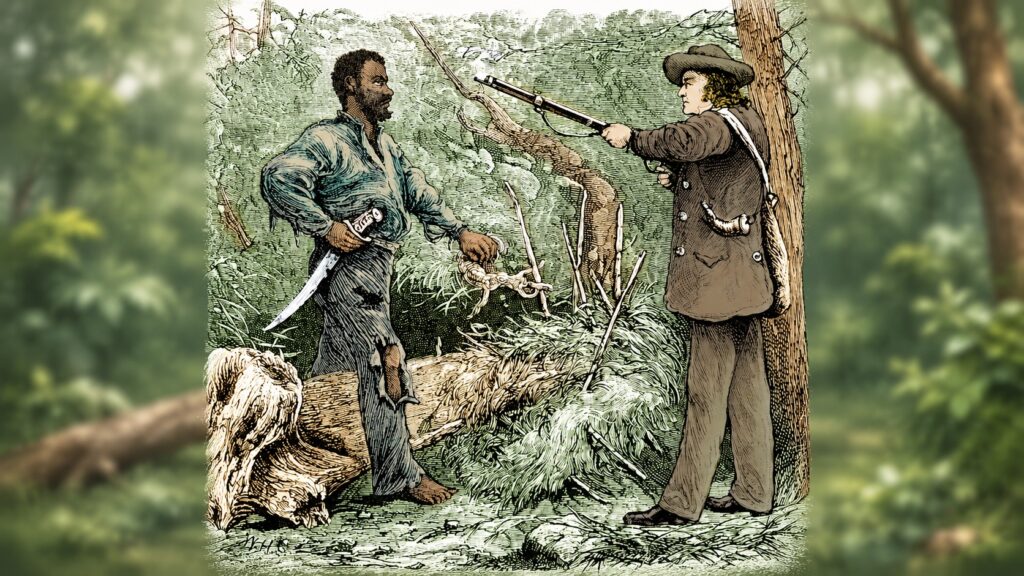
Depiction of Nat Turner. Source: popsci.com
The witnesses themselves were accused of a hoax
The mystery was never fully solved, and over time the event was written off as a deception. The blame fell on the same two enslaved people who had first seen the rain. However, as early as December 1841, The Western Journal of Medicine and Surgery published an objection to this version.
Writer and blood-rain researcher Tom Maxwell believes people simply need some explanation, even a wrong one. According to him, many at the time found it convenient for the event to be a hoax: that way, the story stopped being an unpleasant omen for a slaveholding society.
Falling flesh and red water have different explanations
The Tennessee case was neither the first nor the last of its kind. Blood rains are mentioned in the Iliad and the Bible, were described in ancient Rome and medieval Ireland, and reports of them still appear today.
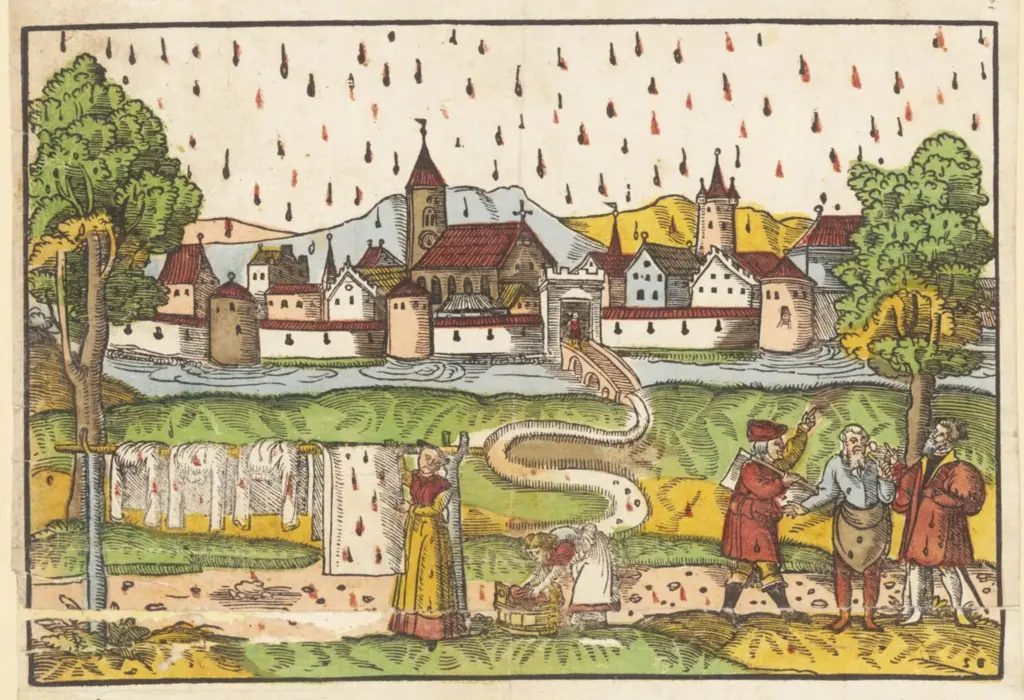
Women hanging laundry under red drops falling over a town
In the 19th century, scientists began examining such material under the microscope. According to Maxwell, in those cases it always turned out to be blood and animal tissue. The debate shifted to a different question: how it all got into the sky. Today, researchers treat these as separate questions, first determining what exactly fell and then looking for how it got into the air.
Falling meat
Falling meat is most often explained much as Troost explained it: a powerful storm can pick up the remains of a carcass, or a vulture may drop its prey. Such weather oddities are known: rains of fish, whirlwinds carrying insects and even frogs falling from the sky have all been described.
Red water
Red water is a different matter. It is usually colored not by blood or flesh but by dust or microscopic organisms. In the past, this was difficult to determine. Patrick McCafferty, a researcher at Chemnitz University of Technology, says people of earlier eras simply lacked the necessary scientific tools. Red rain seemed to them a punishment from God, and Christians familiar with biblical prophecies of the end of the world were ready to see blood in it.
The red rain of Kerala, India, in 2001
A vivid modern example occurred in the Indian state of Kerala during the 2001 monsoon season. Blood-colored rain fell there several times, and this time scientists were able to collect samples.
Researchers reached different conclusions:
- One group found algae spores in the water that produced the red color.
- Another concluded that the rain had been colored by dust carried by wind from the deserts of West Asia.
- A third proposed the boldest idea: that the water contained bacteria-like particles that had entered the atmosphere from a disintegrated comet.
Blood rains do often coincide in time with meteors or comets, and McCafferty is among those who have studied this link. But the cosmic explanation has not gained wide acceptance. So even for the well-studied Kerala case, there is no single answer.
Why such reports should not simply be dismissed
McCafferty cautions against brushing such stories aside. He points out that the French Academy of Sciences once ridiculed accounts of stones falling from the sky, calling meteorites stones that had been struck by lightning. It later turned out that stones really do fall from the sky. Maxwell, for his part, believes the most honest response to the unexplained is to admit: “I don’t know.” For the Lebanon rain, that remains the only honest answer so far.