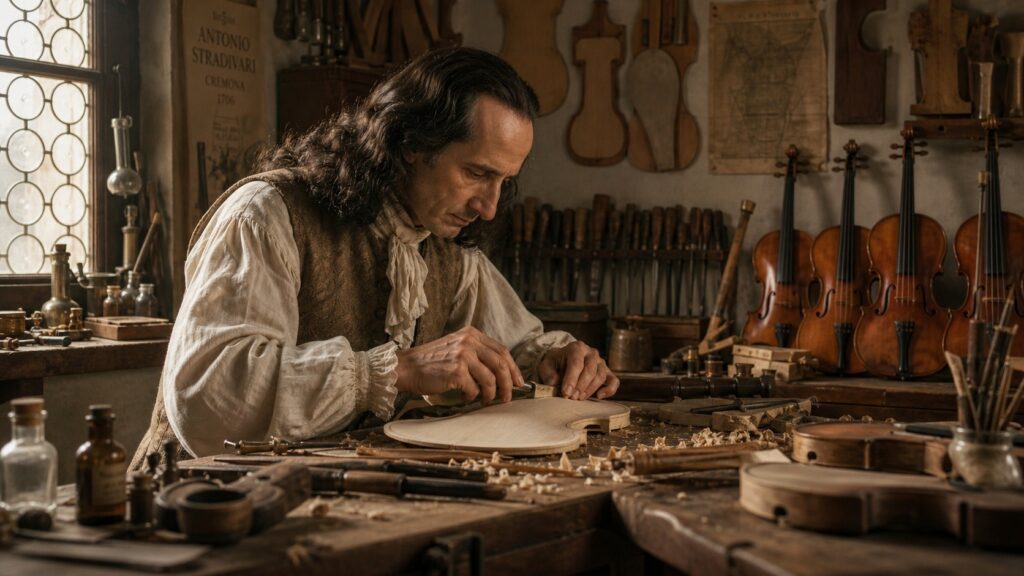
Scientists managed to create a virtual copy of a Stradivarius violin
Authentic Stradivarius violins sell at auctions for $4–16 million, and the last one was made in 1737. Musicians fortunate enough to play an original describe its sound as powerful, pure, and incredibly responsive — it fills a concert hall while reacting to the slightest touch of the bow. Recently, a team of engineers built the first full-scale physical model of a Stradivarius violin that generates sound not from recordings, but from equations describing the behavior of wood, varnish, strings, and air.
How Scientists Created a Virtual Violin
The starting point was the famous Titian Stradivarius violin from 1715 — an instrument from Stradivari’s so-called Golden Period (1700–1720), when the master perfected the shape, proportions, wood thickness, and varnish of his violins. The researchers performed a CT scan of the instrument, reconstructed its three-dimensional shape, and divided it into millions of tiny elements.
Each element was assigned real physical properties: spruce for the top plate, maple for the back, ebony for the fingerboard, varnish, and modern steel strings. Original Stradivarius instruments were made entirely of wood and varnish, but today they are played with metal strings. But the most important step was modeling the violin and air as a unified system, where wood moves air and air pushes back on wood, according to Newton’s third law.
When the scientists removed this two-way interaction from the model, important resonances shifted by more than a semitone, and the volume of some frequencies changed by 10 decibels. Simply put, without accounting for the air’s feedback effect, the virtual violin stopped sounding like the real thing.
How the Virtual Violin Differs from Plugins
Modern virtual instruments (VST plugins) for composers and producers sound impressive. For example, Stradivari Violin by Native Instruments is built on detailed recordings of the Vesuvius Stradivari 1727 violin — thousands of notes, transitions, dynamic nuances, and articulations stitched together by software. Most violin music in film is made this way, and most listeners wouldn’t notice the difference.
But sampled libraries have a fundamental limitation: they capture the sound of a specific instrument at the moment of recording. They cannot answer the question of how the sound would change if you made the plate thinner, altered the shape of the f-holes on the top plate, or replaced spruce with maple.
The computer model works differently — it computes sound from physics rather than playing back recordings. This makes it similar not to a synthesizer, but rather to a wind tunnel for designing violins. However, a single computation takes 8–10 hours on four powerful Dell Precision 7960 workstations, though GPU acceleration could significantly reduce this time.
What Was Played on the Virtual Violin
Currently, the virtual violin can only reproduce pizzicato — the sound of a plucked string. The researchers played fragments of Bach’s Fugue in G minor and the song “Daisy Bell” on it, as a nod to the history of computer sound. In 1961, an IBM computer first sang this song using early speech synthesis technology, and this moment was later immortalized in the film “2001: A Space Odyssey,” when the HAL 9000 computer sings “Daisy Bell” as it’s being shut down.
Modeling the bow is a far more complex task. The bow catches the string, releases it, slips, and catches again in a nonlinear dance of friction, pressure, speed, rosin, and the musician’s intent. The study authors explicitly note that bow-string interaction remains an active area of research and has been left for future work.
Even the current pizzicato sound is far from ideal, and some commercial VST instruments sound more convincing. But beautiful sound was never the goal. Professor Nicholas Makris acknowledged that the sound might seem mechanical:
We use the same standard pluck function for every note. A musician adapts the way they produce the sound, putting more feeling into individual notes. But these subtleties can be added later.
How Violins Are Made
Traditional violin craftsmanship is a slow and expensive process. A master (luthier) can carefully select the wood and calibrate the dimensions, but the full timbre of the instrument only reveals itself after the violin is already assembled. As research associate Yuming Liu explained:
Right now, people try to improve designs incrementally — they build a violin, compare the sound, make a change in the next instrument. That’s very slow and expensive. Now you can make a change virtually and hear the result.
The team tested this in practice by changing parameters of the virtual violin:
- When thinning the top and bottom plates to 2 mm, the low-frequency response was enhanced, but the highs weakened;
- When thickening the plates to 4.5 mm, important low-frequency resonances weakened and shifted upward;
- On low notes, the airflow through the f-holes played the main role in sound radiation, while on high notes it was the vibration of the plates themselves, with the top plate contributing more than the back.
These results matched the empirical rules of master luthiers: plates that are too thin produce volume but impoverish the harmonics, while plates that are too thick stifle the sound. The model doesn’t replace the craft but allows testing an idea before months of work and rare wood are spent.
We are not claiming that we can reproduce the magic of a master — we are simply trying to understand the physics of violin sound and, perhaps, help makers in the design process, — Makris emphasized.
Why the Same Violin Sounds Different
The model also answered a question familiar to anyone who has attended a concert: why does the same instrument sound different depending on where you’re sitting?
A violin doesn’t radiate sound like a small speaker, uniformly in all directions. Different frequencies leave the instrument in different patterns. Low notes spread widely, while high overtones shoot out in directed lobes, creating zones of strong and weak sound around the performer.
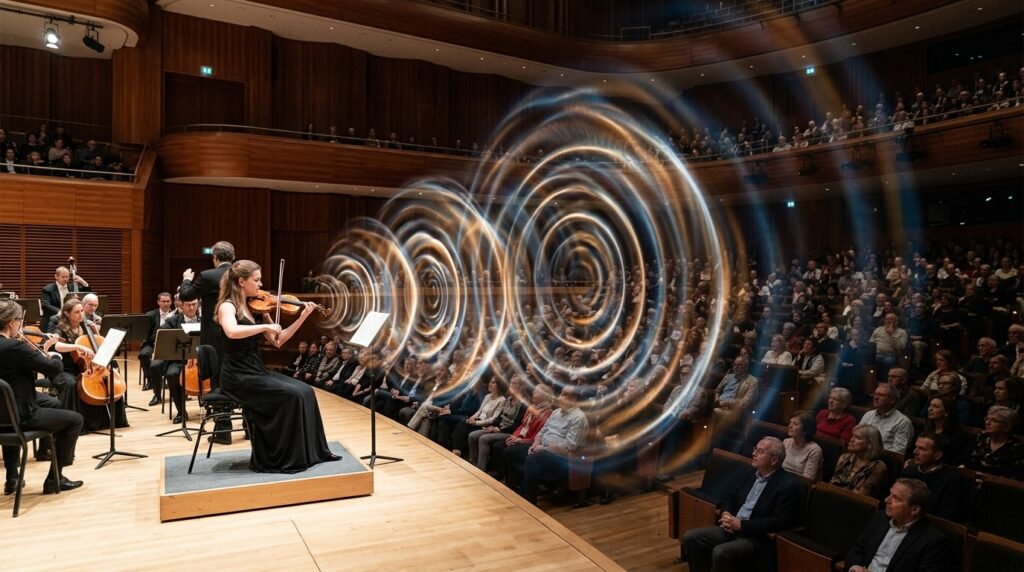
Visualization of sound propagation from a violin in a concert hall
The researchers modeled how the sound of an open D string reaches different points around the violin. Some harmonics like the octave, fifth, and third were strong in one direction but weak in another. This means that the “recipe” of timbre heard by a particular listener depends on their seat in the hall. In a real venue, reflections from walls and ceiling partially compensate for this, but for makers, performers, and acousticians, the model offers a rare opportunity to look at the “weather map” of pressure around the instrument.
How the Digital Stradivarius Model Will Change Violin Making
It’s important to understand what exactly this work claims and what it doesn’t. The authors do not claim to have found a recipe for exactly reproducing a Stradivarius. They call their model “inspired by Titian” because the exact material properties, defects, and hidden details of the original instrument are not fully known.
But the research opens a fundamentally new approach. Instead of debating how important one element is compared to another, you can now change that specific element and hear the result. Physical models of this caliber point to a future in which musical instruments become editable systems. A luthier will be able to test a dozen variations of plate thickness before picking up a chisel. And a museum will be able to let people hear a fragile historical instrument without putting it at risk.
For now, the virtual Stradivarius plays Bach and “Daisy Bell” with a pluck, awaiting the bow. But even in this form, it is the most detailed physical simulation of a violin ever created — and the first step toward making the three-hundred-year-old mystery of Cremona a little more understandable. The research results have been published in the scientific journal npj Acoustics.