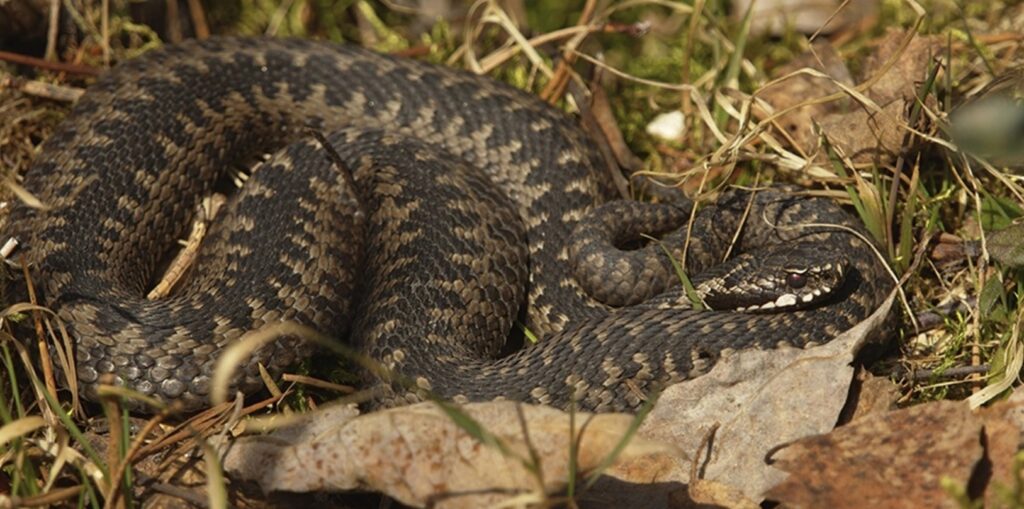
In spring, vipers wake up in Russia, and it’s best to keep your distance. Image source: m24.ru
Spring has only just begun, and the first snakes have already been spotted in Moscow’s parks. Some people calmly walk past, while others panic, unable to tell whether the creature basking on the path is a harmless grass snake or a venomous viper. It turns out that telling them apart is easier than it seems if you know a few key features. At a time when snakes have emerged from their winter shelters, this is very relevant.
When Snakes Wake Up After Winter Hibernation
The first reports of snakes waking up in the Moscow region appeared as early as the beginning of March 2026. As noted by candidate of biological sciences Pavel Glazkov, reptiles usually awaken from winter hibernation when the temperature consistently stays at +10°C (50°F) or above for several days. However, there are exceptions. If the outdoor temperature is only +5°C (41°F), but a sunny hillside has warmed up to +15°C (59°F), so-called “heat traps” form. Because of these, snakes may wake up significantly earlier than expected.
At the same time, according to Moscow’s Department of Environmental Management, as of March 10, no mass awakening of snakes on the city’s natural territories had been recorded. However, visitors to Moscow’s parks, forest parks, and natural areas sometimes notice reptiles on trails or sun-warmed clearings after the bulk of snow has melted. Such encounters are not related to aggression but to the natural biological cycle.
The common grass snake and the common viper are familiar inhabitants of Moscow. Their appearance on the surface in spring is driven by rising soil and air temperatures, the need for sunlight to recover after hibernation, and the search for mating partners. Simply put, snakes do not seek contact with humans but are forced to find open, well-lit areas — forest edges or rocks where they can warm up after a long winter.
How to Tell a Viper from a Grass Snake
Telling a viper from a grass snake is actually not difficult. Just pay attention to a few key features:
- Head shape. A viper’s head resembles a triangle, while a grass snake’s head is round and smooth. This is perhaps the most noticeable difference, even from a distance.
- Eyes. A viper has slit-shaped pupils, similar to a cat’s. A grass snake has ordinary round pupils. But honestly, examining a snake’s eyes up close is not the best idea.
- Pattern on the back. A viper has a distinct zigzag pattern on its back, while a grass snake has no such marking.
- Yellow spots on the back of the head. This is the grass snake’s calling card — two bright yellow spots on the back of its head. But there’s a nuance: some individuals may lack these spots or have black ones instead.
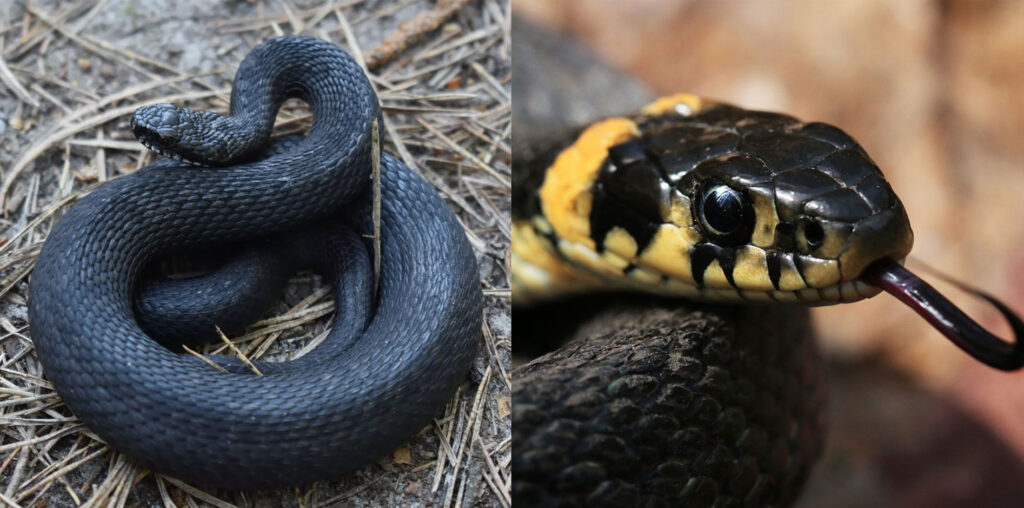
Left: viper. Right: grass snake
What to Do If You See a Snake
Encountering a snake is not a reason to panic. If you spot a reptile, stop, give it the opportunity to slither away, and maintain a distance of at least 5–10 meters. Do not try to touch the snake, photograph it up close, or chase it away with a stick. All snake species inhabiting Moscow are under special protection, and a viper will only bite in self-defense during direct contact.
Extra caution should be exercised in late April and early May. That is when, at air temperatures of 18–20°C (64–68°F), snakes enter their mating season. During this period, their activity increases: the reptiles are focused on finding a partner, which may cause them to react slightly slower to approaching people.
If contact could not be avoided and a snake did bite, seek immediate medical attention at the nearest hospital. A viper bite can cause sharp pain, swelling, and bruising of the limb. However, it poses a real danger mainly to those who suffer from heart conditions or severe allergic reactions that could lead to anaphylactic shock.
What Other Animals Wake Up in Spring
Snakes are not the only ones that come alive with the arrival of warmth. Due to flooding of winter shelters ahead of schedule — specifically in early March — hedgehogs may wake up early. In addition, floods can affect mosquitoes and flies, ground beetles, and some ladybugs. Frogs in central Russia become active closer to the beginning of April.
But that’s not all. Earlier, experts predicted an invasion of marmorated stink bugs (yes, the smelly ones) and Spanish slugs in 2026. The cause may be changes in average annual temperatures and the length of the growing season.
Snow cover is an excellent thermal insulator. The deeper the snow, the higher the temperature in the upper soil layer and the smaller the range of temperature fluctuations. A snowy winter like the current one may result in significantly more insects waking up in spring than usual. So this spring, expect more overwintered butterflies, beetles, and many other insects.