Xiaomi has released the POCO X8 Power without a major launch event. Its headline feature is a 10,000 mAh battery, the largest ever in a POCO phone, surpassing the 8,500 mAh cell in the current POCO X8 Pro Max. The low-key debut has a simple explanation: the X8 Power is not a new design but a rebranded version of the Redmi Note 17 Pro Max, sold for now only in India. Below is what is inside, where Xiaomi trimmed the specifications compared with the Redmi original, and what buyers outside India should keep in mind.
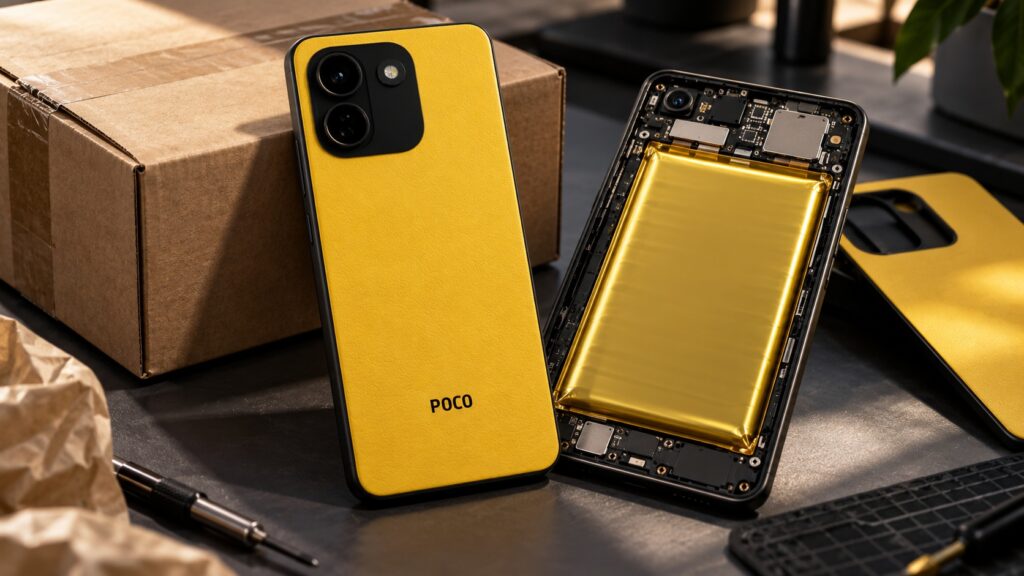
The POCO X8 Power comes with a huge 10,000 mAh battery
What you need to know
- The POCO X8 Power has a 10,000 mAh battery with 100 W wired charging and 27 W reverse charging, in a body 8.6 mm thick and weighing 229 g.
- It is a rebadged Redmi Note 17 Pro Max with the same chipset, display, cameras and battery, but slower LPDDR4X RAM and UFS 2.2 storage across all variants.
- It is sold only in India, priced at 35,999 rupees (8/128 GB) and 38,999 rupees (8/256 GB); no global launch has been announced.
- NFC support is reported to vary by region, and there is no microSD slot or wireless charging.
A new POCO record: 10,000 mAh instead of 8,500
Until now, the largest POCO battery belonged to the X8 Pro Max: 8,500 mAh in the global version and 9,000 mAh in certain regions. The X8 Power raises the bar to 10,000 mAh while keeping the body within reasonable limits: 8.6 mm thick and 229 g. It is a heavy phone, but not a brick.
Charging is wired at 100 W, so even a battery this large should not need to sit on the charger all night. There is also 27 W reverse charging, meaning the phone can top up earbuds, a watch or someone else’s handset, partially standing in for a power bank. Wireless charging is not listed in the specifications. Water and dust protection is rated IP69K, a step above the familiar IP68 that implies resistance to pressurized jets of hot water.
Essentially a Redmi Note 17 Pro Max in different colors
Xiaomi already showed a 10,000 mAh phone this spring, the Redmi Note 17 Pro Max. The POCO X8 Power is a rebrand of that device: the same platform, the same screen, the same camera and the same battery. The differences lie in the styling and the memory configurations.
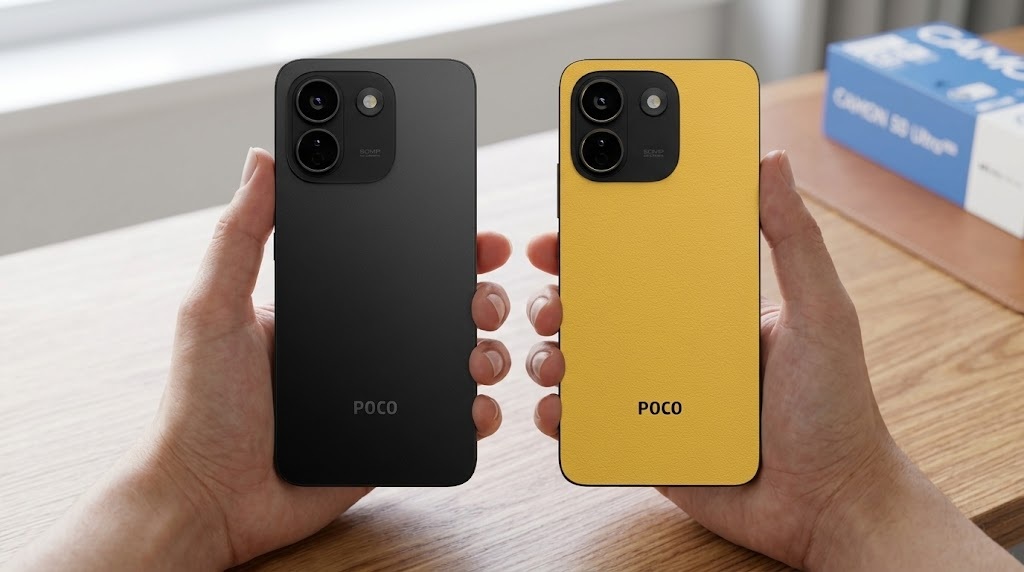
The POCO X8 Power is available only in black and yellow
POCO is stricter with colors. The Redmi comes in four finishes: black, light green, light purple and pearlescent. The X8 Power offers just two: classic black and the brand’s signature yellow-and-black. If you specifically want the eye-catching “wasp” look, this is the only way to get it.

6.83-inch display, Snapdragon 6 Gen 5 and a 50 MP camera
The internals are typical of Xiaomi’s 2026 mid-range lineup, with no flagship pretensions but no glaring weaknesses either. Key specifications:
- 6.83-inch AMOLED display, 2772×1280 resolution, 120 Hz refresh rate, peak brightness up to 3,500 nits, Gorilla Glass Victus 2;
- Qualcomm Snapdragon 6 Gen 5 chip (4 nm), 8 GB of RAM;
- 50 MP main camera with optical image stabilization, 8 MP ultrawide, 32 MP front camera;
- stereo speakers, IR blaster for controlling appliances, Wi-Fi 6, Bluetooth 6;
- in-display fingerprint scanner, two nano-SIM slots with no memory card support;
- Android with the HyperOS 3 interface.
There is no telephoto lens, and the 8 MP secondary camera is more of a box-ticking exercise than a serious shooting tool. According to the source, NFC support depends on the region, so anyone buying the phone abroad should check that point separately. There is also no microSD slot, so the storage capacity you choose is fixed for good.
Where Xiaomi cut costs: slower memory
The main compromise is hidden in the memory specifications. The Redmi Note 17 Pro Max uses LPDDR5X RAM and UFS 4.1 storage in every version except the base 8+128 GB model, which uses UFS 2.2. The POCO X8 Power uses LPDDR4X and UFS 2.2 in all configurations, the previous generations of both standards.
In practice, this means slower app installations, slower copying of large files and longer load times for heavy games. In everyday tasks such as messaging, browsing and video, the difference is barely noticeable, especially since the processor is not a speed champion to begin with. But for the same money, the higher-tier Redmi versions are objectively faster. The POCO’s configuration choice is also narrower: only 8/128 GB and 8/256 GB, with no options offering more RAM.
Sold only in India
This is the answer to the “secret” launch: the POCO X8 Power was announced in India and, for now, only for that market. Pricing is 35,999 rupees for the 8/128 GB version and 38,999 rupees for 8/256 GB. No global release has been announced, so in other markets the X8 Pro Max remains the POCO model with the largest available battery.
This is standard practice for POCO: some X-series models remain India-only offerings for years. Anyone who wants this particular phone elsewhere would need to find sellers handling Indian stock and verify in advance that it supports NFC and the network bands they need.