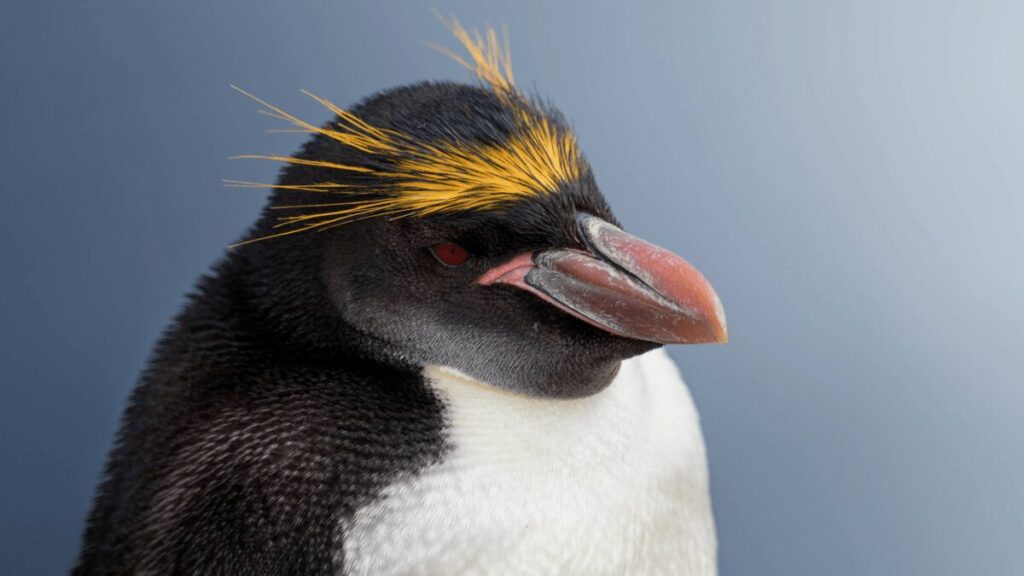
Macaroni penguins turned out to be surprisingly buff
Beneath the funny, somewhat goofy appearance and the famous waddling gait of macaroni penguins lies an impressively powerful musculature adapted for both underwater “flight” and walking on land. A new study has for the first time described in detail the limb muscles of these birds and in the process helped solve a penguin mystery that had stumped zoologists for over 100 years. And this is far from the first oddity about these birds: scientists had previously investigated why penguins sleep in brief snatches right in the middle of their noisy colony life.
How Penguin Muscles Work and How They Differ from Other Birds
The macaroni penguin (Eudyptes chrysolophus) is a medium-sized bird, about 70 cm tall and weighing 5–6 kg. It inhabits sub-Antarctic islands of the South Atlantic and Indian Oceans and is recognizable by its bright yellow feather crests. Despite its somewhat comical appearance, a serious muscular apparatus hides beneath its feathers.
A team of anatomists from Midwestern University (USA), with the participation of specialists from SeaWorld San Diego and Scarlet Imaging, performed detailed dissections of two macaroni penguins and compared their musculature with the anatomy of flying birds. The result is the first modern and complete map of the limb muscles of this species.
Why Penguins Don’t Fly and How They Swim
Most birds fly through the air. Penguins long ago gave up this ability and became one of the most well-known examples of flightless birds. However, they learned to “fly” underwater. And for this, their bodies were radically restructured.
The main difference lies in a muscle called the supracoracoideus. In flying birds, it is relatively small: its job is to raise the wing, while the powerful pectoral muscle does the main work during the downstroke. The return stroke of the wing in air is almost passive — the airflow helps. But in water, everything is different.
Water is approximately 800 times denser than air. To move in such a medium, a penguin needs muscular force on both the downstroke and the upstroke. Therefore, the supracoracoideus in macaroni penguins is significantly enlarged compared to their flying relatives. According to earlier studies on other penguin species, this muscle can constitute nearly half the mass of the pectoral muscle, whereas in flying birds it is only about one-fifth.
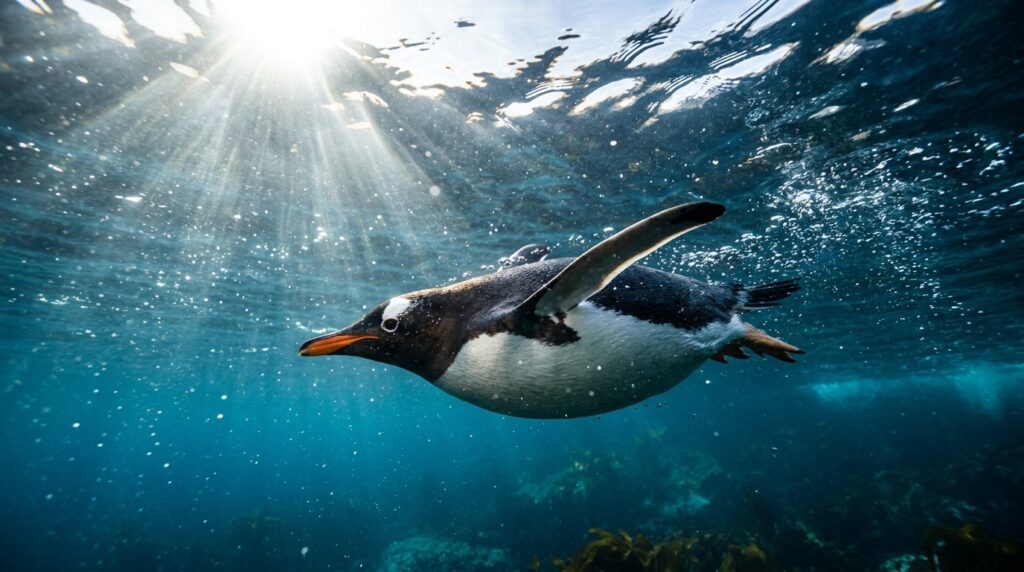
A penguin “flies” underwater, using flippers as wings
Additionally, the researchers discovered an unusual configuration of the shoulder girdle muscles. It gives the penguin’s stroke a pronounced rearward component — meaning the flipper pushes water backward with each movement, which increases thrust. Imagine that you are swimming and your arms with each stroke not only push down but also forcefully push water behind your back. That is exactly how a penguin swims.
Penguins actually behave more complex underwater than one might think: studies have shown that they even produce sounds underwater during hunting.
A Century-Old Mystery of Penguin Hind Limb Muscles
One of the most interesting findings of the study is a muscle in the hind limbs that scientists had debated for over a hundred years. Some considered it part of the external oblique abdominal muscle, while others believed it to be the superficial head of the hip flexor. There was no consensus.
Dissection showed: it is a separate, independent muscle. It originates from the sternum, crosses the midline of the body, and attaches to the tibiotarsus of both legs, effectively linking the hind limbs together. The researchers proposed naming it adductor tibialis — meaning “tibial adductor muscle.”
Its function is to keep the penguin’s legs tightly pressed together. This works on the same principle as in dolphins, whales, and even humans while swimming: the more streamlined the body shape, the lower the water resistance. For a penguin that chases krill at depths of up to 100 meters, such energy savings are critically important.
Why Penguins Waddle When They Walk and Don’t Fall Over
The famous “duck-like” waddle of penguins is not just a cute trait but a direct consequence of their anatomy. That very adductor tibialis muscle, which helps underwater, works differently on land: it holds the shins in an adducted position and helps maintain balance while walking on two legs.
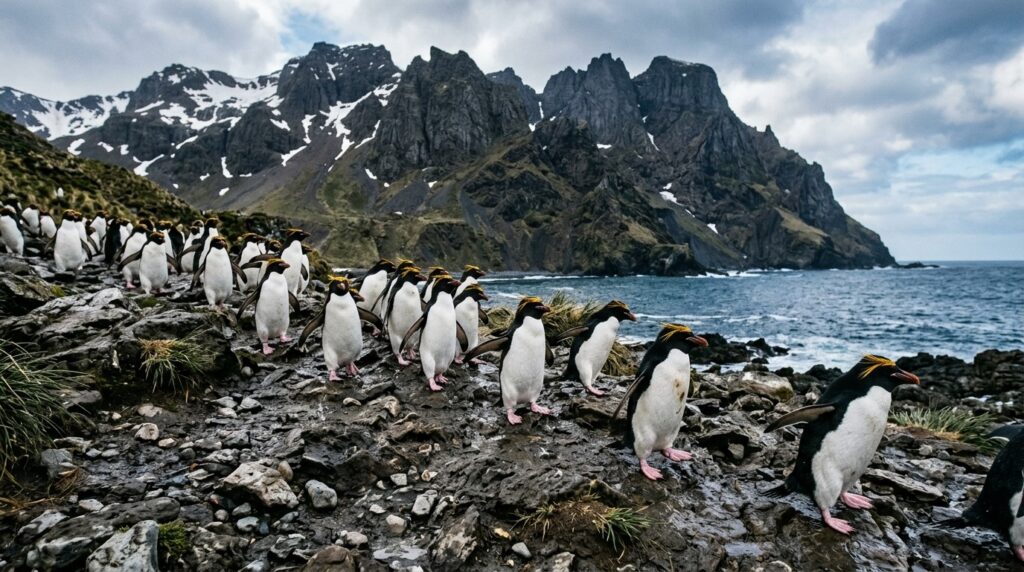
Macaroni penguins walking down a rocky slope toward the ocean
A penguin’s legs are positioned far back compared to other birds, and the knees barely extend during walking. Specialized muscles keep the limbs close to the body, and all of this together results in the characteristic side-to-side swaying. At first glance it looks clumsy, but this gait turns out to be energy-efficient — both on land and in water, where pressed-together legs reduce drag.
Why Scientists Study Penguin Muscles and What It Offers
The study has quite practical significance. Macaroni penguins are frequent residents of zoos and wildlife rehabilitation centers. Yet until now, detailed anatomical references for their musculature practically did not exist. Now veterinarians have a detailed atlas of limb muscles that can help in several areas:
- Diagnosing and treating flipper and leg injuries
- Planning surgical interventions
- Developing rehabilitation programs for injured or sick birds
The better we understand the biology of these birds, including the structure of their bodies, the more precisely we can develop strategies for their conservation.
Furthermore, the study sheds light on the evolution of penguins — from flying ancestors to masters of underwater swimming. Understanding exactly how the musculature was restructured helps reconstruct the evolutionary path taken by an entire order of birds. Findings of ancient penguins, whose wings and legs were already adapted to life in water, fit well into this picture.
So the penguin waddle is not clumsiness. It is the result of millions of years of evolution, during which penguins transformed from flying birds into some of the best swimmers in the animal kingdom. And their powerful musculature, as it turns out, can put many creatures that look far more athletic to shame.