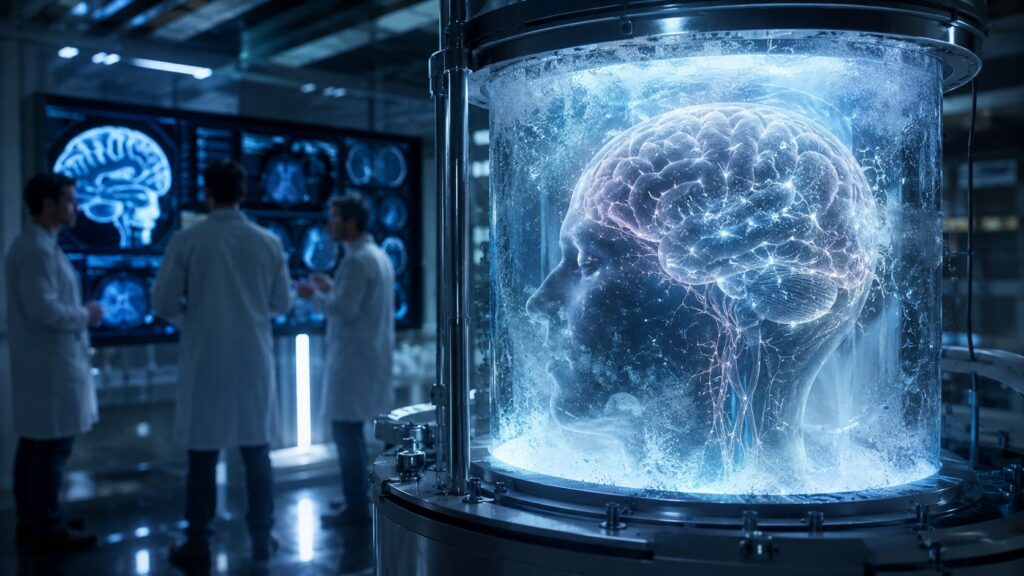
The idea of freezing people for resurrection in the future is not so far-fetched
Nearly 30% of American doctors consider it plausible that one day we will learn to freeze a deceased person’s brain in such a way that it could function again after thawing. This is not a quote from a science fiction series but the result of a fresh survey conducted among dozens of medical experts. The boundary between life and death is blurring, and doctors are debating it more actively than ever.
What Is Cryonics in Simple Terms
The idea sounds like a movie plot: a person dies from an incurable disease, their brain is frozen, and decades or centuries later, when medicine has advanced enough, they are thawed and brought back to life. In practice, this is called cryopreservation — the preservation of biological tissues at ultra-low temperatures.
According to sfgate.com, the first person was frozen for this purpose back in the 1960s. Since then, hundreds of frozen brains and whole bodies have accumulated in special storage facilities around the world. People who agreed to this procedure are counting on future technologies being able to cure what killed them today.
The problem is that the freezing process itself is destructive. Water inside cells expands when frozen and literally tears them apart, just like a water bottle forgotten in the freezer bursts. The delicate neural connections that store our memories, skills, and personality can be irretrievably lost in the process.
Scientists’ Experiments with Brain Freezing
Despite the obvious challenges, encouraging results have emerged in recent years. In 2024, a group of researchers published in the scientific journal Cell about a new method of preserving human brain tissue that did not destroy the structure and function of brain neurons. This was an important step: for the first time, it was shown that the structure of neural connections can survive preservation in relatively good condition.
And in early 2026, scientists recorded neurological activity in sections of a mouse brain that had been converted into a glass-like state through vitrification. Vitrification is essentially turning tissue into biological glass: the liquid does not crystallize but solidifies in an amorphous state without forming destructive ice crystals.
It is important to understand that activity in individual sections of a mouse brain is not yet resurrection. It is roughly like discovering that individual parts of a disassembled engine still work. We are still far from assembling and starting the entire mechanism. But the very fact that cells retain their functionality after such a procedure makes scientists take the topic more seriously.
What Doctors Think About Freezing People
It was against this backdrop that researchers from Australia, Switzerland, and the United States decided to find out what practicing doctors think. They surveyed 150 general practitioners and 184 other specialists.
The results were unexpected. Nearly 30% of the surveyed doctors considered it generally plausible that someday we will invent conditions under which the brain retains enough neural information to function again after death. In other words, one in three doctors does not rule out such a possibility, even if in the distant future.

Doctors discussing brain condition data at a medical conference
Even among the 70% of skeptics, most saw no problem in helping terminally ill patients who want to preserve their brain after death. About 60% of respondents saw no significant conflict between palliative care and actions to preserve the body. Half of the doctors were willing to support a patient’s decision to undergo brain cryopreservation, and 44% would allow preservation procedures to begin even before cardiac arrest.
Can the Brain Retain Memory After Freezing
This is perhaps the most complex question in the entire story. Our memory, character, and habits — all of this is stored in trillions of connections between neurons. If you imagine the brain as a city, then personality is not the individual buildings but the entire network of roads, bridges, and interchanges between them. Destroying one building is half the trouble. But if you destroy the road network, the city ceases to be a city.
Modern cryopreservation methods are gradually learning to preserve this “road network.” Vitrification, which we discussed above, avoids the formation of ice crystals, which are the main destroyers. But even with perfect freezing, the question remains: is preserving the brain’s structure enough for it to work after thawing?
Scientists do not yet know the answer. We still do not fully understand how neural connections store specific memories. Without this understanding, talking about restoring a personality from a frozen brain is like trying to read a book in a language that has not yet been deciphered.
Problems with Brain Thawing After Cryonics
There are several obstacles to brain thawing, and each one is an unsolved scientific problem in itself.
- Freezing damage. Even the best vitrification methods do not guarantee complete preservation of all cells and connections between them;
- The thawing process. Returning tissue from a glass-like state to a living one is a task no less complex than the freezing itself. Uneven thawing can destroy what was successfully preserved;
- Restoring blood supply. The brain consumes about 20% of the body’s total energy. Without a functioning circulatory system, it cannot function even for seconds;
- Transplantation into a body. Even if the brain “wakes up,” it needs a body or its equivalent to sustain its function.
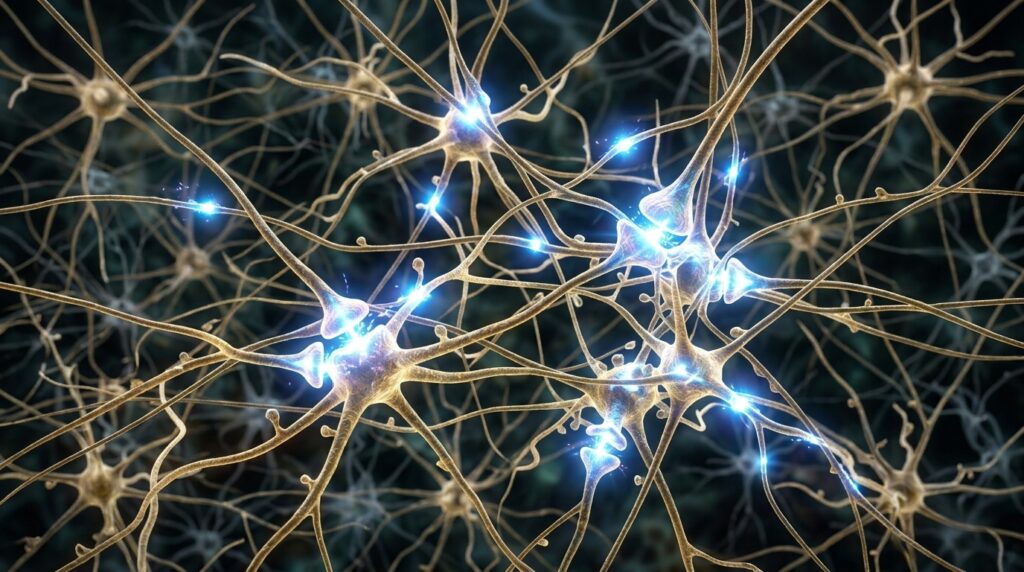
Neural connections of the brain — it is their integrity that determines whether personality is preserved
Neuroscientist Ariel Zeleznikow-Johnston from Monash University, who led the study, notes that many doctors are simply unfamiliar with modern preservation methods.
Can a Person Be Resurrected Through Cryonics
It is important to draw a clear line here. Even if scientists manage to awaken neurons in a frozen human brain in the laboratory, this is fundamentally different from bringing a person back to life. Consciousness is a complex, coordinated operation of billions of neurons connected to the body, sensory organs, and hormonal system.
Approximately one in five doctors in the survey expressed concern that the pursuit of ideal preservation could conflict with the quality of care for a living patient. For example, prescribing blood-thinning medications improves the quality of tissue preservation after death but may affect treatment during life. Most doctors were willing to prescribe such medications, but ethical questions do not disappear.
For terminally ill patients, cryopreservation can be a kind of bet on the future, not much different from other forms of postmortem rituals. If there is even the slightest chance of gaining a bit more time, many want to try.
But whether death will be conquered in the future is a question that has no answer yet. Modern science is taking its first but very cautious steps: learning to preserve brain structure, testing the viability of individual cells, and searching for ways to minimize damage. From these steps to restoring consciousness is a journey that could take decades or could turn out to be a dead end.
What is truly important about this survey’s results is that the medical community is ceasing to view the topic as pure fantasy. Nearly a third of doctors are willing to consider such a possibility, and most see no problem in supporting patients who are counting on it. The conversation about the boundary between life and death is gradually shifting from philosophical to practical, and that is perhaps the most fascinating part of this story.