
Can chickens really run without a head?
Stories about chickens running around after having their heads chopped off sound like rural tall tales. But this is a real and well-documented phenomenon with a clear scientific explanation. Moreover, one rooster managed to live without a head for a full 18 months — and this is not a legend but a historical fact.
How a Chicken Runs Without a Head — A Neurobiologist Explains
When a chicken’s head is cut off, it doesn’t die instantly. The body can continue to move — flapping its wings (flapping, since chickens can’t fly), moving its legs, and even running. From the outside it looks eerie, but the explanation is quite straightforward.
As neurobiologist Andrew Iwaniuk explains, residual nerve activity in the spinal cord continues for some time after the head is severed. The spinal cord is not simply a cable connecting the brain to the body. It contains its own neural circuits capable of generating simple motor commands without any input from the brain. This is why the muscles continue to contract.
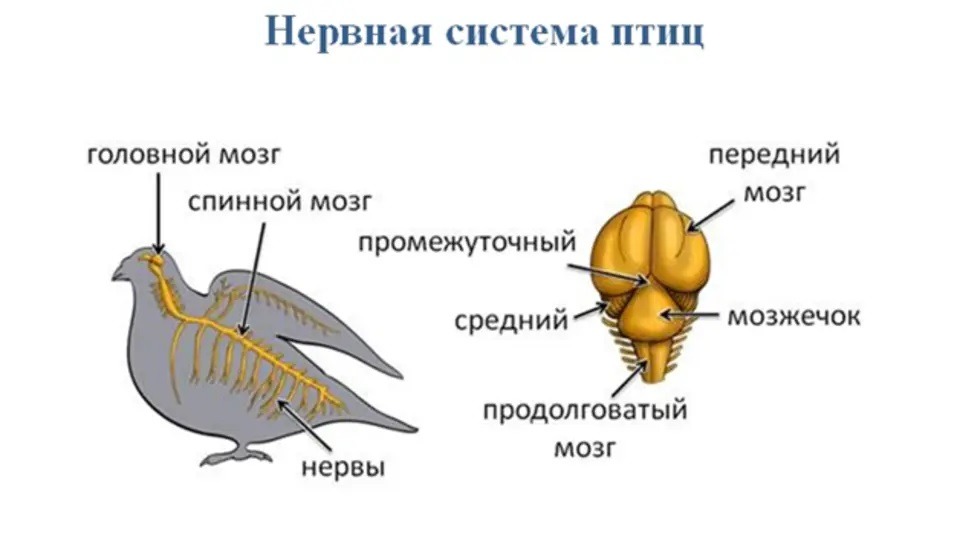
Nervous system of a chicken. Image source: soe-school.ru
There is yet another factor. Normally, the brain constantly sends relaxation signals to the muscles — a kind of “stop command.” When the head is severed, these inhibitory signals cease, and the muscles begin contracting chaotically. According to veterinarian Tom Logsdon, this effect is especially pronounced in chickens: “We sometimes observe twitching, and in chickens it can be very exaggerated.”
How Long Does a Headless Chicken Live
Not long. We’re talking seconds, not minutes. Cardiac death — the moment the heart finally stops beating — occurs roughly 10 seconds after brain death. Iwaniuk emphasizes: “The time difference is on the order of less than 10 seconds.”
Interestingly, the heart continues working slightly longer than other organs. The cardiac muscle can contract without nerve signals — it does so automatically until oxygen and energy run out. So even after the movements stop, the heart may continue beating briefly.
Here an interesting scientific debate arises. Logsdon considers the movements of a decapitated chicken to be “postmortem reflexes” — meaning, in his view, the bird is already dead. Iwaniuk, on the other hand, believes that during those final seconds the chicken is technically still alive, though doomed. The question comes down to the definition of death: should it be considered brain death or cardiac arrest?
Why Chickens Run Without a Head and Can Other Animals Do the Same
Postmortem reflexes are not unique to chickens. Decapitated snakes can bite, and severed octopus tentacles can grab objects. But chickens have become the symbol of this phenomenon, and for good reason.
The fact is that chaotic muscle contractions in chickens are significantly more pronounced than in many other animals. Logsdon notes that the chicken’s body reacts to the loss of inhibitory signals from the brain with particular vigor. Add to that a large body with powerful legs and wings — and you get a spectacle that has astonished farmers for centuries.
Miracle Mike — The Rooster That Lived Without a Head for 18 Months
Everything described above explains seconds of movement. But the story of a rooster named Miracle Mike is an entirely different case.
In September 1945, a farmer from Wisconsin named Lloyd Olsen was slaughtering chickens for sale. One of the birds (a young rooster) did not die after the axe blow. As it was later discovered, the axe had sliced off the front part of the head but preserved the rear portion of the brain — the brainstem, which controls basic functions: breathing, heartbeat, and fundamental reflexes. In effect, Mike lost his face, eyes, and beak, but not the part of the brain that sustains life.
Olsen and his wife began feeding the rooster through the open esophagus and regularly cleared his airways to prevent suffocation. Mike lived like this for 18 months and even toured across the United States as a sideshow attraction.
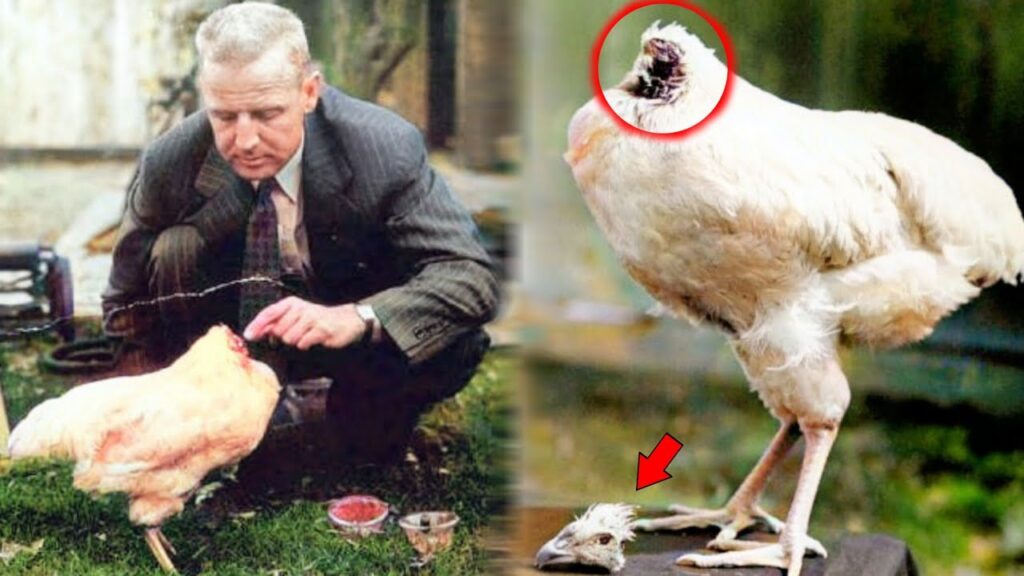
Miracle Mike the rooster became a celebrity in 1940s America
He died in 1947 — not from the injury itself, but from suffocation. The Olsens lost the syringe they used to clear his throat, and the rooster choked, as BBC reported in a 2015 article. Mike’s story is not about postmortem reflexes. It’s about how, at a certain angle of the cut, a critically important part of the brain can survive.
The Boundary Between Life and Reflex in a Decapitated Chicken
The story of headless chickens is essentially a question about what we consider to be life. The spinal cord can send motor signals, the heart can beat on its own, but without the brain the organism cannot see, hear, feel pain, or make decisions.
Those few seconds of movement after decapitation are the work of autonomous neural circuits, not conscious activity. The chicken isn’t “running” in the usual sense of the word. It isn’t trying to escape. Its body is simply executing the last electrical commands encoded in the spinal cord until the oxygen runs out.
Miracle Mike’s case is exceptional: he truly lived because his brainstem was preserved. But an ordinary decapitated chicken is neither a miracle nor mysticism. It is neurophysiology in its most vivid, if not most pleasant, manifestation. And I strongly urge you not to experiment intentionally on these creatures (or any others) for the sake of curiosity or amusement, because chickens are far more intelligent than most people assume. And every life is precious — even that of the most helpless and smallest creature.