Mars has air, but could it save a human life even for a few seconds
Mars has an atmosphere — and that’s not news. What is news is that NASA has already learned to extract oxygen on Mars from the local air, which consists almost entirely of carbon dioxide. However, so far it’s only enough for about ten minutes of one astronaut’s activity. Let’s figure out why you can’t take a single breath on Mars without a spacesuit and how engineers plan to change that.
Mars Atmosphere: Composition, Pressure, and Oxygen Levels
From a distance, Mars might seem almost like Earth’s sibling: rocky landscape, polar caps, changing seasons. But the moment you mentally step onto its surface, the illusion shatters. Mars’s atmosphere is roughly 100 times thinner than Earth’s — the average surface pressure is about 610 pascals, which is less than 1% of sea-level pressure on Earth.
The composition of this thin air is also not in humanity’s favor. Carbon dioxide makes up about 95–96%, nitrogen about 2.7%, and argon 1.6%. Oxygen accounts for only 0.13% — 160 times less than in Earth’s atmosphere, where it’s about 21%.
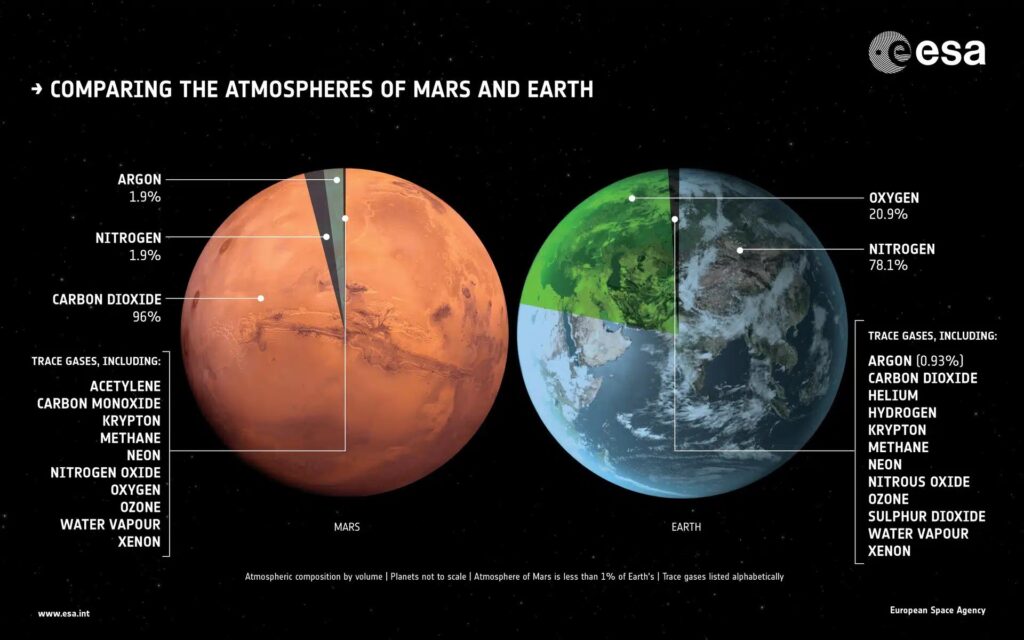
Comparison of Mars and Earth atmospheres.
Simply put, if you could somehow end up on Mars without a spacesuit, there would be nothing for you to breathe. But the lack of oxygen itself isn’t the only problem. Far more dangerous is the extremely low pressure.
How Many Seconds Can a Human Survive on Mars Without a Spacesuit
Our body is accustomed to a pressure of one atmosphere — roughly 101,325 pascals. It keeps liquids in a liquid state, allows lungs to function, and maintains the body’s internal balance. On Mars, the pressure is 170 times lower. This is equivalent to an altitude of about 35 kilometers above Earth — even airplanes don’t fly that high.
At such pressure, several things happen simultaneously. Oxygen cannot enter the bloodstream because gas exchange in the lungs ceases. Without oxygen supply, the brain shuts down quickly: according to aviation medicine data and NASA experiments, loss of consciousness occurs within 10–15 seconds after exposure to near-vacuum conditions.
There’s another threat as well — ebullism. When external pressure drops below the so-called Armstrong limit (about 6.3 kPa, or an altitude of 19 km above Earth), water in body tissues begins to turn into vapor at body temperature. The body swells, and circulation is disrupted. If resuscitation doesn’t begin within 60–90 seconds, there is virtually no chance of survival.
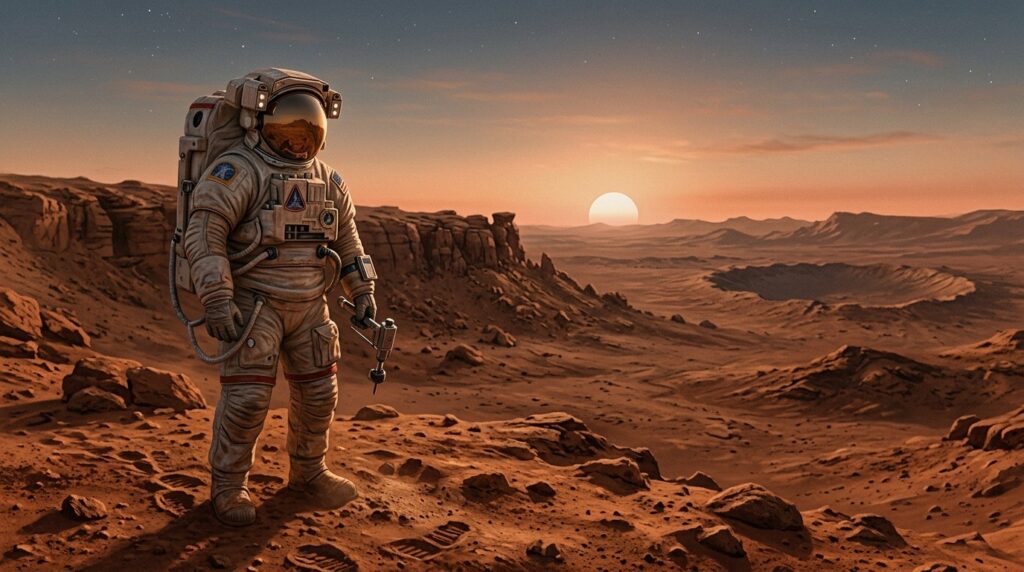
Without a sealed spacesuit, a human would survive only seconds on Mars
It’s important to understand: this is not movie fiction. In 1966, NASA engineer Jim LeBlanc accidentally experienced depressurization during a spacesuit test in a vacuum chamber. He lost consciousness in about 14 seconds. Fortunately, pressure was restored quickly, and he survived without lasting effects. Mars isn’t just a place without air. It’s an environment that is actively incompatible with human biology.
How Oxygen Is Produced on Mars from Carbon Dioxide
If the Martian atmosphere is deadly, can we make it work for us? That’s exactly the question the MOXIE experiment (Mars Oxygen In-Situ Resource Utilization Experiment) was designed to answer — a compact device the size of a microwave oven, installed aboard the Perseverance rover.
MOXIE’s operating principle is based on solid oxide electrolysis. The device draws in Martian air through a HEPA filter, compresses it, heats it to 800 °C, and passes it through a special ceramic cell. There, CO₂ molecules are split: oxygen ions pass through the electrolyte and combine into molecular oxygen (O₂), while carbon monoxide (CO) is expelled back into the atmosphere.
On April 20, 2021, MOXIE produced oxygen from Martian air for the first time. In one hour of operation, the device generated about 5.4 grams — enough for an astronaut for roughly 10 minutes of normal activity. Over the entire mission, MOXIE operated 16 times and in total produced 122 grams of oxygen — the amount a small dog inhales in 10 hours.
At peak efficiency, MOXIE produced 12 grams of oxygen per hour at a purity of at least 98%. This was twice NASA’s initial expectations. In September 2023, the MOXIE mission was officially concluded: the device successfully completed all technical objectives.
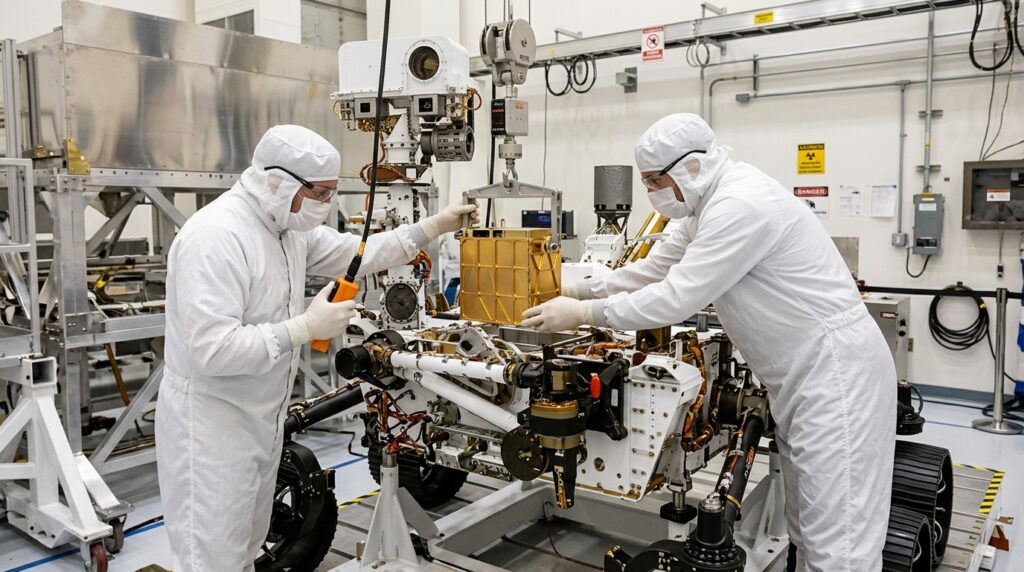
Engineers installing MOXIE into the Perseverance rover body
MOXIE is still just a technology demonstration. But it proved the key point: producing oxygen on Mars from local resources is fundamentally possible.
How Much Oxygen Is Needed for a Mars Mission
It might seem like 122 grams is negligible. And it truly is. But MOXIE’s significance lies not in the volume of oxygen produced, but in the very fact that the technology works on another planet, in real conditions, across different temperatures and seasons.
For a future crewed mission, scaling up will be necessary. To return four astronauts from Mars to Earth, approximately 25 tons of oxygen are needed — just as a rocket fuel component. That’s the weight of a loaded truck. Transporting that volume from Earth is a task on the edge of feasibility, especially when it comes to the first human flight to Mars. But producing oxygen on-site is no longer science fiction.
NASA estimates that a scaled-up version of MOXIE, running on a 25–30 kilowatt power system, could produce at least 2 kilograms of oxygen per hour. Over an Earth year, such a system would accumulate tens of tons — enough for the return flight and crew breathing.
This approach is called ISRU — In-Situ Resource Utilization. In the future, it could radically reduce mission costs. Every kilogram that doesn’t need to be launched from Earth saves fuel, money, and time. In this logic, Mars stops being just a destination and becomes a place where infrastructure can begin to be built.
When Will Humans Fly to Mars and What’s Holding Us Back Now
Even with oxygen, Mars remains hostile. Surface temperatures can drop below −73 °C. There is almost no liquid water, although water on Mars does exist — mostly as ice and bound moisture. Radiation on Mars is significantly higher than on Earth because the planet has neither a dense atmosphere nor a magnetic field for protection. On top of that, there are global dust storms that can last for weeks and block out the sun.
Astronauts will need sealed habitation modules, advanced life support systems, radiation protection, and autonomous energy sources. Oxygen is just one piece in a much more complex puzzle.
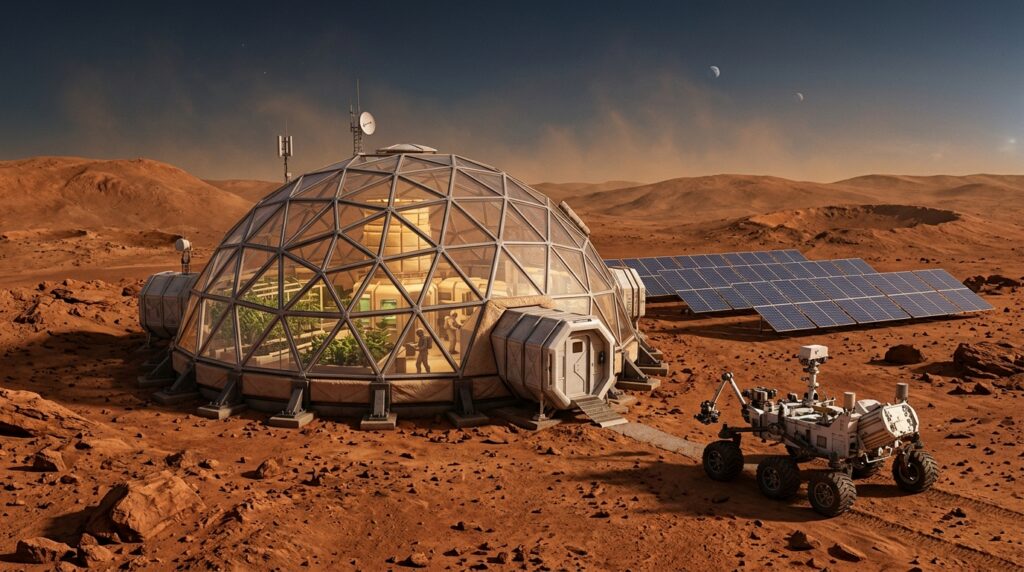
Concept of a Martian base with sealed habitation modules and solar panels
But progress is being made. Every robotic mission reduces uncertainty. Perseverance continues to study the geology of Jezero Crater and collect soil samples for future delivery to Earth. NASA plans to send humans to Mars in the late 2030s to early 2040s, although a specific date has not yet been determined. The Artemis program, which is returning astronauts to the Moon, is being considered as a stepping stone toward Mars.