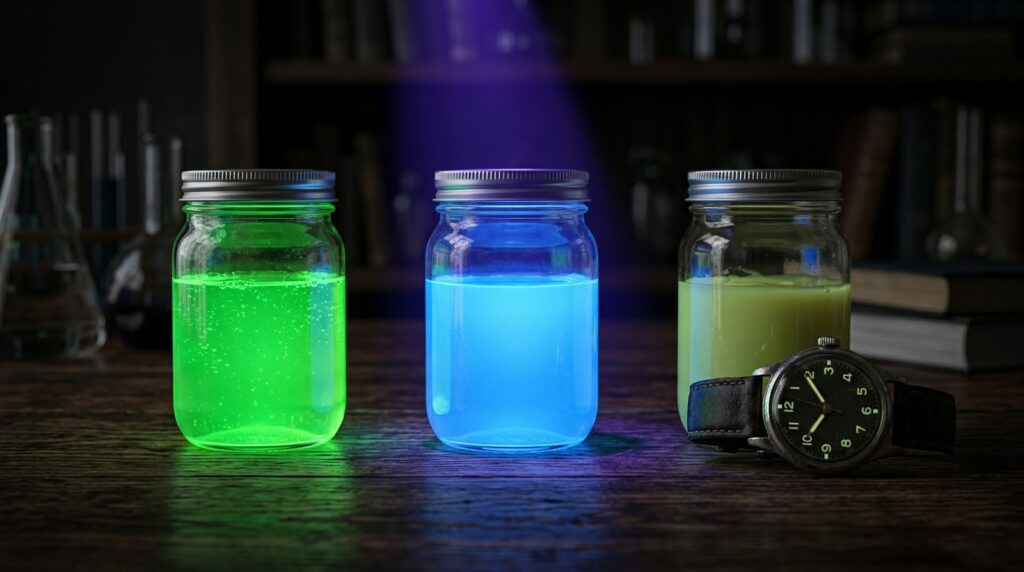
Glow-in-the-dark paint isn’t always dangerous — the key is knowing the difference
You’ve probably seen figurines, stickers, wallpapers, or paintings that glow in the dark. It looks beautiful, but a question immediately arises: is glow-in-the-dark paint harmful? The answer depends on what exactly is glowing: some formulations simply accumulate light, others work under ultraviolet light, and old radium-based paints are indeed dangerous.
Three Types of Glow-in-the-Dark Paint
The main reason for confusion is that different technologies hide behind one everyday term. To understand whether a specific paint is dangerous, you first need to determine what type it belongs to.
- Phosphorescent paint charges from light and then glows in the dark. Inside there is usually a luminophore: most often strontium aluminate or zinc sulfide. This paint is not radioactive if it’s a normal modern product;
- Fluorescent paint doesn’t glow on its own in complete darkness — it only glows brightly under an ultraviolet lamp. Here the risk is often not in the paint itself, but in the UV light source;
- Radioluminescent paint — the most serious one. This is old radium paint from watches, compasses, and instruments that glowed constantly because it contained radioactive radium.
For modern phosphorescent paint, manufacturers usually indicate that the substance is not considered hazardous, but when working with the powder they still advise avoiding dust, ventilating the room, and rinsing eyes and skin if contact occurs.
Is Modern Glow-in-the-Dark Paint Harmful
If we’re talking about normal phosphorescent paint for walls, decor, models, or markings, then after drying and with normal use it is generally not dangerous. The problem isn’t in the “glow” itself, but in what the paint is made of and how it’s applied.
The main risks of modern glow-in-the-dark paint are roughly the same as with any other paint:
- solvent fumes and volatile organic compounds (VOCs);
- skin and eye irritation;
- dust from powdered pigment;
- fine aerosol when spraying from a can.
The U.S. Environmental Protection Agency (EPA) states that volatile organic compounds from paints can cause irritation of the eyes, nose, and throat, headaches, and nausea. And some organic substances are associated with more serious consequences. Therefore, the harm lies in the composition: solvent, binder, additives, and pigment quality. The application method is also very important.
It is considered that water-based acrylic paint with proper labeling and low VOC levels is significantly safer than a cheap aerosol of unknown origin from a marketplace seller. The glow has nothing to do with it — what matters is the chemistry.
Why Old Glow-in-the-Dark Paint Can Be Radioactive
Until the mid-20th century, the task of “making something glow on its own, without any recharging” was solved with radioactive radium. Radium-based compound glowed constantly because radium decays and produces energy on its own. At the time, this was considered convenient, and watch dials were visible at night without any lamps.

Old aviation and military instruments with luminous compound — a potential source of radioactive radium
The danger of radium paint is not that it glows, but that it contains radioactive material. While the device is intact, the risk is lower, but problems begin during disassembly, repair, scraping, and storing paint flakes. Specialists advise against disassembling radium watches and instrument dials because paint particles can flake off and enter the body.
Also, radium is chemically similar to calcium. Because of this, it can be absorbed and retained in the body after inhalation or ingestion. The most frightening risk is that it can cause bone cancer. This is because the body confuses it with calcium and deposits it in the bones.
If you somehow have an old military compass or luminous watches manufactured before the 1970s, don’t disassemble or restore them yourself. It’s better to check such items with a dosimeter, and if there’s any suspicion, contact radiation control services.
Is Tritium Paint Dangerous
Glow-in-the-dark paint can also be made from tritium. Fortunately, it’s not used as regular wall paint, but in sealed luminous devices. For example, tritium paint can be found in emergency EXIT signs, weapon sights, watches, and markers.
If a product with tritium paint is intact and factory-made, danger only arises if the sealed capsule is broken. So the conclusion is the same as with radium: such items should not be broken open or disassembled on your own.
Where Glow-in-the-Dark Paint Is Used
Most often, photoluminescent paint is used where it’s important to see the path in the dark without electricity. For example, its glow can be seen on exit markings, stairways, handrails, stair edges, and guide strips.
Here are more places where glow-in-the-dark paint is used:
- interior decor, souvenirs, toys;
- fishing lures and model-making;
- stage design and nightclub decoration;
- road and bicycle elements, signs;
- equipment marking and security labels.
Can You Paint a Child’s Room with Glow-in-the-Dark Paint
Making a child’s room more interesting is possible, but with conditions. Only paint with a clear composition, low VOC content, certifications, and a label indicating it’s for indoor use is suitable. Industrial paints and powder pigments that a child could scrape off and lick are definitely not appropriate.

Glowing decor in a child’s room is safe only when using quality interior paint
After painting, the room needs to be ventilated and the child should not move in right away. Don’t paint radiators, dishes, toddler toys, or surfaces that a child might chew on. The EPA separately notes that paints always emit volatile substances, which means ventilating rooms with such coatings is especially important.
How to Tell If Glow-in-the-Dark Paint Is Safe
The main rule is to look not at the promise of “glows for 12 hours,” but at the documentation. Quality paint has a composition, intended use, instructions, safety data sheet, application conditions, and many other labels.
Warning signs that mean it’s better not to buy the paint:
- no composition, manufacturer, or safety data sheet;
- claims like “suitable for everything” and “can be used on skin, walls, nails, and cars”;
- strong chemical odor;
- unmarked powder;
How to Use Glow-in-the-Dark Paint Safely
Safe work with glow-in-the-dark paint comes down to a few rules:
- Work in a well-ventilated area and wear gloves;
- Don’t spray aerosol without a respirator and don’t sand a dried layer without protection;
- Don’t apply paint to skin or dishes;
- Don’t use it around children until it’s fully dried and the room is ventilated.
Is Glow-in-the-Dark Paint Safe and How to Choose It
In the end, modern glow-in-the-dark paint is generally not harmful if it’s a quality phosphorescent formulation used according to instructions. Risk appears where cheap unknown formulations, aerosol cans without ventilation, powder without protection, or “glow-in-the-dark” tattoo inks come into play.
The most dangerous items are old radioactive watches, compasses, and instrument panels with radium paint. They should not be disassembled, scraped, or restored at home. If such a rarity ends up in your hands, the best course of action is not to admire it under a magnifying glass, but to show it to radiation control specialists.