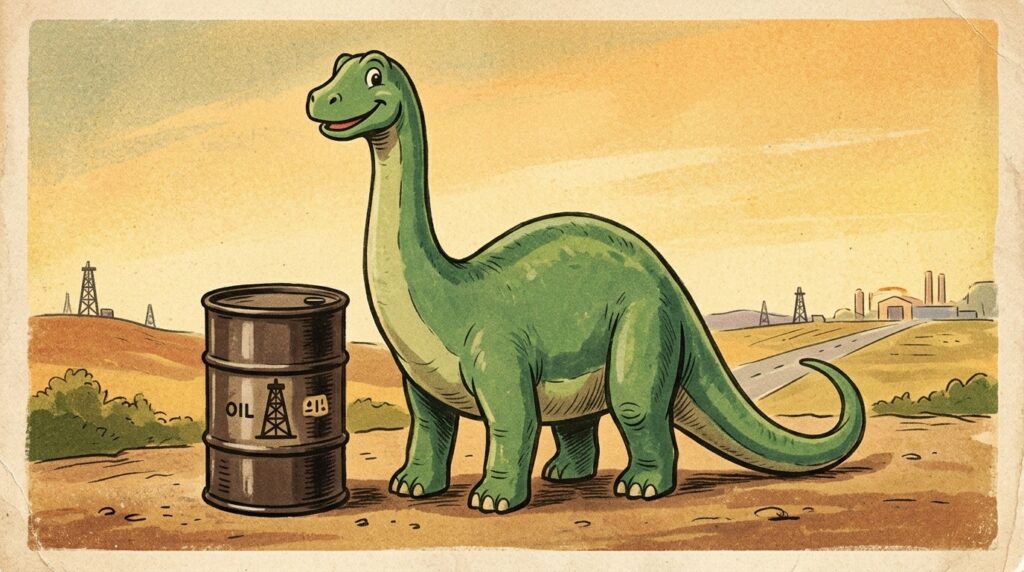
It may sound unexpected, but there is no real connection between dinosaurs and oil
Were you also told in school that oil was formed from the remains of dinosaurs? The truth is that it has nothing to do with ancient reptiles up to 30 meters long, and it never did. And yes, I was also slightly surprised when I learned about this. So where did this misconception come from, if no serious geologist ever supported it? Science isn’t to blame — marketing is.
What Oil Is Actually Made From
In short, the oil beneath our feet is not formed from dinosaurs at all, but from trillions of microscopic algae and plankton. A very long time ago, these tiny creatures lived in the ocean, getting energy from the Sun or feeding on each other. After dying, their remains sank to the bottom and accumulated in layers within sedimentary rocks. Then heat and pressure took over, and over millions of years this organic material first turned into a waxy substance called kerogen, and then into liquid hydrocarbons.
The entire process can be imagined as a giant stone slow cooker that very slowly cooks organic matter at temperatures from 65 to 150 degrees Celsius. Geologists call this range the oil window: it is precisely under these conditions that chemical bonds in kerogen break apart, releasing oil.
Oil Formed in the Ocean, Not on Land
Oil is born in the sea, not on land. Its main source is marine organisms, especially algae and plankton, rich in fats that easily convert into hydrocarbons. Dinosaurs, on the other hand, were land-dwelling creatures, and even in theory they could not have ended up in any significant quantities within oceanic sediments.
Moreover, if a large animal did end up on the sea floor, scavengers would quickly consume it — marine organisms process such carcasses within a matter of months. There simply wouldn’t be enough left of a dinosaur to contribute to future oil. As a colleague from IFLScience aptly put it: strawberries may indeed contain mites, but that doesn’t mean strawberries are made from them.
Interestingly, oil was formed roughly during the same era as the dinosaurs — the Mesozoic. However, a coincidence in timing does not imply a cause-and-effect relationship. For example, the iPhone came out around the same time as “Shrek Forever After” hit theaters, but nobody thinks of advertising smartphones with the face of a green ogre.
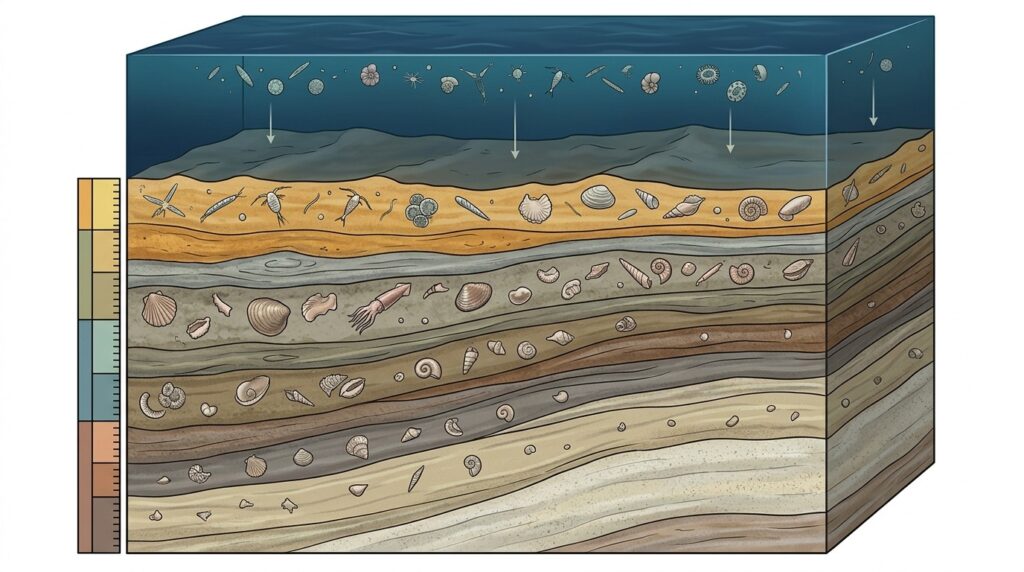
Layers of sedimentary rocks on the floor of an ancient ocean, where oil forms
What Lomonosov Said About Oil
When people first encountered oil, they had no idea what it was and considered it a type of mineral.
The theory of the fossil origin of oil dates back to Russian scientist Mikhail Lomonosov, who in 1757 described in the “Proceedings of the Imperial Academy of Sciences” the idea that “rock oil originates from tiny bodies of animals buried in sediments, which under the influence of increased temperature and pressure over an unimaginably long time transform into rock oil.”
Lomonosov demonstrated the organic origin of soil, peat, coal, oil, and amber, and in 1763 published the work “On the Strata of the Earth” — his most significant geological work, which places him even before James Hutton, traditionally considered the founder of modern geology. Note that Lomonosov spoke of “tiny bodies of animals,” not giant lizards. Scientists pointed to small organisms from the very beginning!
How the Myth About Dinosaurs and Oil Appeared
If science isn’t to blame, then who started the myth that oil is made from dinosaurs? In 1930, advertisers from the oil company Sinclair Oil first decided to use dinosaurs in marketing, promoting motor oils made from petroleum that, according to their claims, formed during the age of dinosaurs. The idea was simple and brilliant: the oldest formations produce the best oils, and dinosaurs are the most recognizable symbol of antiquity.
On May 27, 1933, at the “Century of Progress” World’s Fair in Chicago, Sinclair Oil opened an exhibition featuring full-size dinosaur models — the exhibition ran until October 31, 1934. Approximately 16 million people visited the Sinclair exhibit — a colossal audience for an era without television.
From that point on, the dinosaur became an inseparable part of the Sinclair brand. In 1963, a giant inflatable Apatosaurus first appeared at the Macy’s Thanksgiving Day Parade and quickly became an annual crowd favorite. It became so popular that in 1975 it was made an honorary member of the Museum of Natural History.
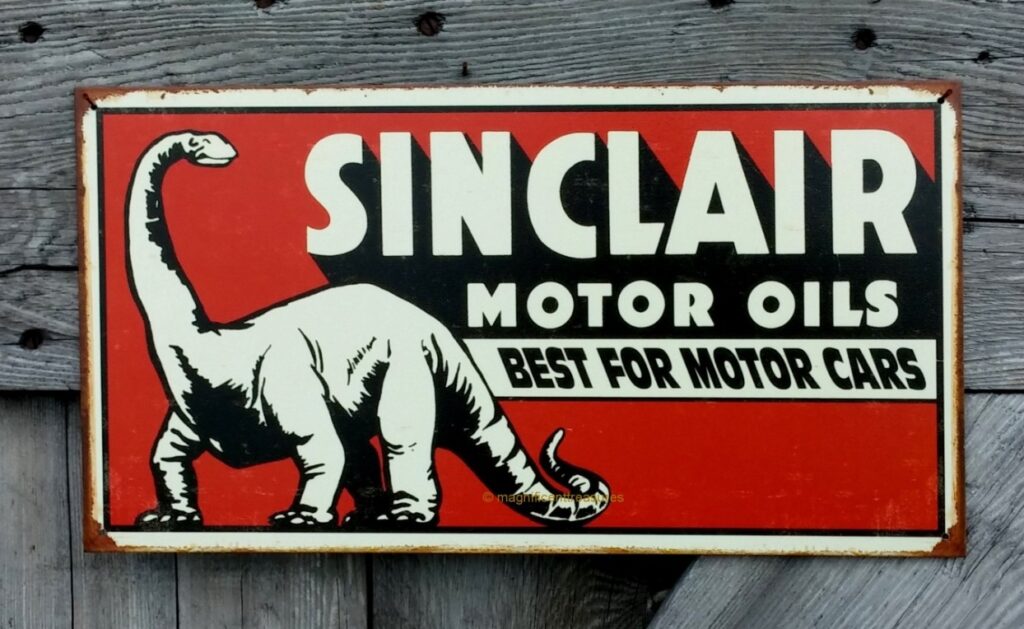
Advertising poster of an oil company with a dinosaur mascot
What Is Fossil Fuel
Part of the blame also lies with the term fossil fuel. For most people, the word “fossil” automatically evokes images of giant skeletons in museums. But in geology, a fossil is any trace of ancient life, including microscopic remains of algae.
American paleontologist and geologist Kenneth Lacovara described this flawed chain of reasoning: oil is a fossil fuel, most oil formed during the age of dinosaurs, fossil means dinosaur, therefore dinosaur means oil. Each link individually contains a grain of truth, but together they create an absolutely false conclusion.
At the 1933–1934 World’s Fair in Chicago, Sinclair sponsored a dinosaur exhibition intended to emphasize the connection between the formation of oil deposits and the age of dinosaurs — a claim that today is considered a largely discredited misconception.
Thus, the myth of “dinosaur oil” is a product of advertising, not science. Sinclair wanted to sell motor oil, but instead sold the entire world a beautiful yet incorrect picture.
The story of dinosaurs and oil is an example of how a successful marketing image can compete with real scientific knowledge for decades — and win. The green Apatosaurus at the gas station turned out to be more convincing than any geology textbook.
But it’s worth remembering a simple fact: every time you fill up your car, you are using energy stored by trillions of tiny marine organisms millions of years ago. Most geologists believe that oil comes predominantly from the remains of marine life — algae and plankton. Dinosaurs have absolutely nothing to do with it, but the advertisers of the 1930s deserve respect for creating one of the most enduring marketing legends in history.
Source: PubMed