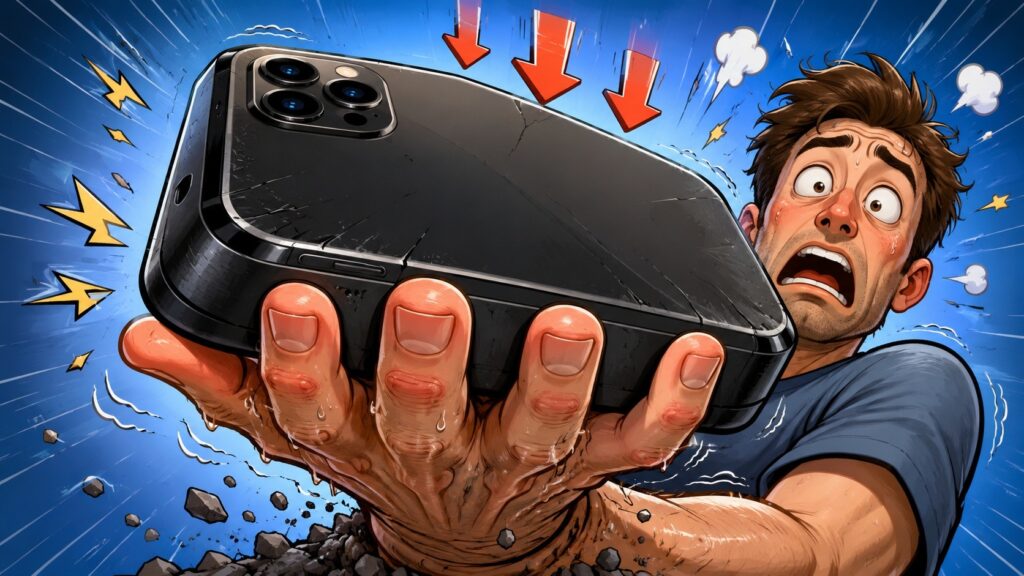
A smartphone gets heavier from data volume, but we don’t notice it
When you download a large file, your smartphone becomes heavier. That’s because information has physical weight. You might think I’m joking, but physics says exactly this: a phone packed with photos and apps is heavier than an empty one. However, the difference is so negligible that neither a human hand nor the most sensitive instrument in the world could detect it. So it’s not just the hardware hidden inside and the abundance of bacteria on its surface that give your smartphone its weight, but also the information stored on it.
How Much Do Files on a Smartphone Physically Weigh?
Imagine you’ve downloaded thousands of books onto your phone. Has your hand gotten heavier because of it? Intuitively, it seems like no, since no substance has been added inside the device. But Berkeley computer science professor John Kubiatowicz explained back in 2011 in The New York Times that information actually has physical weight. According to his calculations, an e-reader with 4 GB of data gains approximately one attogram in mass. That’s 10⁻¹⁸ grams — a value the scientist himself called practically immeasurable.
One attogram is a billion billion times less than a gram. For comparison, this is comparable to the mass of a single virus or DNA molecule. The same three and a half thousand books in paper form would weigh about two tons.
But if no new substance is added to the phone, where does the extra mass come from? The answer lies in how device memory works.
How Smartphone Memory Works
Digital data seems like something weightless. Photos live in the cloud, music simply flows from the speaker. But inside the phone, everything is much more material than we’re used to thinking. Every snapshot is a physical pattern imprinted in memory cells.
Most modern smartphones use flash memory. It stores information as bits — those same zeros and ones we studied in computer science class. Each bit corresponds to the state of a tiny electronic component. To put it simply, a flash memory cell distinguishes “0” from “1” by whether electrons are trapped in a special layer or are free. A photo, an app, or a book is billions of such bit states.
And here’s the key point. Trapped electrons sit at a higher energy level than free ones. It’s this small difference in energy that provides the tiny increase in mass. The number of electrons in the memory doesn’t actually increase — only their energy distribution changes.
Einstein’s Formula and the Physical Mass of Data
The explanation lies in the most famous equation in physics: E = mc². It links energy and mass. If you add energy to a system, you add mass as well. This works everywhere — from a nuclear reactor to the device in your pocket.
When you save a photo to your phone, electrons in memory cells transition to a state with slightly higher energy. According to Einstein’s formula, this additional energy is equivalent to additional mass. But the speed of light squared is a colossal number, so even a noticeable difference in energy by electronic standards translates into a fantastically small increase in weight.
Professor Kubiatowicz estimated the energy of a single bit of data at approximately 10⁻¹⁵ joules. For four gigabytes of information, this gives a mass on the order of an attogram. The value is real but lies far beyond the sensitivity of any existing scales: the most precise scientific instruments work with a resolution of about 10⁻⁹ grams, which is a billion orders of magnitude coarser.
Why You’ll Never Feel the Weight of Your Photos
Modern smartphones hold far more than four gigabytes. But even if you recalculate the estimate for 512 gigabytes — a typical flagship capacity — the result is about 10⁻¹⁶ grams, or approximately 0.1 femtograms. This is still nothing for human perception.
A person can notice that an object has become heavier only if the mass changes by a few percent. For a phone weighing 170 grams, that means an increase of 8–9 grams — roughly the weight of a couple of coins. Data on the phone adds mass tens of trillions of times less than this threshold.
Kubiatowicz noted another curious benchmark. The mass increase from storing data is approximately one hundred million times less than the mass fluctuations from charging and discharging the battery. In other words, battery charge affects the phone’s weight far more than all your photos and apps combined. And even that difference is imperceptible to the hand.
How Much Data Would You Need to Download to Make a Smartphone Noticeably Heavier?
For fun, we can estimate the reverse problem. To make a phone heavier by a perceptible 8–9 grams, you would need to load it with tens of millions of zettabytes of data. One zettabyte is a trillion gigabytes. By various estimates, the total volume of data created by humanity by 2025 amounts to roughly 175–200 zettabytes. This means you would have to download the entire internet millions of times over, and only then would your hand notice something.
At this point, the physics of the phone ceases to be the physics of a phone and enters the realm of a pure thought experiment. But the fact remains: not a single photo, not a single song is written to memory without a trace. Every bit leaves a tiny physical imprint — but it’s too small for us to ever notice.
This story is a beautiful illustration of how fundamental physics works literally in each of our pockets. Einstein’s formula describes not only stars and reactors but also your selfies. The mass of information is real — it’s simply arranged so that nature reliably hides it from our senses.