
Scientists believe that humans also have something like a mating season
Have you ever wondered why humans don’t have a mating season? For most animals, it’s strictly tied to the season. In spring, cats serenade the neighborhood with heart-wrenching concerts, in autumn deer grow antlers and hold tournaments for females, and elephants periodically experience musth — a state when testosterone levels skyrocket and they literally lose their minds. So why don’t humans have such a period?
Why Animals Only Reproduce During Mating Season
First, it’s worth understanding why most species are tied to a specific time of year at all. Seasonal reproduction is an ancient and energetically advantageous strategy.
The thing is, maintaining constant readiness to mate is expensive for the body. For males, this means year-round high testosterone levels needed to maintain muscle mass, bone density, spermatogenesis, and libido. Also, forgoing seasonal reproduction may increase men’s risk of developing prostate cancer, because the gland is constantly in a stimulated state without periods of rest and natural cell renewal.
For females, the costs are even more obvious. Pregnancy lowers blood pressure, increases blood volume, radically changes resource needs, and makes fleeing from predators practically impossible. If all this happens during winter or drought, survival chances drop.
That’s why most species wait for the optimal moment. Offspring also need to be born when it’s warm, food is plentiful, and there’s no risk of freezing. This is logical and proven by millions of years of evolution.
Why Humans Don’t Have a Breeding Season
At some point in evolution, primates — the branch to which we belong — abandoned strict seasonality. Ovulation in humans became concealed — no external signals of fertility, no estrus cycles. Ovulation in women occurs approximately every 28 days year-round. Why did this happen? The answer lies in several characteristics of our species.
First, humans are extremely social creatures, and sex in primates serves more than just a reproductive function. We depend on our group for survival, and intimacy and physical contact strengthen social bonds. Bonobos, our closest relatives, demonstrate this perfectly, using sex as a tool for peace and cooperation.
Second, our large brains and life in social groups provided pregnant females with support: someone could obtain food, watch over offspring, and protect from predators. Pregnancy ceased to be a fatally dangerous adventure tied to a specific season.
There’s also another hypothesis explaining concealed ovulation: it may have protected offspring from infanticide by males. If no male knows for certain whose child it is, killing others’ offspring becomes a risky strategy — you might destroy your own progeny.

Social support in ancient human groups reduced pregnancy risks at any time of year
In Which Month Are the Most Children Born?
Everything above sounds convincing, but here’s the catch. If humans truly reproduce randomly and evenly throughout the year, birthdays should be distributed more or less uniformly. However, that’s not the case at all.
In the USA, the most common birth date is September 9th. It’s approximately 12% more likely than you’d expect with random distribution. Second place goes to September 19th, third — September 12th, fourth — September 17th. At least in the USA, children are most often born in September. And in Russia, between 2000 and 2022, children were most often born in July and August. That’s also close to September.
If you count nine months back, you get winter. And indeed, November and December are the months with the highest number of conceptions. Among possible reasons, several factors are cited:
- Cold weather makes people spend more time at home, increasing the likelihood of intimate contact;
- The holiday season with its vacations and relaxed atmosphere promotes conception;
- Sperm quality may be higher in winter months due to lower temperatures;
- Shortened daylight hours affect hormonal levels and ovulation.
However, scientists honestly admit that there is no definitive explanation yet. A large-scale review showed that seasonal fluctuations in birth rates are observed in virtually all populations, but no single hypothesis receives universal confirmation.
How Climate Affects Childbirth
One of the most interesting patterns involves the connection between peak birth rates and geographic latitude. A study covering 78 years of birth data in the USA revealed a clear latitudinal gradient: in northern states, the birth peak falls in spring and summer, while in southern states it falls in autumn.
This pattern extends far beyond America. In Europe, for example, the birth peak traditionally falls in spring. In pre-industrial Finland, according to a University of Turku study, maximum births were observed in March-April with an additional peak in September.
A fresh 2026 preprint on bioRxiv, analyzing data from more than 100 regions worldwide, discovered something else unexpected: over recent decades, the birth peak in northern regions has shifted, approaching the patterns of southern regions. The authors attribute this to climate change — warming, it appears, is restructuring the seasonality of human reproduction.
It’s also important that birth seasonality is more pronounced in rural communities and weaker in cities. A study from the Czech Republic showed that the most pronounced seasonality is observed among married women aged 25-34 with higher education, expecting their second or third child. This suggests that conscious family planning also contributes to the statistics.
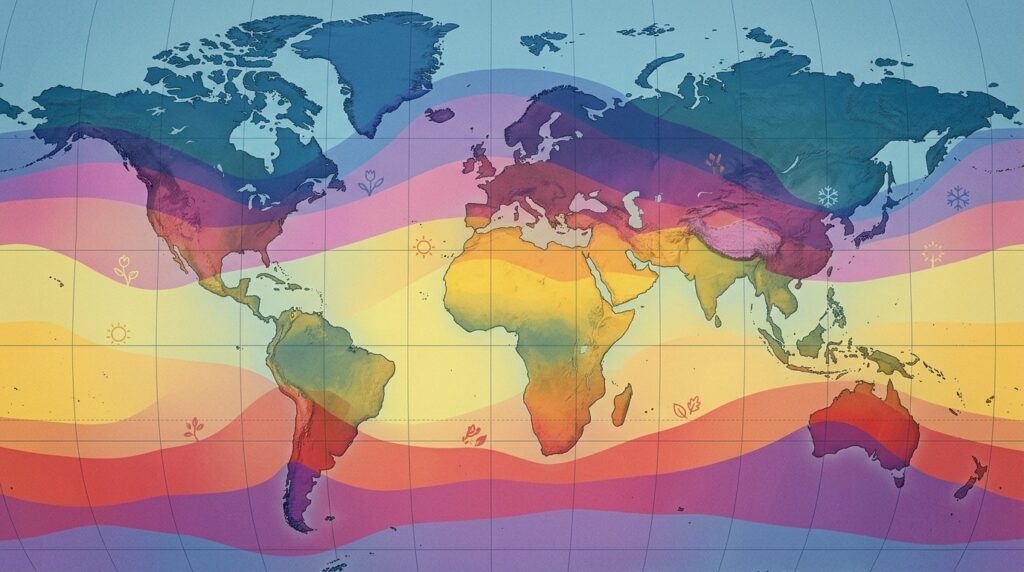
Birth peak depends on latitude: the farther north, the earlier in the year more children are born
A Hidden Rhythm: Do Humans Have a Concealed Breeding Period?
So, formally, humans don’t have a mating season in the classic biological sense. We don’t go into rut, we don’t lose our minds from hormones, and we can conceive a child in any month. But the data shows that echoes of a seasonal reproductive rhythm have nonetheless been preserved in us.
Evolutionarily, we sometimes lose the full need for something but retain its traces. A disproportionately large number of people are born in summer, meaning winter conception is indeed preferable for our species.
This doesn’t mean you need to plan pregnancy exclusively for December. Modern medicine, heating, and supermarkets with year-round fruits have long removed the constraints that once made seasonality a matter of life and death. But the very fact that statistics stubbornly show seasonal waves even in the 21st century reminds us: beneath the thin layer of civilization, we remain part of nature with its rhythms that were shaped over millions of years.
Source: PubMed