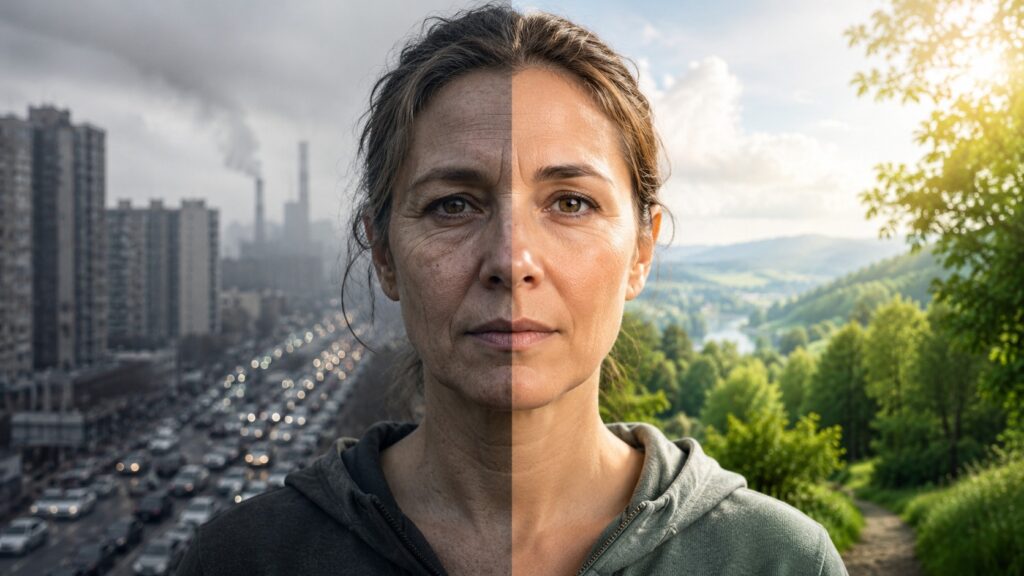
Research has shown that place of residence strongly affects a person’s biological age
The place where you live can speed up or slow down your body’s aging. An international team of scientists conducted the first detailed molecular analysis of more than 300 healthy people from three continents. It turned out that geography and ethnic origin together form a unique biological portrait of each of us. It seems the residents of the Japanese island of Okinawa live to 100 for good reason.
What Is Biological Age and How Can You Determine It
Everyone knows their passport age, but it says little about the actual state of the body. Two people at 50 can look and feel completely different: one may have blood vessels and cells like a 40-year-old, while the other’s resemble those of a 60-year-old. This is exactly the difference reflected by the concept of biological age — a measure of how worn out cells and tissues are at the molecular level.
Biological age can be determined using a set of molecular markers: proteins, metabolites, and DNA status. A new study published in the journal Cell on May 14, 2026, showed that this indicator depends not only on genes and lifestyle but also on where exactly a person lives.
How Scientists Created a Complete Biochemical Passport of a Person
The researchers used an approach called multiomics — where tens of thousands of molecules from a single person are analyzed simultaneously: genes, proteins, lipids, metabolites, gut bacteria, and even traces of past infections. Imagine a complete biochemical passport of a person in which literally everything that can be measured in blood, urine, and the gut is recorded.
The study involved 322 healthy volunteers of European, East Asian, and South Asian descent living in Asia, Europe, and North America. The design was clever: among the participants, there were people of the same ethnic group but from different continents. This is precisely what made it possible to disentangle the influence of genes from the influence of environment — something that had not been achievable before.
Differences Between People at the Molecular Level
The first important result: ethnic origin leaves a stable molecular trace that does not disappear after relocation. Participants of South Asian descent were found to have higher levels of antibodies to pathogens, indicating a greater history of contact with infections. People with European roots had a more diverse gut microbiome and elevated levels of metabolites associated with cardiovascular diseases.
These patterns persisted regardless of where the person lived — in Europe, Asia, or America. This points to a powerful genetic component that shapes a person’s baseline molecular identity.

Multiomic data analysis allows the creation of a detailed molecular portrait of a person
Moving to Another Continent Changes the Rate of Aging
The second, and most unexpected, result concerns biological age. It turned out that place of residence affects how quickly the body ages, and this effect depends on ethnic origin.
East Asians living outside Asia were biologically older than those who remained on their home continent. For Europeans, the picture was reversed: those who moved beyond Europe, mainly to the US and Canada, appeared biologically younger than their peers who stayed home.
Moving to a different environment with a different climate, diet, ecology, and pace of life turns the molecular mechanisms of aging differently in people with different genetics. The specific mechanisms have not yet been established, but the researchers suggest that diet, the microbiome, and environmental factors play key roles.
At the same time, the scientists emphasize that these are preliminary results and correlations, not proven cause-and-effect relationships. However, the scale and depth of the analysis make these data truly significant.
The Link Between Gut Bacteria and Cellular Aging
A separate finding of the study was a newly discovered molecular link between the telomerase gene (an enzyme that protects chromosome ends and slows cell aging), the gut bacterium Oscillospiraceae UCG-002, and the lipid molecule sphingomyelin.
In simpler terms, the scientists found a three-link chain: a gut microbe, a fat molecule, and an aging gene. This connection may mean that gut bacteria can indirectly influence how quickly our cells age. This is still a hypothesis, but it opens an entirely new research direction — since the composition of the gut microbiome depends on diet, and diet is directly tied to where a person lives.
If the link is confirmed, it may turn out that scientists have found a way to reverse brain aging. And this is far from the only promising direction — working with the microbiome could become yet another key to managing age.
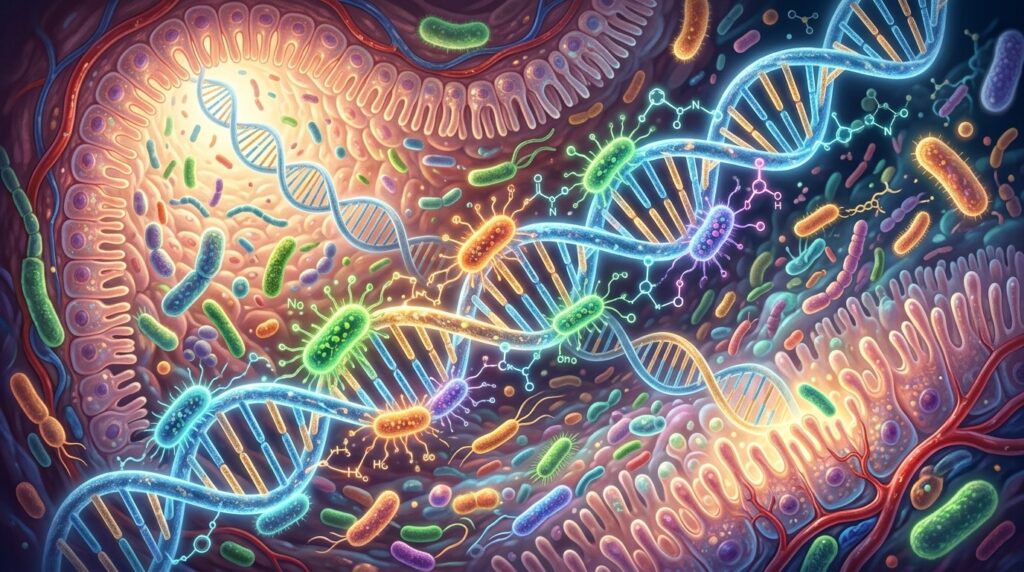
Gut bacteria may influence the rate of cellular aging through molecular chains
How the New Discovery Changes the Approach to Medicine
The practical takeaway here is clear: there can be no single medicine “for everyone.” Lab test norms, disease risks, drug responses — all of these are tied to the combination of genetics and environment. What is considered normal for a European in Europe may be cause for concern in a person of Asian descent living in North America. And vice versa.
All of the study’s data have been made publicly available so that other scientists and doctors can use them for more accurate diagnostics and prevention. In essence, this is a step toward personalized medicine, where treatment is tailored to a specific individual with consideration for their origin and living conditions.
For each of us, this study is a reminder that aging is not hardwired into our genes once and for all. The environment around us, the food on our plate, the microbes in our gut — all of this one way or another affects how quickly the body wears out. This means we have more levers of influence over our own health than it might seem.