
Setting plank records is a bad idea, according to scientists
The plank is an exercise where you hold yourself face down, resting on your forearms and toes, keeping your body straight as a string. Many people believe that the longer you hold this position, the stronger your abs become and the healthier your back gets. But research says the opposite: people with back pain often hold the plank longer than healthy individuals. This is because their body compensates for muscle weakness by loading the spine. Consequently, minutes on the mat don’t build your abs — they injure your lower back.
Why You Shouldn’t Hold a Plank for Too Long
For many years, it was believed that the longer you hold a plank, the stronger your abs and the healthier your back. Two minutes of planking seemed like the gold standard. But a 2025 study, referenced by Prevention, revealed something unexpected: people with chronic back pain often held the plank longer than those with no back pain at all.
This sounds paradoxical but has a simple explanation. When the abs fatigue, the body starts cheating. The lower back sags or, conversely, the hips rise up — and the load shifts from the muscles to the spine, joints, and ligaments. The person appears to still be holding the plank, but the abs stopped working long ago. Instead of strengthening muscles, you end up overloading the very structures that need protection.
How Many Minutes Should You Hold a Plank
Dr. Stuart McGill, one of the world’s leading specialists in spinal biomechanics, has long proposed a different approach. Why suffer through a plank by sheer willpower? He recommends holding for just 10 seconds with maximum tension in all muscles. Then a short 5–10 second rest and another set. A total of three to six such repetitions.
Why does this work? The plank is a so-called isometric exercise, where muscles contract but don’t move. Maximum tension of the abs, glutes, and shoulders can only be maintained briefly. After just 20–30 seconds, the nervous system begins to “shift” the load to passive structures — ligaments and joints. The muscles receive less and less stimulus for strengthening.
Physical rehabilitation specialist Dr. Edward Phillips notes that the ability to hold a plank for up to one minute can be a marker of good spinal health. But the key phrase is “up to a minute,” not “the more the better.” After 40–60 seconds of additional planking, there’s no more benefit for the muscles, and the risk of injury increases.
How to Do a Plank Correctly
It’s precisely the technique that turns the plank from a beneficial exercise into a useless or even dangerous one. The ideal plank looks like this: the body forms a straight line from the crown of the head to the heels, elbows directly under the shoulders. The abs are braced as if you’re about to receive a light punch to the stomach. Glutes and thighs are engaged. Your gaze is on the floor slightly ahead of your hands, so the neck stays in a neutral position.
Signs of an incorrect plank include:
- The lower back sags down — meaning the abs have shut off and the spine is bearing the weight;
- The hips are raised up — the load shifts to the shoulders, and the abs barely work;
- You’re holding your breath — this leads to blood pressure spikes and accelerates loss of postural control;
- The head is tilted up or dropped down — the neck becomes overloaded;
- The shoulders have drifted forward past the elbows — the shoulder joints suffer.
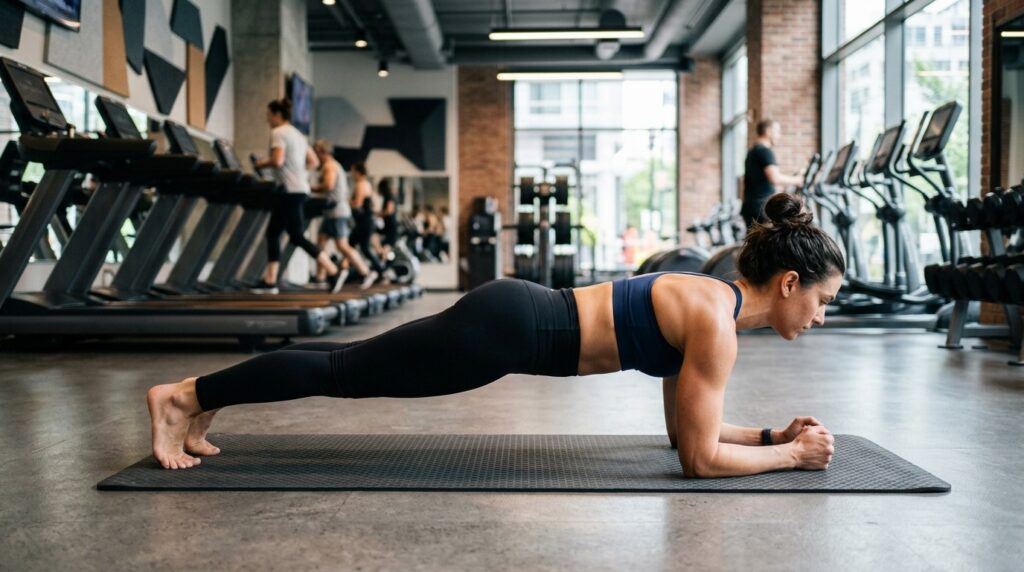
Proper plank: straight line from head to heels, elbows under shoulders, gaze on the floor
As specialists emphasize, the plank is only as beneficial as your form is correct. Twenty seconds in a perfect position gives more than ninety seconds with a sagging belly.
What Prevents You from Strengthening Your Abs
Several persistent myths have formed around the plank, and they continue to migrate from one fitness blog to another.
The first myth — the longer, the better. As research data shows, after 60 seconds the returns from the exercise drop sharply.
The second myth — the plank burns belly fat and creates visible abs. Unfortunately, no. This is a static exercise: it burns a negligible number of calories, and muscle mass barely increases from it, so there’s nowhere for definition to come from. Visible six-pack abs only appear at a low body fat percentage, which is a matter of diet and more intensive training.
The third myth — the plank cures back pain. There is indeed a connection between the ability to hold a plank and back health, but it’s not straightforward. The aforementioned 2025 study directly states that a long plank doesn’t guarantee a healthy spine. A long plank hold may simply mean that a person has learned to compensate for muscle weakness using joints and ligaments.
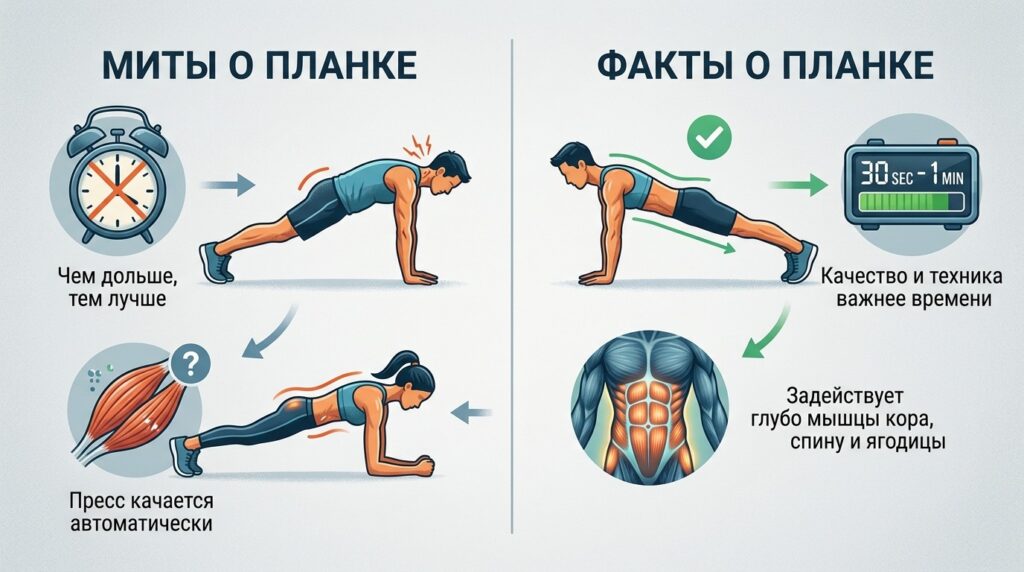
Common plank myths are not supported by research
Plank Program for Beginners and Advanced
Based on expert recommendations, you can build a simple and safe training plan.
For beginners, the McGill method is suitable:
- Get into a plank with perfect technique;
- Hold for 10 seconds with maximum tension in the abs and glutes;
- Rest for 5–10 seconds;
- Repeat 3–4 times;
- Train 3–4 times per week with a rest day between sessions.
If you prefer one long set, time your starting point — the moment when your technique begins to break down. Then add 5–10 seconds each week until you reach a confident 40–60 seconds in perfect form.
When the one-minute plank is no longer a challenge, progress not toward bigger numbers but toward variations:
- Lift one leg a few centimeters off the floor;
- Try a side plank — it targets the obliques more intensely;
- Add dynamic elements — for example, alternating shoulder taps;
- Use an unstable surface — place your forearms on a ball.
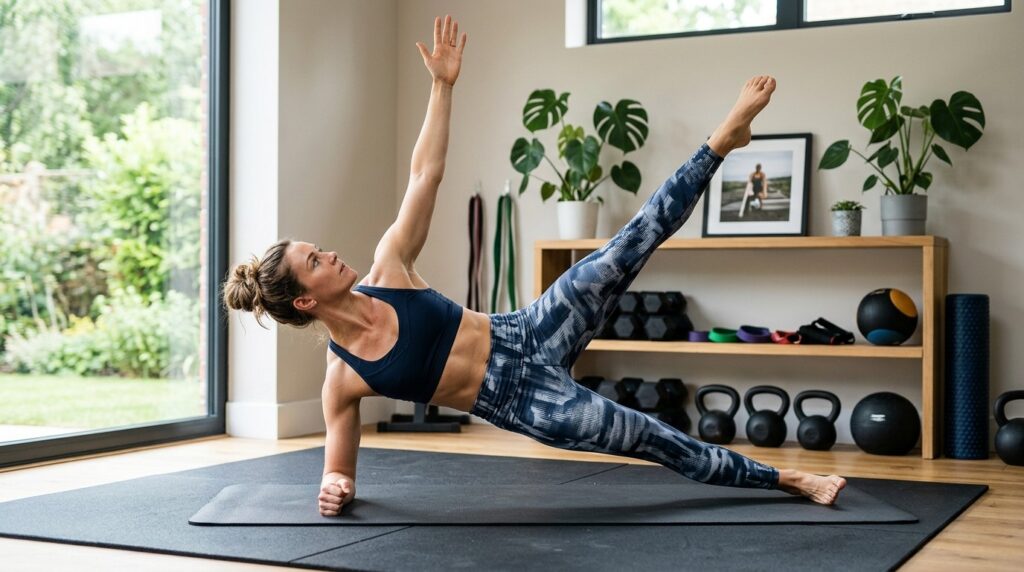
Side plank — one way to make the exercise harder when the regular plank has become too easy
This approach trains real core stability rather than the ability to endure for a long time.
The main takeaway from the research and leading spine specialists is simple: the plank works only as long as your muscles are working. Once your technique falls apart — it’s time to stop, whether that’s at the ten-second mark or the fifty-second mark.