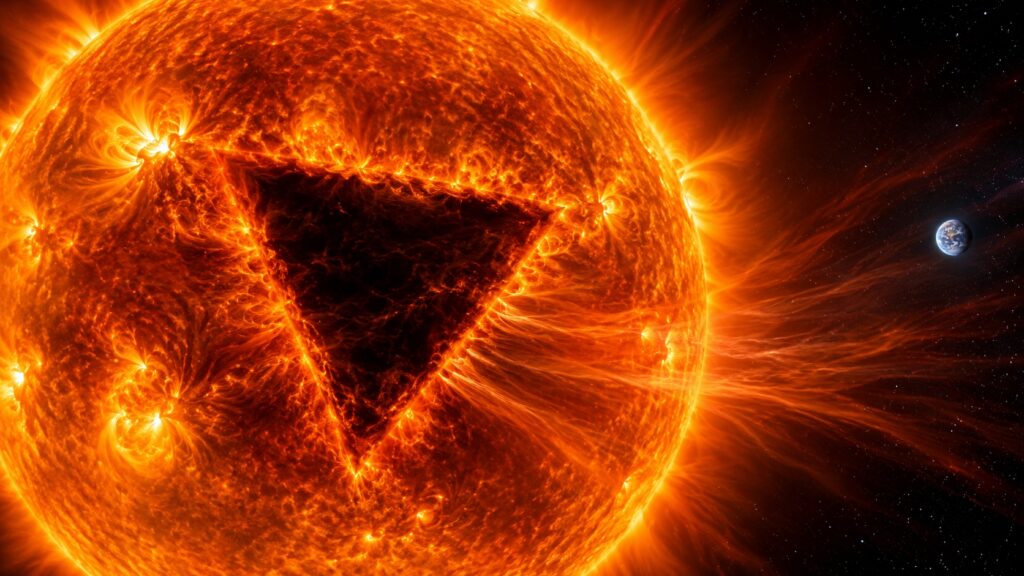
A triangular hole has formed on the Sun, and people are wondering whether it’s dangerous
A coronal hole has formed on the Sun in the shape of a nearly perfect triangle. It sounds alarming, but in reality it’s not a breach or a rupture — it’s a perfectly normal phenomenon for our star. However, we may still feel the consequences of this process. Let’s talk about what to expect.
What Is a Coronal Hole in Simple Terms
A coronal hole on the Sun is not a hole in the usual sense. There is no void or cavity in the Sun. It is a region in the Sun’s outer atmosphere where the magnetic field opens outward.
In normal areas of the Sun, magnetic field lines form loops. They exit the star and return back, holding superheated plasma in place. But in a coronal hole, the magnetic field lines extend into open space and don’t return. Through such a “vent,” the Sun’s material freely escapes outward.
This is precisely why an intensified stream of solar wind — the constant flow of charged particles from the Sun — bursts into space through coronal holes. And it is this stream that can ultimately reach Earth.
Why the Hole on the Sun Appears Dark
In images, the coronal hole looks like a dark spot on the Sun or a gap on the star’s bright disk. This is because the gas in this region is noticeably cooler and more rarefied than its surroundings.
Telescopes take photographs of the Sun in ultraviolet, capturing the glow of hot plasma. Where the plasma is dense and superheated, it glows brightly. But in a coronal hole, material constantly flows out into space, so there is less of it and it’s cooler — there’s almost nothing left to glow. To the eye, such an area appears dark, hence the word “hole.”
The triangular shape in this case is simply a coincidence. The Sun’s magnetic fields can form bizarre outlines, and sometimes the boundary of a coronal hole happens to form a recognizable geometric shape.
How a Coronal Hole Differs from a Solar Flare
A coronal hole and a solar flare are completely different phenomena, but they’re easy to confuse. The difference lies in how the Sun emits energy:
- A solar flare is a sudden explosion, an instantaneous release of energy and radiation. It strikes briefly and powerfully, like a blow;
- A coronal hole is not an explosion but a long, steady “draft.” An intensified solar wind flows from it for weeks.
That’s why flares cause sharp and strong magnetic storms, while coronal holes produce weaker but more prolonged disturbances.
Why Solar Wind Affects Earth’s Magnetosphere
We are surrounded by the magnetosphere, Earth’s protective shell that deflects charged particles from space. Normally, it handles the solar wind flow perfectly well.
But when an intensified and faster stream of particles arrives from a coronal hole, it pushes on the magnetosphere harder than usual and causes it to fluctuate. These fluctuations are what we call geomagnetic disturbances or magnetic storms.
This is exactly the scenario scientists are describing now. According to IKI RAS data, around June 3, 2026, weak geomagnetic disturbances are possible. These will be the consequences of material arriving from this triangular coronal hole.
Is the Triangular Coronal Hole Dangerous for Earth
For the health of an average person and for technology, the hole on the Sun is almost not dangerous. We’re talking only about weak geomagnetic disturbances, not a powerful storm.
What can actually happen during weak geomagnetic activity:
- minor fluctuations in the magnetic field that instruments can detect;
- in rare cases, auroras slightly farther south than usual;
- minimal impact on satellites and radio communications at high latitudes.
It’s almost impossible to see the consequences with the naked eye — unless you’re lucky enough to catch the northern lights. A weak storm carries no destructive effects. Concern is warranted during strong flares and major storms, but right now, according to scientists, there are no precursors of strong solar flares.
Why the Sun Is Considered Calm Despite the Appearance of Holes
Specialists describe the star’s condition as relatively calm. The increase in activity recorded in the second half of May has almost subsided. At the same time, background radiation remains at the high “C” level. This indicates hidden activity that heats the solar corona, but it doesn’t escalate to strong flares.
It’s worth noting that the visible side of the Sun remained quiet, but on the far side, hidden from us, four flares of the maximum X class — the most powerful class — occurred. We might not have known about this if not for the Solar Orbiter probe and coronagraphs that detected gigantic plasma clouds flying out from behind the edge of the Sun.
In the end, the triangular coronal hole is a reason not for panic but for curiosity. It reminds us that the Sun constantly influences our planet, even when it’s behaving quietly. And it’s worth monitoring such events if only because coronal holes and flares are precisely what scientists use to predict magnetic storms and our star’s behavior in the coming days.