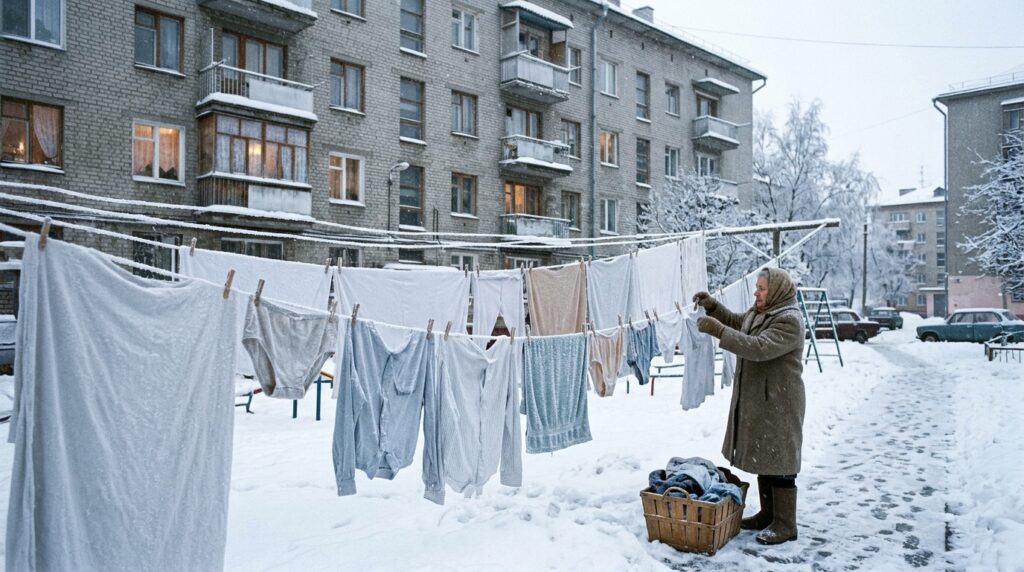
An elderly woman hangs laundry outside in a frosty courtyard
Wet laundry hung outside in sub-zero weather really can dry. The reason is a physical process called sublimation: ice can turn directly into water vapor without melting first. In the Soviet Union, many people hung wet washing on balconies and in courtyards in winter and rarely dried it indoors. Sheets and towels froze as stiff as cardboard, yet by evening they really were dry. There was no special Soviet secret behind it, but it does not work in every kind of weather either. The result depends on several conditions, and the strength of the frost is not the deciding one.
What you need to know
- Water in frozen fabric can pass straight from ice to vapor through sublimation, so laundry can dry below freezing.
- Meteorologist Tobias Reinartz, writing for the German weather portal Wetterdienst.de, notes that clothes can dry even at −20 degrees if the air is not too humid.
- Dry air, wind and sunshine matter more than how cold it is; on a damp, foggy, windless day drying slows sharply.
- Stiff laundry is not necessarily dry, and cold alone does not guarantee that bacteria and viruses are killed.
In the cold, a wet sheet first turns to ice
In summer, drying is straightforward: water in the fabric evaporates into invisible vapor and the wind carries it away. In winter, something different happens in the first few minutes. Suppose it is −15 degrees outside and a sheet goes straight from the washing machine onto a balcony line. The water between the fibers starts to freeze, and the fabric soon barely bends.
The ice effectively glues the fibers together, so a frozen item holds the shape it was hung in. It may seem that drying has stopped at this point, since the water is now solid and ice supposedly should not evaporate. But that is not the case.
Ice escapes into the air without becoming liquid
We tend to think water changes state in a fixed order: ice melts, then water evaporates. But ice can also turn directly into vapor. Physicists call this sublimation.
Even in freezing conditions, water molecules inside ice crystals are not completely still; they keep moving slightly. From time to time, individual molecules gain enough energy to break away from the surface of the ice and escape into the air as vapor. Water evaporates faster in heat, but the process does not stop in the cold.
That is why a frozen sheet can eventually give up almost all of its moisture: first it stiffens, then the ice gradually disappears, leaving dry fabric. Meteorologist Tobias Reinartz, in an article on laundry drying for the German weather portal Wetterdienst.de, notes that items can dry even at −20 degrees if the air is not too humid.
Dry air, wind and sun matter more than the frost
Cold by itself guarantees nothing. Consider two days, both at −10 degrees. On the first, the sun is out and there is a light breeze. On the second, it is foggy, damp and still. Laundry will most likely dry noticeably better on the first day.
Turning ice into vapor is only part of the job: that vapor also has to move away from the fabric. If the surrounding air is already saturated with moisture, the process slows down considerably. Laundry dries fastest with:
- dry air, into which moisture from the fabric escapes easily;
- wind, which continually carries vapor away from the surface of the items;
- sunshine, which gives the fabric extra energy so the ice turns to vapor faster.
One more detail: very cold air is not necessarily dry enough for drying. It is worth checking the humidity and the overall weather, not just the thermometer.
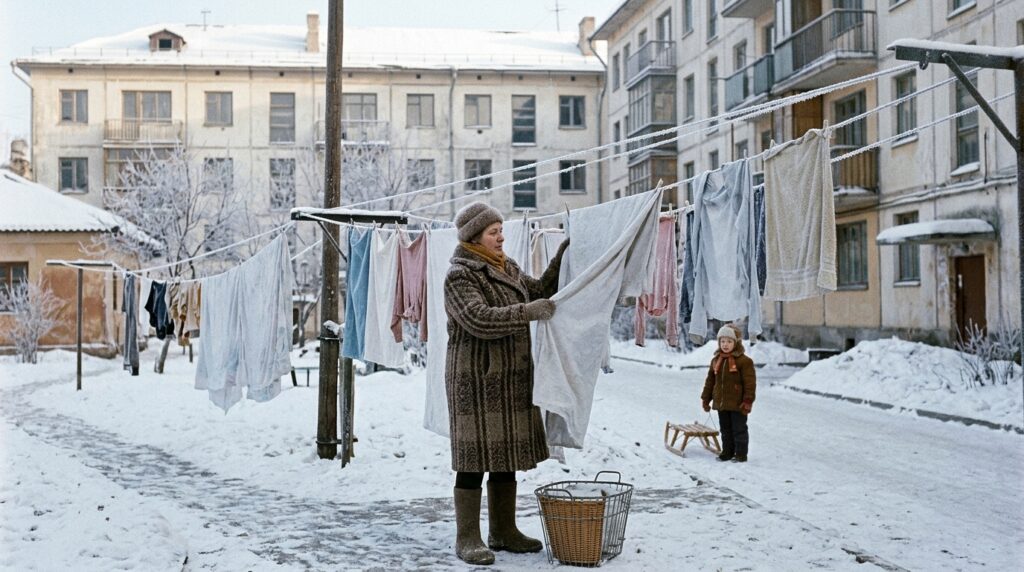
A woman hangs out laundry in a courtyard in winter
Stiff laundry is not the same as dry laundry
Freezing and drying are different processes. An item can go rigid quickly, while actually drying takes much longer. If such a frozen “board” is taken off the line and brought into a warm apartment, it will thaw and turn out to be wet again: the ice simply did not have time to leave the fabric.
If the laundry has hung long enough in dry, frosty air, most of the ice will have sublimated. Indoors, the fabric then just warms up, softens and stays dry. People often partly dried laundry outside and finished drying it at home. That also makes sense: some of the moisture leaves outdoors, so less has to evaporate inside.
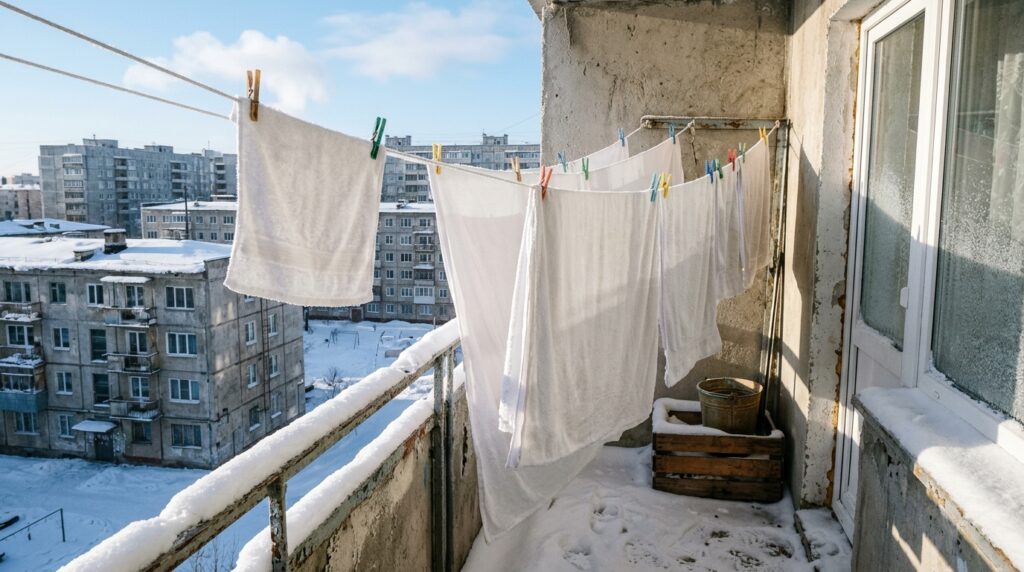
White laundry drying on a snowy balcony of an old building
Why frost drying was common in cramped Soviet apartments
The Soviet habit had practical reasons. Most apartments had no tumble dryers, and hanging duvet covers, sheets and large towels in a small room or kitchen was difficult.
A pile of wet laundry also noticeably raises indoor humidity. With poor ventilation, windows fog up and items take a very long time to dry. Drying outdoors solved several problems at once: it freed up space, made it possible to dry large items, and did not add dampness to the home.
Many people remember the distinctive fresh smell of laundry brought in from the cold. There is nothing magical about it: outdoors, fabric is well aired and, in good weather, sheds moisture faster than it would in a stuffy room. However, frost drying should not be considered disinfection: cold by itself does not guarantee that bacteria and viruses will be killed.
How to dry laundry in freezing weather
The method still works today and needs no special equipment: an ordinary line on an open balcony or in a yard is enough. To help items dry better:
- Wring or spin the laundry thoroughly.
- Hang items spread out flat.
- Choose a dry day with a light breeze and, if possible, a sunny spot.
- Take items down carefully: do not fold or twist heavily frozen fabric; let it thaw first.
The last point is especially important for delicate fabrics. Thick items are another limitation: in heavy towels and jeans, ice can persist for a long time, and in damp weather they will almost certainly need to finish drying indoors.
Soviet homemakers probably did not know the word “sublimation,” but they relied on it every winter. The physics has not changed, so on a dry, frosty, breezy day, a balcony can still stand in for a dryer.