The Ministry of Digital Development has officially confirmed that it is preparing a mechanism for additional charges for international mobile traffic — and this directly affects those who use VPN. Specific limits and tariffs have not yet been approved, but the ministry’s logic is already clear: foreign traffic and VPN are being treated as one and the same.
International traffic, including VPN, will be heavily restricted
Charges for VPN and Foreign Traffic: What We Know
The Association of Telecommunications Companies (ACS) received a response from the Ministry of Digital Development regarding the possible introduction of charges for international traffic. In the letter, the ministry indicated that parameters for additional traffic tariffication are currently being worked out. This is a formulation from the official response, not an approved decision.
The key point: specific limits and tariffs have not yet been determined. In other words, there are no “15 GB for such-and-such rubles” in the letter — there is only confirmation that such a model is being discussed in principle. Any figures currently circulating online are speculation, not the Ministry of Digital Development’s position.
Why VPN Is Considered International Traffic
From the ministry’s response, one can conclude that the Ministry of Digital Development equates VPN with foreign traffic and international traffic in general. In other words, a request through a VPN server outside of Russia looks to the operator and regulator just like regular international traffic and falls under the same tariffication logic. This means that accessing the App Store, downloading a free app, updating iOS, and everything of that sort are lumped together with VPN and will be tariffed accordingly.

The Ministry of Digital Development recognizes VPN as international traffic, which is unsurprising
In parallel, the letter reminds that Roskomnadzor can block VPN as part of centralized network management. This is not a new regulation, but in the context of paid international traffic, it is significant: some VPN services will be blocked, while the remaining VPN traffic will potentially become paid on top of the regular mobile internet package.
VPN Charges on Home Internet
An important detail that’s easy to miss: the letter only concerns mobile communications. Nothing is said about home wired internet in the Ministry of Digital Development’s response. Formally, this means that at the current stage, the discussion is about tariffication of specifically mobile international traffic — what you consume through your carrier’s SIM card.
Restrictions won’t affect home Wi-Fi, but only for now
For users, this means a simple thing: if VPN is enabled on your iPhone at home via Wi-Fi, the model being discussed doesn’t apply to you for now. But if VPN is running on your smartphone on the go, in the metro, or at a café via mobile internet — that’s exactly the scenario that falls under the future rules. I emphasize: this is a conclusion from the current wording, not a guarantee that home internet will forever remain unaffected.
Launch Date for Paid VPN in Russia
According to the letter of the Ministry of Digital Development’s response — no launch dates have been announced. The ministry uses the phrase “being worked out,” which in government language means an early stage of discussion. Before an actual tariff can be implemented, there must be at least a stage of parameter approval, regulatory changes, and technical preparation by operators.
Therefore, any headlines like “starting from such-and-such date VPN will become paid” currently have no confirmation behind them. There is the fact that a mechanism is being discussed — and nothing more specific. If you’re planning trips or work scenarios dependent on VPN, it’s too early to panic, but it’s worth keeping the topic on your radar.
What to Configure on Your iPhone Before VPN Charges Are Introduced
There are no specific actions required by this news just yet — you don’t need to pay anything extra. But there are several sensible steps that make sense regardless of the Ministry of Digital Development’s final decision:
- Check which apps on your iPhone actively use VPN in the background and disable auto-launch where it’s not needed
- Look in your cellular data settings to see how much mobile traffic actually goes out per month — this will come in handy if limits are introduced
- Keep in mind that some VPN services in Russia are already blocked, and the stability of a particular app can change without warning
- Don’t sign up for long prepaid VPN subscriptions years in advance while the rules of the game aren’t finalized
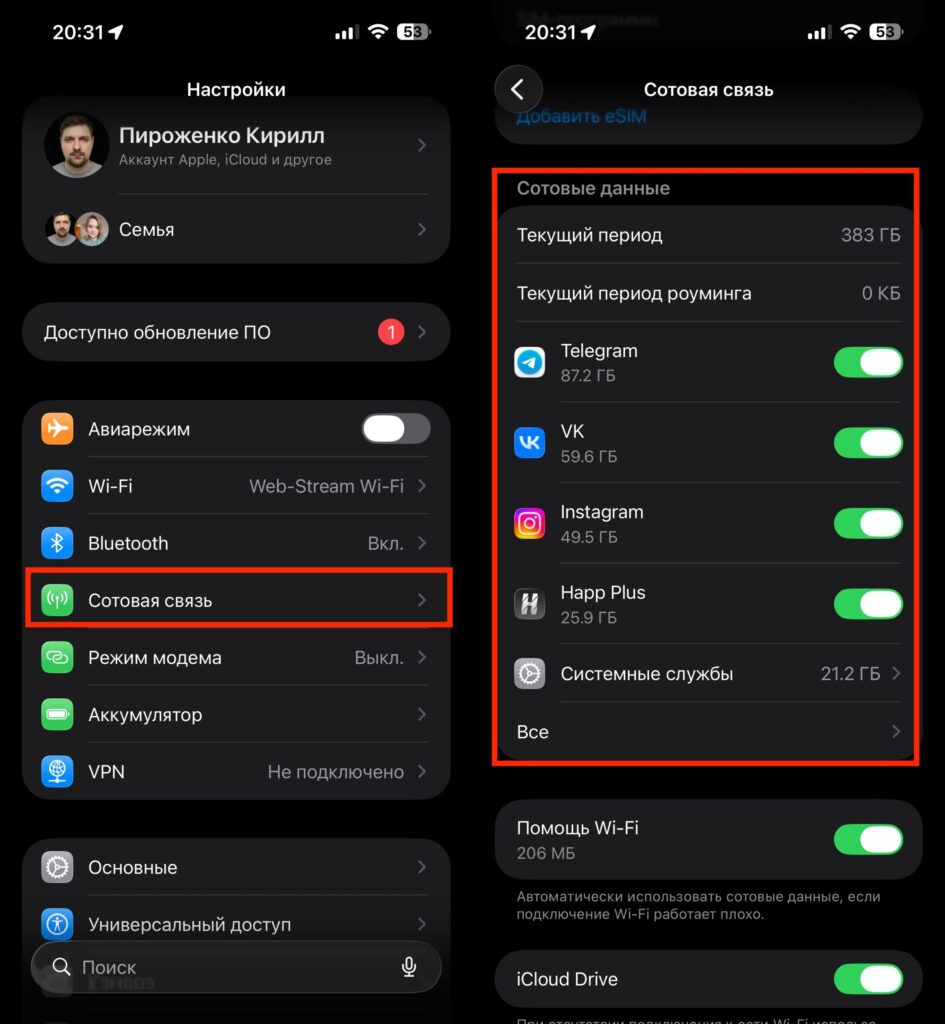
Check your traffic usage in this settings section
It makes sense to follow this story if you regularly use VPN on mobile internet: for working with foreign services, for accessing familiar social networks, or for traveling around Russia with active roaming within the country. This is the group that will be hit hardest if the paid international traffic mechanism is actually introduced.
Those who turn on VPN occasionally and mostly at home via Wi-Fi don’t need to rush to change anything. The current response from the Ministry of Digital Development is a signal about the direction of movement, not a ready-made tariff. Specifics are worth discussing when limit figures, overage prices, and launch dates appear. So far, the ministry has not announced any of these.