
Formula 1 drivers’ methods could save you from neck pain
Formula 1 drivers experience forces of up to five G, which makes their heads five times heavier during high-speed turns. To maintain control of the car, drivers specifically train their neck muscles with special exercises. And, as it turns out, the same basic techniques can help ordinary people who suffer from neck pain after long hours at the computer.
What Is Computer Neck Syndrome
If you spend several hours a day in front of a screen, your head almost certainly shifts forward relative to your spine. You don’t notice it, but your neck muscles and ligaments do.
You sit in front of a computer for two, three, four hours and don’t even realize that your head has been in the wrong position the entire time, — explains Dr. Niru Jayanti in a conversation with Science Alert.
This condition is called computer neck syndrome. An adult’s head weighs about 5 kilograms, but when tilted forward, the load on the cervical spine increases several times over. The result is pain in the neck, shoulders, and upper back that can become chronic over time.
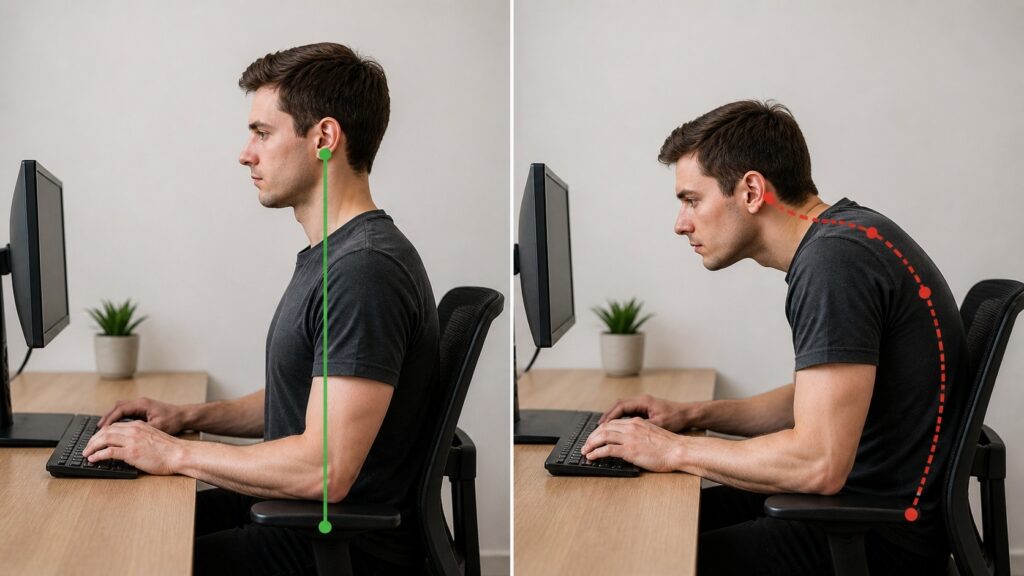
An example of computer neck is shown on the right
How Formula 1 Drivers Train Their Necks
In the world of auto racing, a strong neck is not a luxury but a necessity. At speeds over 300 km/h, forces of up to five G act on a driver’s head during turns. Without preparation, it’s simply impossible to hold your head up in a helmet under such conditions.
Antti Kontsas, an experienced fitness trainer who worked with four-time world champion Sebastian Vettel, told Associated Press about the key training principles:
- Bodyweight exercises — for example, a side plank in which the head is held in line with the shoulders;
- Static holds: lying on a bench with the head hanging over the edge, you hold it strictly horizontal for as long as possible — this works the anterior neck muscles;
- Resistance training — resistance bands or specially weighted helmets for more advanced stages.
Does an ordinary person need the same powerful neck brace of muscles as a Formula 1 driver? Probably not. But the healthy foundation is the same for an ordinary person and a racer. You need to start with the same things, — said Kontsas.
Simple Daily Neck Exercises
Good news: even Formula 1 drivers spend only 10–15 minutes per session on neck training, two to three times a week. For an office worker, the entry threshold is even lower.
Here’s what experts recommend:
- Chin tucks — sitting up straight, gently pull your chin back as if making a “double chin.” This returns the head to the correct position above the spine;
- Isometric exercises — press your palm against your forehead and push your head forward without moving it. Repeat for the sides. Hold for 5–10 seconds;
- Posture reminders — set a timer every 30–60 minutes to check your head position and straighten your shoulders.

Neck exercises can be done right at your desk
Why You Should Strengthen Your Neck
Beyond combating discomfort from sedentary work, trained neck muscles offer other benefits. Strengthening the neck is one of the most accessible and affordable ways to prevent concussions and aid in recovery from them.
The logic is that strong neck muscles better stabilize the head during an impact or sudden movement, reducing the amplitude of brain oscillation inside the skull. This same principle works in contact sports and in everyday life — for example, during sudden braking in a car.
Additionally, the strength of the spinal support muscles overall can be a predictor of reduced injury rates. This is confirmed by observations of tennis players.
The days when Formula 1 drivers smoked and drank before a Grand Prix are long gone. Already in the 1990s, physical fitness was key to Michael Schumacher’s success — the seven-time world champion relied on cardio and strength training, understanding that fatigue leads to mistakes.
Today, neck training is a mandatory part of every driver’s preparation. But the principles behind it are surprisingly simple and accessible to everyone.
You don’t need a weighted helmet or a personal trainer from the world of motorsport. All you need are three things: conscious posture control, a couple of simple exercises, and consistency. Ten minutes two to three times a week, and your neck will stop being the weak link paying the price for your work schedule.