
Doctors identified the most dangerous age for gaining excess weight
Obesity in youth may be more dangerous than weight gain after 40 — this is the conclusion reached by scientists from Sweden. In a large-scale study involving more than 600,000 people, they found that those who first became obese between the ages of 17 and 29 were 70% more likely to die from any cause compared to people who had not developed obesity by age 60. The main idea is simple and alarming — what matters is not only how much you weigh, but also when exactly you started gaining excess weight.
Obesity Before Age 30 Increases Mortality Risk by 70%
The main finding concerns young adults. The study showed that it is not just the fact of weight gain that affects health — the age at which it occurs plays a decisive role. Participants who first reached the obesity threshold between the ages of 17 and 29 were approximately 70% more likely to die from any cause compared to those who had not developed obesity by age 60.
What does this number mean in practical terms? If out of 1,000 participants without early obesity, 10 people died during the observation period, then among those who developed obesity in their youth, that number was already 17 out of 1,000.
The onset of obesity was defined as the moment when the body mass index (BMI) — an indicator calculated as the ratio of weight in kilograms to the square of height in meters — first reached 30 or above. For a person 175 cm tall, that’s approximately 92 kg or more, although the numbers on the scale don’t always give a complete picture of health.
BMI = body weight (kg) / height² (m)
The study authors caution that the exact risk figures should not be taken literally — they depend on many factors accounted for in the analysis, as well as on measurement accuracy. What matters more is recognizing the pattern itself.
Why Excess Weight in Youth Is More Dangerous for Health
The researchers’ key hypothesis is logical: the longer the body lives with excess weight, the more damage accumulates. If obesity begins at age 20, the body is subjected to chronic inflammation, insulin resistance, and increased vascular stress for decades. It is no coincidence that people with excess weight are more likely to face a whole range of chronic diseases.
As Huyen Le, a doctoral student at Lund University and the study’s first author, explains: one possible reason for the increased risk is precisely the longer exposure to the biological effects of excess weight on the body.
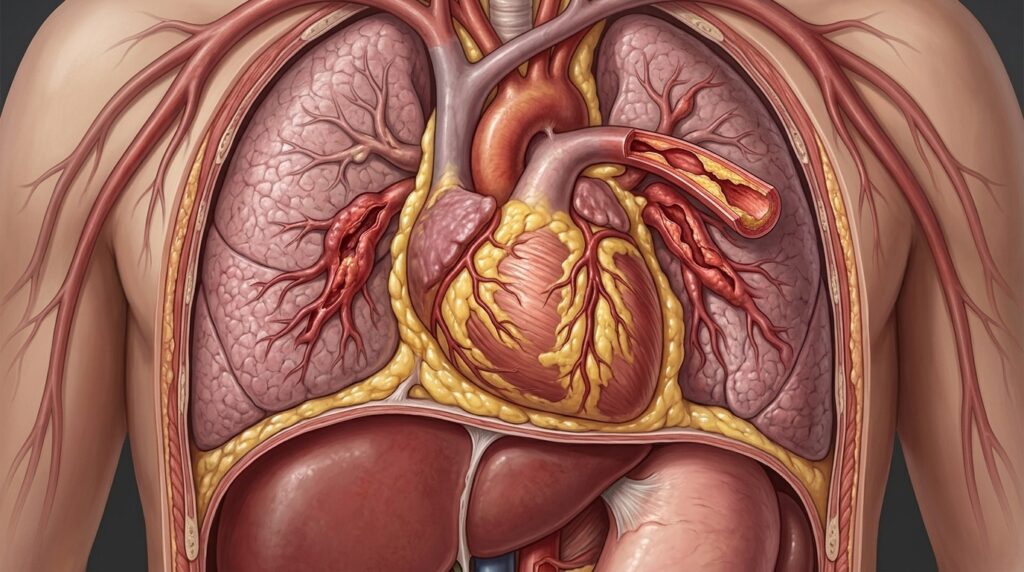
Long-term obesity creates chronic strain on blood vessels and internal organs
Think of it this way: if you’re carrying an extra 20 kg in a backpack, the difference between a half-hour walk and a ten-hour hike is enormous. Joints, heart, and muscles respond differently to the load depending on its duration. The mechanism of long-term obesity works in roughly the same way — the body copes, but its resources are not unlimited.
Weight gain at a later age (from 30 to 60) was also associated with increased mortality, but this association was noticeably weaker. Among the specific causes of death linked to early obesity, the most significant was type 2 diabetes. Serious risks also included hypertension, liver cancer in men, and uterine cancer in women.
It is important to emphasize: a person with obesity who exercises regularly and eats a varied diet may have a completely different risk profile than a person with the same BMI who leads a sedentary lifestyle.

Physical activity in youth — a factor the study did not account for
How Excess Weight Affects Cancer Risk in Women
An interesting detail: the described pattern — “the earlier you gain weight, the higher the risk” — did not apply equally to all diseases. In women, the increased risk of cancer death associated with obesity was roughly the same regardless of when the weight gain occurred. At the same time, excess weight is linked to cancer not directly, but through inflammation, metabolism, and hormonal changes associated with menopause.
The logic is straightforward: if it were solely about the duration of living with excess weight, then early obesity should have increased cancer risk more significantly as well. Since that doesn’t happen, additional biological mechanisms are likely at work in the development of oncological diseases in women.
Epidemiologist Huyen Le poses the question directly: what comes first — hormonal changes that affect weight, or the weight itself reflecting what is already happening in the body? There is no definitive answer yet, but the very fact of this exception is important — it shows that obesity affects different diseases through different mechanisms.
How the Swedish Obesity Study Was Conducted
The scale and quality of data in this study set it apart from similar research. The study was designed to track weight changes throughout adult life rather than relying on a single measurement. Data from more than 600,000 people (258,269 men and 361,784 women) were taken from an existing database — only those whose weight had been recorded at least three times between the ages of 17 and 60 were included in the sample.
One of the study’s strengths is the use of multiple objective weight measurements. In most similar studies, researchers rely on participants’ recollections of how much they weighed in their youth. Here, measurements were taken by medical personnel — for example, at healthcare facilities, during military registration, or as part of research projects.
During the observation period, 86,673 men and 29,076 women died. The team tracked both overall mortality and deaths related to specific diseases — cardiovascular, oncological, and type 2 diabetes.
Why It’s Important to Control Weight Before Age 30
The main takeaway for public health is simple and specific: obesity prevention needs to start as early as possible — ideally during adolescence and young adulthood, when excess weight gain lays the foundation for future health problems.
Many researchers today speak of an “obesogenic society” — an environment in which living conditions hinder a healthy lifestyle and contribute to the development of obesity. Measures with proven effectiveness should be implemented at the level of government policy — and this study adds arguments in favor of such an approach.
For an individual, the conclusion is also clear. If you are between 17 and 29 years old and notice steady weight gain — this is not just an aesthetic issue. This is the period when extra kilograms begin triggering processes in the body whose consequences may manifest decades later. The sooner you manage to stop this trend (through nutrition, exercise, and lifestyle changes), the better. However, the study also serves as a reminder: weight gain at any age is a reason to pay attention to your health — it’s just that the stakes are higher when you’re young.