Many people choose sunglasses by a simple rule: the darker, the better. But tint and ultraviolet protection are not the same thing. Dark lenses without a UV filter can actually damage your eyes more than wearing no sunglasses at all. The reason is straightforward: dark lenses trick your pupils into dilating — as they would in dim light — while doing nothing to block UV radiation. The result is that more harmful ultraviolet reaches the retina than if you had simply squinted in the sun. UV affects the eyes year-round, so understanding what to look for on a label — and how to test your lenses at home — matters regardless of the season.
What you need to know
- UV400 is the most reliable marking: it means the lenses block over 99% of UVA and UVB radiation up to a wavelength of 400 nm.
- The “Filter Cat” (or N, C) marking indicates tint darkness, not UV protection — a light-tinted lens can still have full UV400 protection.
- The popular TV-remote test for UV protection does not work: remotes emit infrared, not ultraviolet light.
- Polarization and UV filtering are separate properties — sunglasses can have one without the other.
How to choose quality sunglasses and verify their protection.
Why cheap dark sunglasses can be worse than none
It all comes down to the pupil. In bright sunlight, the pupil reflexively constricts to protect the retina. In darkness, it dilates to capture more light. Dark lenses fool the eye into thinking it is in dim conditions, causing the pupil to open wider.
If the lens is merely tinted but does not block ultraviolet radiation, UV passes through unimpeded — and through a wider pupil at that. In effect, poor sunglasses open the door to harmful radiation. Prolonged UV exposure is one of the factors associated with deteriorating vision.
It is worth noting that most modern sunglass “lenses” are polymer rather than glass. However, the material alone does not determine UV-blocking ability: different plastics and glasses filter UV to varying degrees, which is why labeling and testing matter more than material.
What to look for on the label or temple arm
Good sunglasses should block two types of rays — UVA and UVB. You can check this in the store by knowing what to look for on the tag or temple:
- UV400 — the most reliable marking. These lenses block more than 99% of UVA and UVB radiation up to a wavelength of 400 nm.
- UV380 — still good protection, but some long-wavelength UVA in the 380–400 nm range may pass through.
- CE or ISO 12312-1 — useful supplementary markings, but they do not replace a UV400 or “100% UV protection” designation.
This protection matters even while driving: car side windows let some UVA through, so a closed window alone does not shield you from ultraviolet.
An important caveat: in most countries, certification is voluntary, so standard numbers may not appear on the glasses at all.
Some sunglasses display a numerical UV-filter category. The grading systems differ by region, but the principle is the same: the lower the number, the weaker the protection, and zero means no protection. In Europe, categories 0, 2, 6, and 7 exist. In the United States, three categories are used: “Cosmetic” blocks less than 50% of UV; “General” provides a 50–80% filter; and “High UV-protection” offers approximately 99%. Notably, the top US category requires 99% protection, while the European “7” allows 95–99% for UVA rays.
The “Filter Cat” marking (or letters N, C) refers to the degree of tint darkness, not UV protection. There are five levels, with 0 being nearly transparent. Both light and dark lenses can carry full UV400 protection. Tint and UV filtering are different things and should not be confused.
A UV flashlight test you can try at home
The most reliable method is to visit a well-equipped optician: they will have a UV meter that shows in seconds how well lenses block ultraviolet. But a rough check is possible at home.
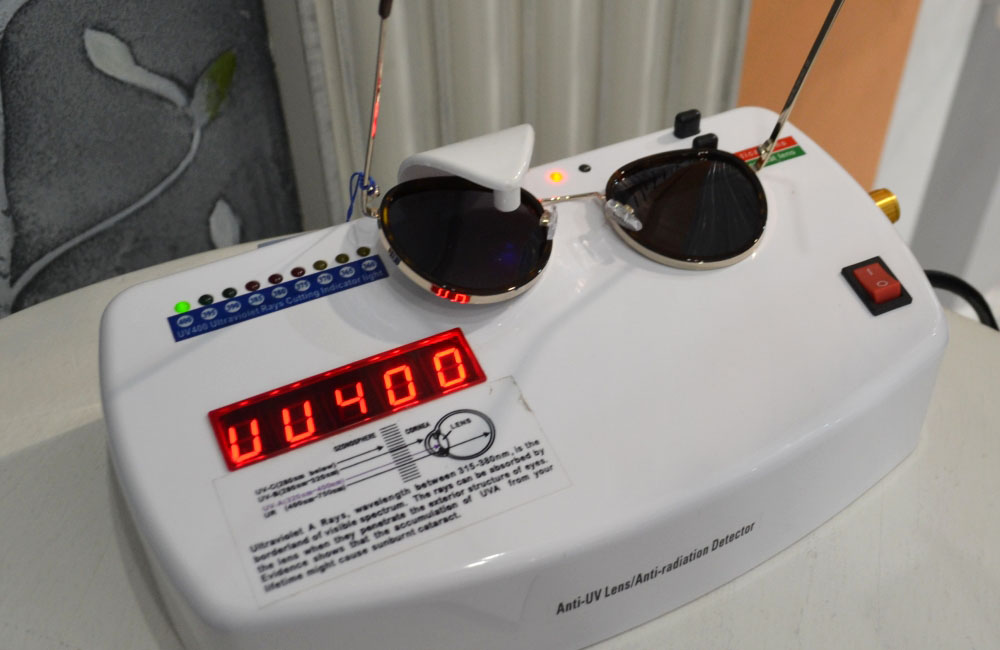
Testing sunglasses on a UV meter for ultraviolet protection. The device shows the degree of UV protection. Image source: smotri-optic.ru
If you have a UV flashlight, take a banknote and shine the light on its security fibers and markings through the sunglass lens. If the glowing elements noticeably dim or stop glowing when viewed through the lens, it is blocking at least some of the UV the flashlight emits. If the brightness barely changes, the filter is questionable. However, this test cannot be considered proof of UV400 — only a UV meter can give a precise result.
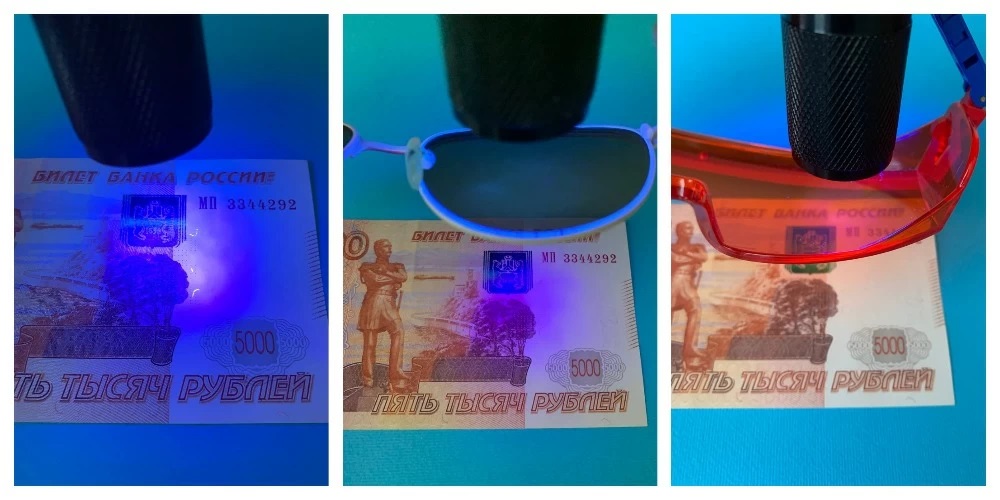
Professional sunglasses blocked the radiation completely; ordinary ones only partially. Image source: rskrf.ru
A popular suggestion involving a TV remote control does not work at all. The idea is that if you point the remote at a TV through the lens and the TV “doesn’t respond,” the glasses are protective. In reality, a remote control uses infrared radiation, not ultraviolet, so this test proves nothing.
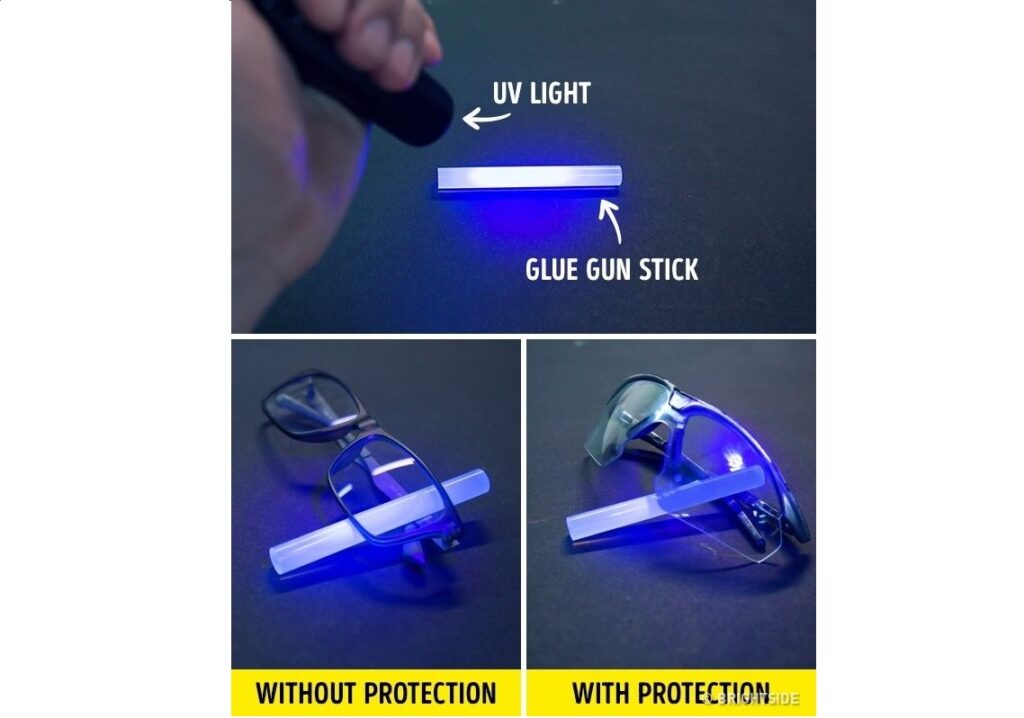
Another simple way to check UV protection in sunglasses without a banknote.
How polarization differs from UV protection
These two properties are often confused, but they serve different purposes. A UV filter protects the eyes from ultraviolet radiation. Polarization, on the other hand, is about visual comfort: it eliminates blinding glare caused by light reflecting off water, wet pavement, snow, or a car hood. It is especially useful on water, snow, and while driving.
The difference is particularly noticeable in winter, when snow can be blinding even on overcast days: polarization reduces reflected glare, while the UV filter performs an entirely separate task.
Sunglasses can have excellent UV protection without being polarized — and vice versa.
How to check for polarization in under a minute
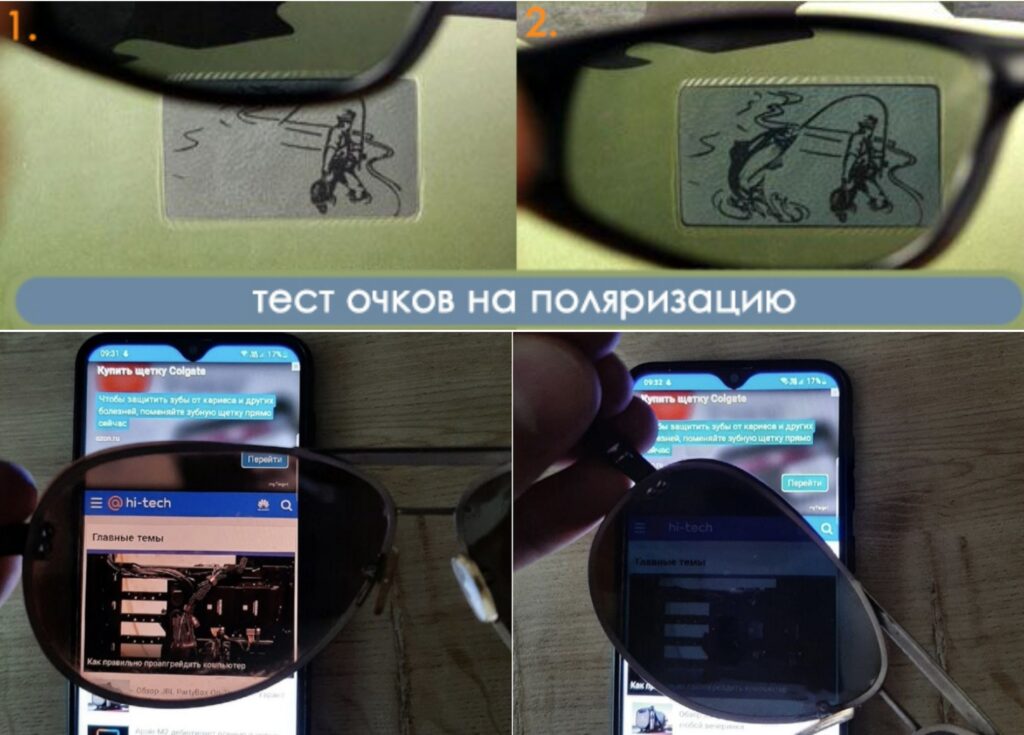
Polarization tests.
Several methods require no special equipment:
- Phone screen test: Open a white image on your phone, set brightness to maximum, and look at the screen through one lens. Slowly rotate the glasses 90 degrees — with a polarized lens, the image on a compatible display will darken significantly or nearly disappear. If nothing happens, try a different LCD screen, as this test does not work with all display types.
- Two-pair test: Place two pairs of polarized sunglasses lens-to-lens and rotate one pair 90 degrees. The gap between them should become nearly black.
- Glare test: Look at a glare from a puddle or car hood, then tilt your head sideways 90 degrees. If the glare noticeably intensifies, polarization is present.
- Test card: Quality polarized sunglasses often come with a gray test card. Without the glasses, the card appears nearly blank; through the lens, a hidden image becomes visible.
The phone screen method works because LCD displays rely on polarized light to produce an image.
Ultimately, choosing safe sunglasses comes down to a couple of quick checks and a glance at the markings. Once you have confirmed that the UV filter is genuine, the degree of tint can be chosen to personal preference — as long as the lenses are comfortable in bright light without being so dark that you need to remove them to see.