The Moon’s gravity is about one-sixth of Earth’s, which means you could jump roughly six times higher there than on our planet. But could a powerful enough leap actually launch you off the lunar surface and into space forever? The short answer: not even close. The escape velocity of the Moon is 2.38 km/s (about 8,570 km/h) — roughly 760 times faster than a typical human jump. No biological body could survive the forces required to reach that speed in a single push. However, on much smaller celestial bodies, a strong jump really could send you drifting into the void permanently.
What you need to know
- A person who can jump 50 cm on Earth would reach about 3 meters on the Moon and stay airborne for roughly four seconds — impressive, but nowhere near escape velocity.
- Accelerating an 80 kg person to lunar escape velocity (2.38 km/s) would require about 227 megajoules of energy — equivalent to detonating 54 kg of TNT — delivered in a fraction of a second.
- Even escaping the Moon does not mean escaping Earth: you would enter orbit around our planet, and leaving the Earth–Moon system entirely would require roughly 2.4 km/s under ideal conditions.
- On tiny asteroids or small planetary moons, escape velocities can drop to mere centimeters per second, making an accidental jump into space a genuine hazard.
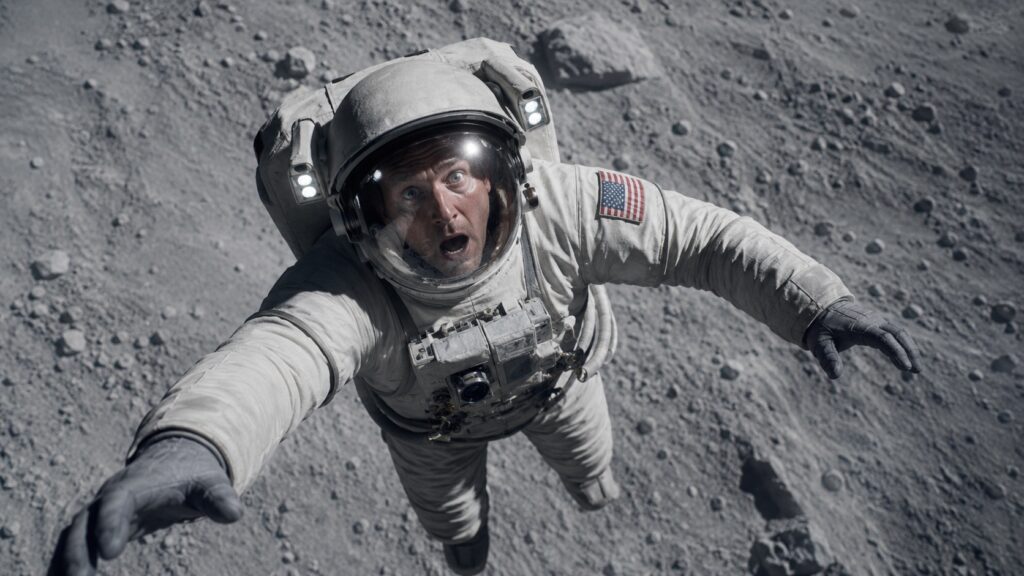
Jumping off the Moon is theoretically possible, but only under one fantastical condition.
How high could you jump on the Moon?
Gravitational acceleration on Earth is approximately 9.8 m/s², while on the Moon it is only about 1.62 m/s². Your mass stays the same wherever you go — an 80 kg person is still 80 kg on the Moon — but the downward force pulling on you drops dramatically.
If you can jump 50 centimeters on Earth, your feet leave the ground at roughly 3.1 m/s. Applying the same push on the Moon would send you nearly 3 meters into the air, with about four seconds of hang time. That is superhero-level by Earth standards, but it is catastrophically short of what you would need to escape into space.
The escape velocity problem
To leave a celestial body permanently, an object must reach what physicists call escape velocity (or second cosmic velocity). Because the Moon has virtually no atmosphere, there is no aerodynamic drag to worry about — you are effectively standing in open space already. The only obstacle is gravity itself.
The Moon’s escape velocity is 2.38 kilometers per second (about 8,570 km/h). That is approximately 760 times faster than a normal human jump.
The kinetic energy needed to accelerate an 80 kg person to that speed works out to roughly 227 megajoules — the energy equivalent of detonating 54 kilograms of TNT. All of that energy would have to be delivered during the fraction of a second it takes your legs to extend. The resulting acceleration would reach millions of m/s², and no human body could withstand such forces.
What happens at different launch speeds
Setting aside the fragility of the human body and imagining any arbitrary starting speed directed straight up, here is a useful progression:
- 3 m/s — a normal jump; about 3 meters of altitude, then a gentle fall back.
- 10 m/s — you rise to roughly 31 meters, the height of a 10-story building.
- 100 m/s — you reach about 3 kilometers, but gravity still pulls you back.
- 1,000 m/s — an impressive 370 km altitude, yet still trapped by lunar gravity.
- 2,000 m/s — you soar 4,000 km from the surface (more than the Moon’s own radius) and spend hours in space, but eventually fall back.
- 2,380 m/s — the critical threshold is crossed; you never return to the Moon.
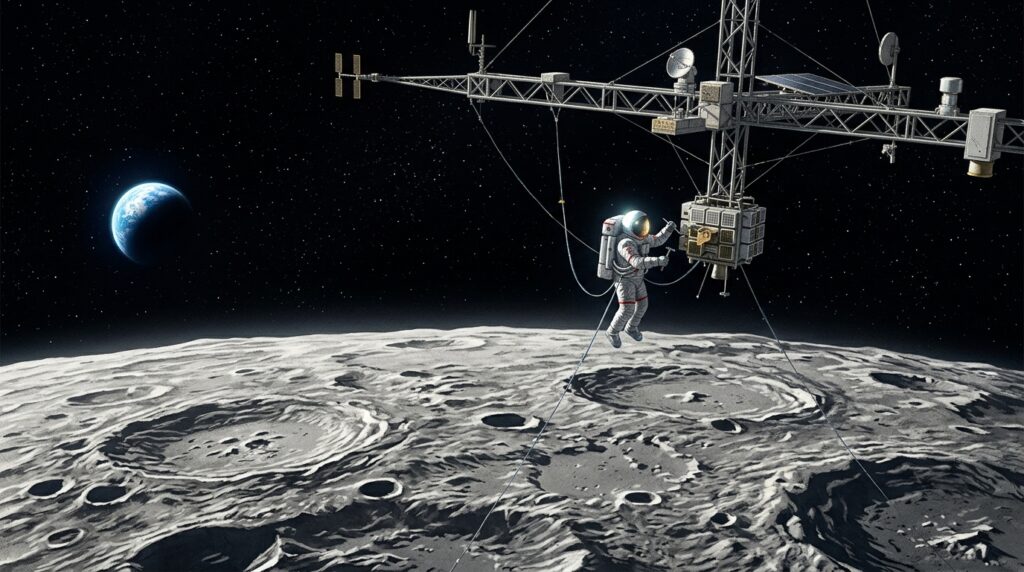
Even thousands of kilometers from the Moon, you could still fall back to its surface.
Could you become a human satellite?
There is also the concept of orbital velocity (first cosmic velocity) — the speed needed not to escape, but to enter a stable orbit. At the Moon’s surface, that figure is 1.68 km/s.
If the Moon were a perfectly smooth sphere and a person could push off horizontally at that speed, they would begin continuously falling toward the surface while the curvature of the Moon kept the ground dropping away beneath them. In effect, the person would become an artificial satellite. In reality, such an ultra-low orbit would quickly end in a collision with a crater or mountain.
Where a jump really could launch you into space
While the Moon is far too massive for a human jump to matter, the idea becomes entirely plausible on smaller solar system objects. Escape velocity depends directly on a body’s mass and radius. On tiny asteroids or small planetary moons — such as Jupiter’s moon Metis — escape velocities can fall to just a few meters per second, or even tens of centimeters per second, according to educational materials from the Interneturok portal.
On such a body, an astronaut would need to move with extreme caution and use tethers. A single strong jump could permanently detach them from the surface, sending them slowly but irreversibly drifting into the darkness of space.
Escaping the Moon does not mean escaping Earth
Even if someone could somehow reach 2.38 km/s and break free of the Moon, the journey would not be truly “free.” The Moon itself orbits Earth at about 1 km/s. As the science-communication project Elementy emphasizes, gravity never fully disappears — the dominant gravitational influence simply shifts from one body to another. After escaping the Moon, you would find yourself in a new orbit around Earth. To leave the Earth–Moon system entirely, the initial speed from the lunar surface would need to be approximately 2.4 km/s, assuming a perfectly chosen direction.
The Moon may feel light underfoot, but its mass is a colossal 73 quintillion tonnes — more than enough to hold rocks, cosmic dust, and any would-be jumpers firmly in place. Without a powerful rocket, no jump will ever be enough.