Chickens are indeed dinosaurs — but not in the way internet memes suggest. The popular claim that Tyrannosaurus rex somehow shrank into a modern hen is a myth. T. rex lived around 66 million years ago, by which time early birds had already been flying for tens of millions of years. The famous predator sits on a neighboring branch of the evolutionary tree, not in the chicken’s direct lineage. Nevertheless, modern biology classifies birds as the only surviving lineage of dinosaurs. They belong to the theropods — a large group of bipedal, predominantly carnivorous reptiles. If you mentally scaled up a modern rooster to two meters, gave it a toothy jaw and a long tail, the structural resemblance to bipedal dinosaurs would be strikingly obvious.
What you need to know
- Birds, including chickens, are classified as theropod dinosaurs — the only dinosaur lineage that survived to the present day.
- The domestic chicken descends from the red junglefowl (Gallus gallus) of Southeast Asia, not from T. rex.
- The oldest confirmed archaeological remains of domestic chickens date to roughly 3,500 years ago, found at Ban Non Wat in central Thailand.
- Chickens were likely first kept as ritual or prestige animals, not as food — early remains show no butchery marks.
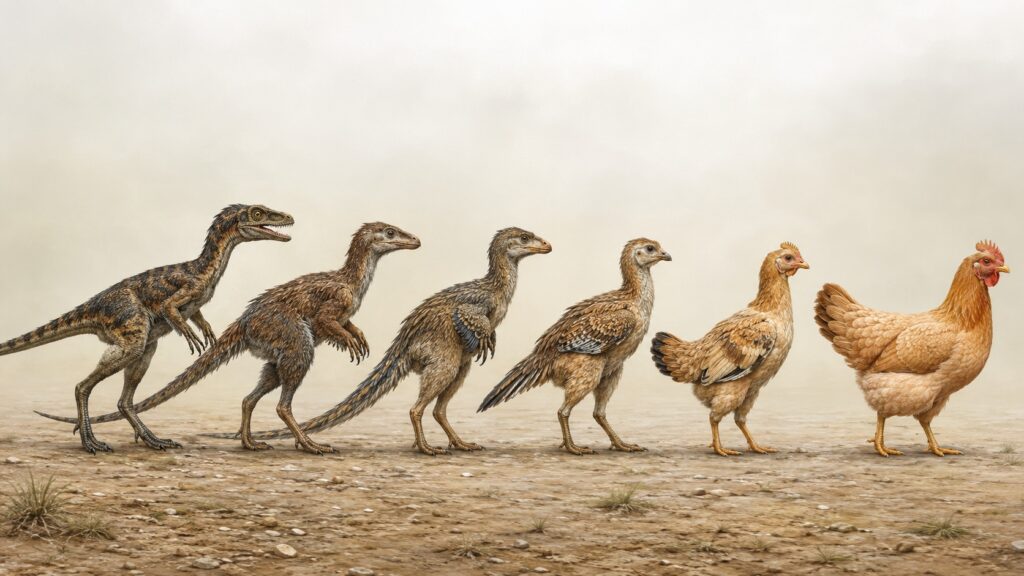
Scientists believe the first chickens appeared 4–6 million years ago.
The real ancestor: the red junglefowl
To see the actual — rather than prehistoric — ancestor of modern chickens, you need only look at the red, or Bankiva, junglefowl (Gallus gallus) still living in the forests of Southeast Asia. The male of this species looks remarkably like a farmyard rooster: red comb, golden-russet neck, and dark tail feathers. Wild junglefowl, however, are much lighter and leaner. They run well, fly up into trees to roost at night, and have no inclination to lay eggs on an industrial schedule — their reproduction is strictly seasonal.
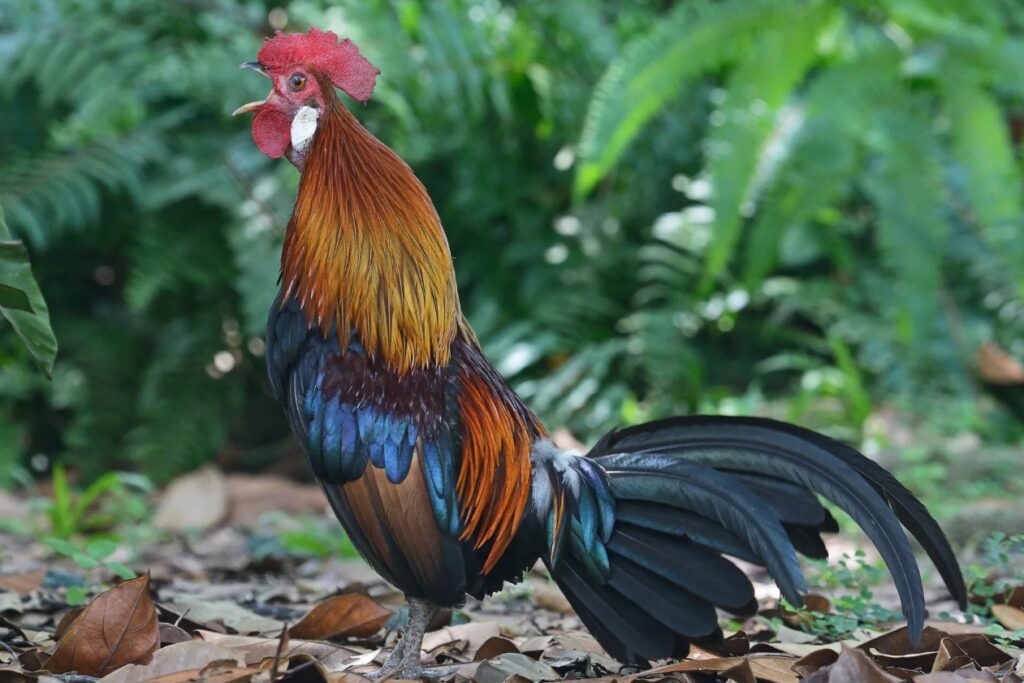
Bankiva junglefowl. Image source: clasbio.ru
How chickens became domesticated
For a long time, researchers struggled to determine exactly where and when chickens were domesticated. Bones initially dated to nearly 10,000 years old were later found to have been confused with remains of other wild birds. A large-scale review of the evidence, reported by multiple scientific publications, concluded that reliable archaeological traces of truly domestic chickens appear only about 3,500 years ago. The oldest confirmed remains were found at the Ban Non Wat settlement in central Thailand.
Agriculture likely played the decisive role. Local communities had begun growing rice on dry, elevated plots — creating an irresistible free buffet for timid forest birds. The domestication process appears to have unfolded in stages:
- Wild junglefowl ventured out of the forest onto rice fields for easy grain.
- Over time, the birds grew bolder and began scavenging scraps near human dwellings.
- People grew accustomed to their useful neighbors and started collecting their eggs.
- The calmest individuals stayed permanently, marking the beginning of controlled breeding.
Chickens were not originally raised for food
Perhaps the most surprising aspect of chicken domestication is that nobody initially intended to eat them. At early settlement sites, archaeologists frequently find chickens buried whole — sometimes even alongside humans. Their bones show no signs of butchery or cooking. Researchers suggest that the brightly colored tropical rooster, with its large red comb and dawn crowing, was first valued as a ritual animal, a status symbol, or simply an exotic pet.
Only centuries later, as chickens spread with human populations across Asia, the Middle East, and Europe, did they gradually become a routine source of meat and eggs.
How living with humans changed the chicken
The modern domestic chicken is far more than a tamed copy of its wild ancestor. As chickens traveled the world, they interbred with other wild junglefowl species. For example, the characteristic yellow skin of many domestic breeds came from the grey junglefowl.
But the most profound changes were driven by human selection — sometimes unintentionally. Swedish biologists conducted an experiment in which they took wild junglefowl and selected, in each successive generation, only the birds that showed the least fear of humans. After just six generations, the fearless birds had spontaneously developed altered growth rates and metabolism. Genes responsible for docile temperament, it turned out, drag along an entire chain of physiological changes that transform a wild bird into an ideal agricultural breed.
Domestic chickens are now threatening wild populations
In an ironic twist, domestic chickens have become so numerous in Southeast Asia that they are interbreeding extensively with the remaining wild junglefowl populations. Domestic genes are now actively infiltrating wild genomes. In some regions, the proportion of domestic genetic material reportedly approaches half the genome of local wild populations. Humans first created a domestic bird from a wild one; now the domestic bird is gradually making its free-living relatives a little tamer.
So what came first — the chicken or the egg?
Science offers a clear answer to the classic riddle. Eggs appeared hundreds of millions of years before the first feathered creatures. And the very first egg from which a domestic chicken hatched was laid by a bird that was genetically almost a chicken — but not quite.