
A beanie that reads minds: the end of the keyboard era is near.
A California startup has unveiled a beanie that reads minds and types them on a screen of a computer or smartphone. No implants, no surgery — just an ordinary-looking knitted beanie with thousands of tiny sensors inside. It sounds incredible, but the device has already been announced and is promised by the end of 2026.
How the Sabi Mind-Reading Beanie Works
The company Sabi, based in Palo Alto, California, emerged from stealth mode in April 2026 with an unusual product. Its CEO Rahul Chhabra calls his creation “the most wearable brain-computer interface on the planet” — it’s a beanie that you simply put on your head and think about what you want to type, and the text appears on a connected device at a speed of about 30 words per minute.
The device is based on electroencephalography — EEG. This is a well-known method in which sensors on the surface of the head detect the brain’s electrical activity. EEG has been used for decades in sleep laboratories and epileptology clinics. But usually the signal that passes through the skin and skull bone is too weak and noisy for decoding continuous inner speech.
Sabi bets on “brute force”: while standard EEG devices contain from a dozen to a couple of hundred sensors, the Sabi beanie has 70,000 to 100,000 miniature sensors built in, each smaller than a lentil. For comparison: the most advanced research EEG systems contain a maximum of about 512 sensors. The difference is hundreds of times greater.

The Sabi beanie is expected to go on sale by the end of 2026, followed by other headwear.
How AI Translates Brain Signals Into Text
Sensors alone are not enough. To turn noisy electrical signals into meaningful text, Sabi developed its own AI model — the Brain Foundation Model. To train it, the company collected 100,000 hours of brain activity data from 100 volunteers.
Why is such scale needed? Brain activity patterns differ significantly between individuals. The model was trained on a massive dataset to identify universal patterns: when two Sabi users think of the same word, it should appear on screen — despite individual differences in brain signals.
In essence, the Brain Foundation Model works as a translator between the brain’s electrical activity and text. It’s similar to how large language models like ChatGPT learned to understand natural language — except instead of words as input, there are electrical impulses from the surface of the skull.
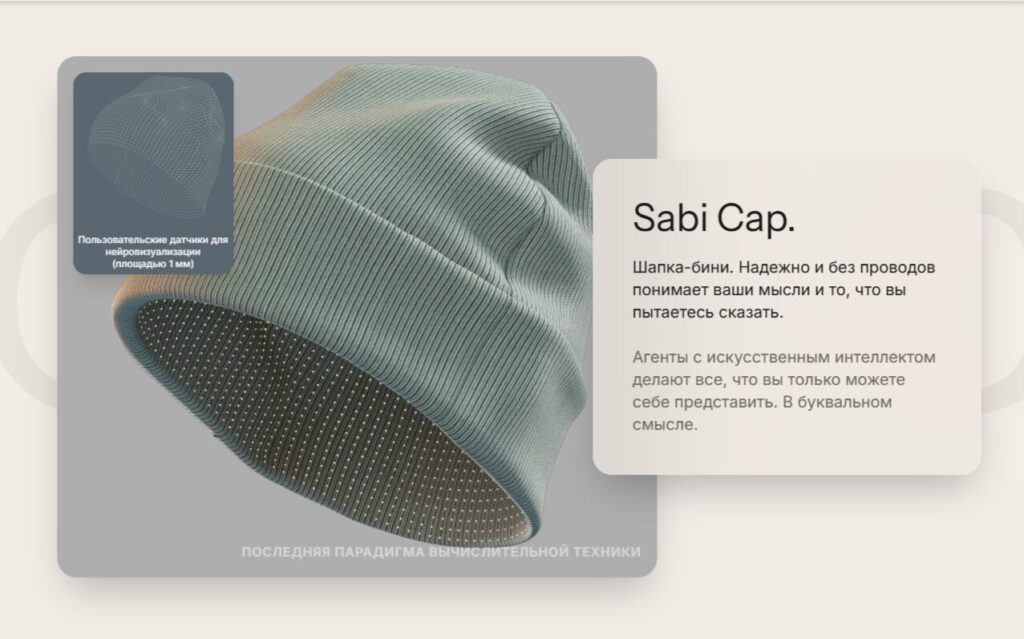
This beanie can read your thoughts.
The company also claims that its technology can recognize continuous inner speech, rather than a limited set of commands like typical EEG devices. This is a fundamental difference: you’re not just selecting from a list of “left-right-confirm,” but freely forming thoughts.
How the Sabi Neuro-Beanie Differs From Neuralink
The main difference is in the approach to reading brain signals. Unlike Elon Musk’s Neuralink, where a hole needs to be drilled in the skull and an implant placed directly on the brain to read strong signals, Sabi simply asks you to put on a beanie.
The company’s investor Vinod Khosla, who also invested in OpenAI at an early stage, explains the logic simply: “If you want a billion people to use a brain-computer interface daily to access computers, it can’t be invasive.”
Each approach has its strengths and weaknesses:
- Invasive implants (Neuralink and similar) provide a powerful, clean signal but require surgery and carry medical risks
- Non-invasive EEG devices (Sabi) are safe and accessible to anyone but receive a weaker signal that has passed through skin and bone

Invasive neuroimplant and non-invasive beanie — two approaches to brain-computer interfaces
Sabi’s strategy is to compensate for the weakness of the external signal through sensor density and large-scale AI processing: less precision per channel, but much greater surface coverage, more data, and a significantly lower barrier to entry for users.
How Sabi Encrypts Users’ Brain Data
When a device literally reads your brain signals, the question of privacy becomes especially acute. Sabi states that data is encrypted before being sent to the cloud, and the model was trained on encrypted signals rather than unprotected “raw” data.
Rahul Chhabra claims that neural data is end-to-end encrypted right inside the beanie, and the stack is audited by neurosecurity researchers from Stanford.
Nevertheless, experts point to unresolved questions. The encryption model protects against interception by third parties, but does not necessarily prevent the manufacturer itself from accessing decrypted or raw data. This creates potential risks — from monetizing neurodata to targeted manipulation.
Sabi says it is working with neurosecurity experts, but the broader discussion about brain data rights and their ethical use will intensify as such devices approach the mass market.
When Will the Sabi Beanie Launch and How Much Will It Cost
The Sabi beanie is expected to go on sale by the end of 2026, followed by a baseball cap version. It is not yet known how much the device will cost or whether it will be able to do anything beyond typing text.
The obvious use case is working in open offices and public places where voice dictation is inconvenient. Even with powerful transcription and dictation tools, the main problem remains: you have to speak aloud, and that’s not discreet enough for shared workspaces.
But an even more important application is helping people with motor function impairments. For someone who cannot move their hands due to injury or a disease like ALS, the ability to communicate without voice and without movement is not a tech toy but a fundamentally new quality of life.
A similar scenario has already become reality: an ALS patient, after receiving a Neuralink chip implant, was able to communicate with others again through a computer and AI. And since the Sabi device requires no surgical intervention, trying it carries no serious risks.
Why Scientists Are Skeptical About Sabi Technology
It’s important to understand: Sabi is still a startup with ambitious claims, not a finished product with confirmed effectiveness. Independent validation and peer-reviewed data on the device’s actual performance have not yet been published.
The most advanced invasive projects, including Stanford’s inner speech team, have achieved speeds of 70–80 words per minute, while normal human speech is 140–180 words per minute.