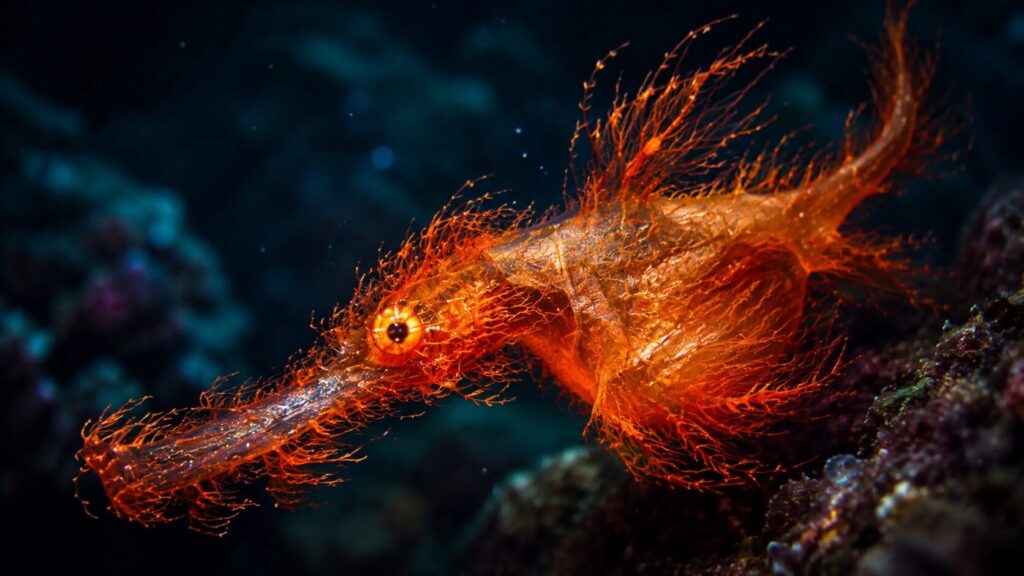
The new ghost pipefish species was named after a hairy Sesame Street character
A marine biologist spent 20 years searching for a strange hairy fish he first spotted off the coast of Papua New Guinea. It has now been officially described as a new species and named after a children’s show character. But behind its comical appearance lie surprises that astonished even ichthyologists.
How scientists searched for the hairy fish
According to ZME Science, in 2001, marine biologist David Harasti was diving off the coast of Papua New Guinea when he noticed something strange. It seemed to him as though a clump of red algae was swimming on its own through the water column. Harasti photographed the find with a film camera, returned home, and searched through every fish identification guide he had. No species matched.
The creature turned out to be tiny, just 2–3.5 centimeters long, and masterfully hid among filamentous red algae. After the first encounter, the fish essentially vanished. Harasti returned to the region time and again, but without success. Meanwhile, rare sightings surfaced from divers near the Great Barrier Reef, Fiji, and Tonga — meaning the species could be widespread but nearly impossible to spot.
Everything changed in 2020, when divers spotted the same creature near Cairns in Australia. Harasti teamed up with ichthyologist Graham Short from the California Academy of Sciences and the Australian Museum. The team organized a targeted expedition: researchers combed reef walls and coral overhangs at depths of 5 to 30 meters, carefully inspecting patches of red algae. Eventually, the scientists caught a male and a female for a full scientific description.
What are ghost pipefish
Ghost pipefish are a small and poorly studied group of tropical marine fish, close relatives of seahorses, pipefish, and sea dragons. They all belong to the order Syngnathiformes and are found in the tropical zone of the Indo-Pacific region, from the Red Sea to the central Pacific Ocean.
The main superpower of ghost pipefish is camouflage. They masterfully mimic algae, seagrasses, crinoids, and soft corals — both in body shape and coloration. Like seahorses, they have an elongated tubular snout with a tiny mouth at the end. But there is an important difference: in seahorses, the male carries the eggs, while in ghost pipefish it is the female that broods them in a special pouch formed by fused pelvic fins.
Before the description of the new species, only six to seven species were known. Solenostomus snuffleupagus became the first new ghost pipefish species described in over twenty years.
Features of the new ghost pipefish species
When Graham Short and colleagues scanned the collected specimens with a high-resolution CT scanner, it became clear just how unusual this species is. Externally, the fish somewhat resembles the already known species Solenostomus paegnius, but anatomically it differs significantly.
Here are the key distinctions of the new species:
- 36 vertebrae instead of 32–34 in its closest relative;
- A more compact and robust body;
- Abundant elongated filamentous skin appendages. These are not fur in the usual sense, but growths of integumentary tissue, particularly dense on the snout, jaws, head, and fin tips;
- A unique lattice-like structure of bony plates on the front part of the body;
- Differences in the shape of the occipital crest between males and females.
Mitochondrial DNA analysis showed that this species diverged from its closest relatives approximately 18.3 million years ago. Over that time, one could say it perfected its camouflage.
The “fur” of the new species is dense, reddish-orange, and perfectly mimics the filamentous red algae among which the fish lives. A rare green color form also exists.
Other ghost pipefish can also be somewhat “hairy” — for example, with short appendages under the snout. But this species, according to Short, took shagginess to the absolute extreme — the entire body is covered in long filaments.
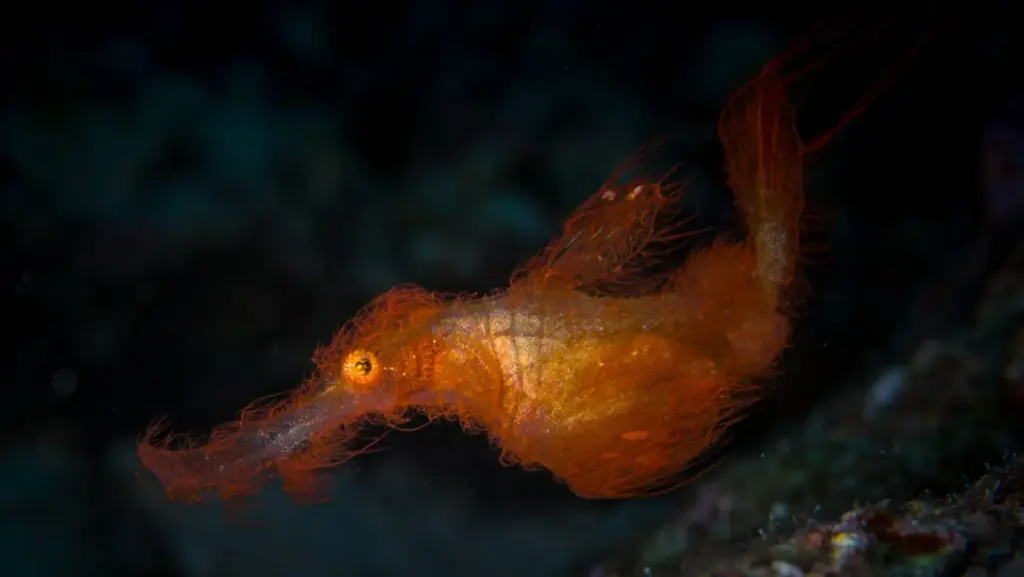
The covering of the new fish species is not fur in the way we usually understand it
Why this ghost pipefish turned out to be a predator
The biggest surprise awaited scientists when they examined the stomach contents of one of the specimens. Inside, they found a partially digested skeleton of an entire small fish. This became the first confirmed case of a ghost pipefish hunting another fish.
Until now, it was believed that all ghost pipefish species fed exclusively on small crustaceans, which they sucked in through their long tubular snout. The finding in the stomach of S. snuffleupagus overturns the long-held understanding of this group’s diet and suggests that at least one species is a full-fledged predator.
The size of the prey relative to a body length of 2–3 centimeters is impressive. As ichthyologist Graham Short put it, for such a cute little creature, this animal is surprisingly predatory.
The name of the new ghost pipefish species
When it came time to give the species an official name, the choice was obvious. The shaggy body texture and long sloping snout are a strikingly accurate match for Mr. Snuffleupagus — the hairy mammoth-like character from Sesame Street, Big Bird’s best friend.
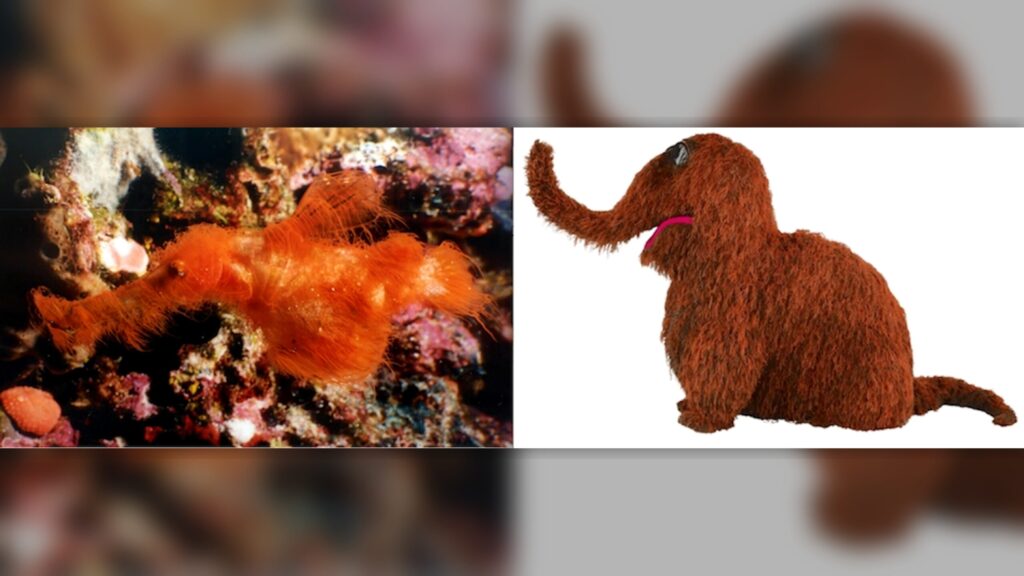
The hairy fish and the Sesame Street character
The scientists even wrote to Sesame Workshop, the nonprofit organization behind the legendary show, and received a response the very next day. The show’s creators fully supported the idea. Rosemarie Truglio, Senior Vice President of Global Education at Sesame Workshop, noted that the connection between science and imagination has always been part of the spirit of Sesame Street.
The species description was published on May 10, 2026, in the peer-reviewed Journal of Fish Biology. The work was carried out by Graham Short and David Harasti using morphological, molecular, and tomographic methods.
Studying little-known fish species
The story of Solenostomus snuffleupagus is a vivid example of how little we know about life on coral reefs. A creature that eluded scientists for 20 years turned out to be not just a new species, but the earliest branch of its genus — its evolutionary lineage split from other ghost pipefish about 18 million years ago.
The Great Barrier Reef and the waters of the southwestern Pacific are considered some of the most studied marine ecosystems in the world. Yet even here, species are discovered that have been hiding in plain sight for decades.
This discovery confirms that the ocean is still full of surprises for those who know how to look carefully. And one small “shaggy” predator also showed that even the most basic ideas about the biology of a well-known group of fish can turn out to be incomplete.