Xiaomi has announced the Xiaomi 18 Pro and Xiaomi 18 Pro Max at a launch event in China. The two phones share almost everything — a triple camera system with two 200-megapixel sensors, a rear secondary display, a new hardware-based Privacy Display, 100W wired and 50W wireless charging, IP68/IP69 protection, and HyperOS 4 — and differ mainly in screen size, chipset, battery capacity, and speaker count. Chinese pricing starts at 5,999 yuan for the 18 Pro and 6,999 yuan for the 18 Pro Max. Xiaomi has confirmed an international release in 2026, but has not yet named specific countries, dates, or which configurations will ship globally.
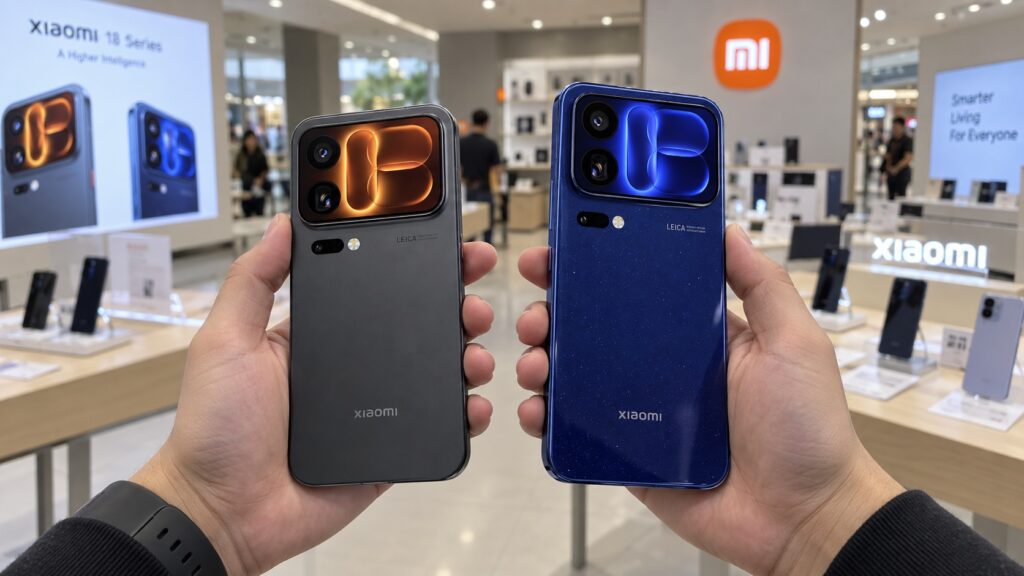
The Xiaomi 18 Pro and Xiaomi 18 Pro Max smartphones
What you need to know
- The 18 Pro has a 6.4-inch display, Snapdragon 8 Elite Gen 6 and a 7,000mAh battery; the 18 Pro Max has a 6.9-inch display, Snapdragon 8 Elite Extreme Gen 6, an 8,500mAh battery and three speakers instead of two.
- Both phones use the same cameras: a 200MP main sensor (1/1.28-inch, f/1.67, OIS), a 200MP periscope telephoto with 3.2x optical zoom (1/1.56-inch, f/2.4, OIS) and a 50MP ultrawide (f/2.2), with Leica optics.
- Xiaomi Smart Privacy Display is a hardware feature: at a 60-degree viewing angle, brightness drops to about 1% of normal when the mode is enabled, at the cost of some sharpness up close.
- China pricing starts at 5,999 yuan (18 Pro) and 6,999 yuan (18 Pro Max); a global launch is confirmed for 2026 with no further details yet.
Two chips, two sizes: how the models differ
The two phones are more alike than their names suggest. The substantive differences come down to:
- Xiaomi 18 Pro: 6.4-inch display, Snapdragon 8 Elite Gen 6, 7,000mAh battery;
- Xiaomi 18 Pro Max: 6.9-inch display, Snapdragon 8 Elite Extreme Gen 6, 8,500mAh battery, three speakers instead of two.
Everything else — the cameras, the rear display, Privacy Display, 100W wired plus 50W wireless charging, IP68/IP69 protection and HyperOS 4 — is identical. Choosing between them is essentially a choice between a compact phone with a slightly less powerful chip and a large flagship with the top-tier processor and a record-capacity battery.
On the processors: according to the source, the Snapdragon 8 Elite Gen 6 is about 10% faster than the previous generation, while the Extreme version is about 13% faster. Both are built on a 2nm process and are described as 37% more power-efficient than their predecessors. The performance gap between the two chips is described as minimal — unlikely to be noticeable in games or everyday tasks — though the Extreme variant in the Pro Max is said to deliver better graphics and expanded camera capabilities. These are launch-stage figures rather than independent benchmarks.
Cameras: 200MP twice over, with caveats
The camera system is the same on both models, which the source author considers a positive given how substantial the hardware is.
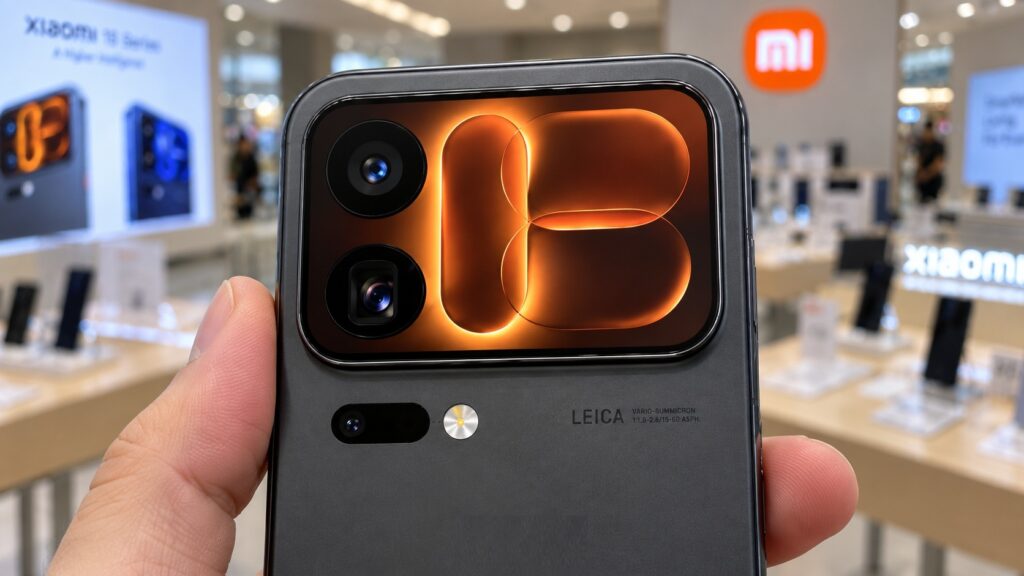
The Xiaomi 18 Pro camera module with its secondary display
Three modules make up the system:
- 200MP main camera: 1/1.28-inch sensor, f/1.67, optical image stabilization — a large sensor comparable to top-tier flagships;
- 200MP periscope telephoto: 1/1.56-inch sensor, f/2.4, OIS, 3.2x optical zoom;
- 50MP ultrawide: f/2.2.
Two 200MP sensors on one phone remains rare even among flagships, though the source notes that OPPO has gone further with three 200MP modules on its latest flagship. The optics are Leica-branded, with Xiaomi’s Light Hunter 960 image processing. The source author’s assessment is that the zoom is nothing extraordinary, but that for the price this is a complete, high-end triple camera setup.

The rear display is no longer an experiment
The small screen on the back panel around the camera module carries over from the Xiaomi 17 Pro and appears to be a permanent fixture. This time Xiaomi says more than 100 optimized apps have been written for it: mini-games, timers, reminders, recipe cards and notifications. It is controlled by voice and gestures.
The rear display also enables selfies with the main cameras — you see yourself on the back screen while shooting with the primary sensors. The idea is not new, but the source describes Xiaomi’s implementation as mature. The author admits doubt about using the rear screen heavily, but argues that the 100-plus dedicated apps show Xiaomi is investing seriously in the concept.
Privacy Display: a hardware approach to shoulder-surfing
Xiaomi Smart Privacy Display is the feature the source author found most interesting. It is not a software dimming trick but a property of the display construction itself: the OLED panel alternates ordinary pixels with pixels whose light output is restricted by microstructures on their sides. When the mode is enabled, the ordinary pixels switch off — and at a 60-degree viewing angle, brightness drops to about 1% of normal.
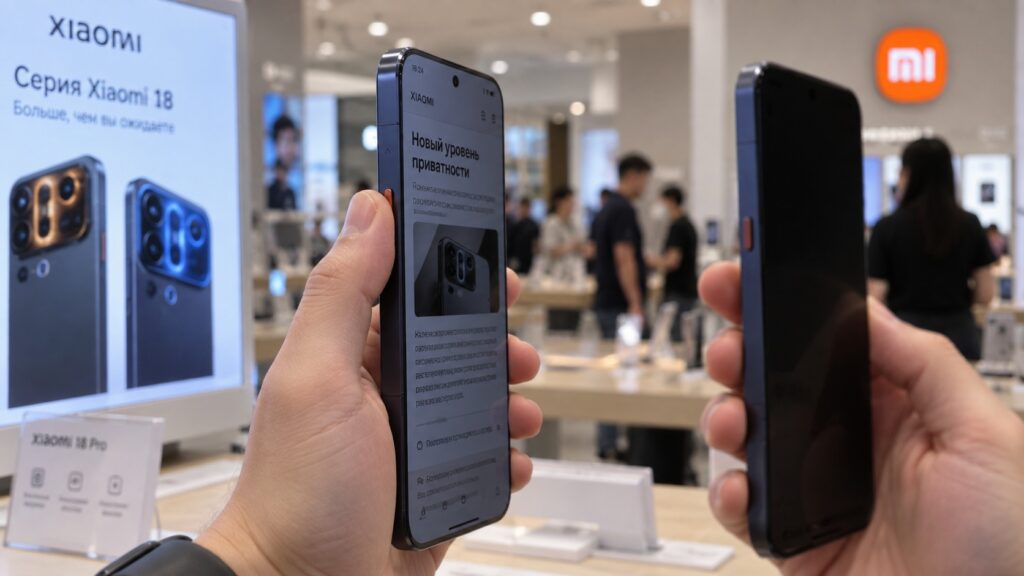
The phone with Privacy Display switched on and switched off
Practical uses described at launch:
- enabling it for specific apps only — for example, a messenger or a banking app;
- it also applies to that app’s notifications;
- the front camera can detect someone peering over your shoulder and warn you with a vibration.
Xiaomi is upfront about the trade-offs. With the mode enabled, there is a visible loss of sharpness when viewing the screen up close, because part of the pixel grid is switched off. And even with the mode disabled, off-axis brightness is slightly reduced because of the panel’s construction. The source frames this not as a defect but as an inherent consequence of the design.
Pricing and availability
Launch prices in China:
- Xiaomi 18 Pro — from 5,999 yuan;
- Xiaomi 18 Pro Max — from 6,999 yuan.
These are domestic Chinese prices and will not translate directly to other markets, where import costs and local pricing apply. Xiaomi has confirmed an international release in 2026, but the specific countries, timing and configurations of the global versions have not been announced.
Verdict from the source
The source author’s conclusion is that the Xiaomi 18 Pro and 18 Pro Max are Xiaomi’s strongest 2026 phones by overall specification — evolutionary and well executed rather than revolutionary. Compared with the Xiaomi 17 Pro, the new models bring a 2nm chip, a larger battery, Privacy Display and a more capable rear screen. On cameras, however, the author says they still trail the Xiaomi 17 Ultra. Against rivals in the same class, the author places them at the level of the iPhone 18 Pro and 18 Pro Max in terms of feature set — an opinion based on announced specifications, not on side-by-side testing.