
Scientists revealed the main secret: how exercise rejuvenates the entire body
We’re used to thinking of muscles as a mechanical drive: they contract — an arm lifts, legs run. But modern physiology has revealed a completely different picture. Muscles function as a full-fledged endocrine organ that sends hundreds of signaling molecules throughout the body with every contraction. These substances are connected to the functioning of the brain, heart, bones, immune and nervous systems. Essentially, movement is biologically necessary for the normal functioning of the body — just like breathing or eating. This is especially noticeable against the backdrop of sedentary work, which damages health more than many people realize.
How Muscles Become a Source of Beneficial Hormones
When a muscle contracts, it releases special molecules into the bloodstream — myokines. Their discovery in the early 2000s overturned our understanding of the physiology of movement and gave rise to the concept of “exercise as medicine.” Scientists are increasingly studying how exercise rejuvenates muscles and helps them maintain strength longer. But researchers from the University of San Jorge (Spain) go even further: they assert that a sedentary lifestyle should be viewed not merely as a bad habit, but as a source of disease.
The most studied myokine is interleukin-6 (IL-6). At rest, it is released in small amounts, but during intense aerobic exercise its level can spike 100-fold. Two other important myokines are irisin, which helps maintain fat tissue balance, and BDNF (brain-derived neurotrophic factor), responsible for neuroplasticity — the brain’s ability to reorganize its connections.
In addition to myokines, other organs also release signaling substances during physical activity — exerkines. A review published in 2022 in Nature Reviews Endocrinology showed that these molecules play an important role in cardiovascular, metabolic, immune, and nervous system health. If a person moves very little, there are almost no exerkines in their blood, and this increases the risk of disease and overall mortality.

Physical exercise is essential for our health.
How Exercise Strengthens Immunity and Reduces Inflammation
A fresh review from 2024 identified at least nine myokines that directly affect the immune system. Among them are irisin, decorin, and several interleukins (IL-6, IL-7, IL-15). During exercise, these substances enter the bloodstream and stimulate the proliferation and maturation of immune cells, enhancing immune surveillance.
But there is a second, equally important effect. Myokines reduce chronic systemic inflammation — a quiet process that destroys blood vessels and tissues over years and underlies many metabolic and cardiovascular diseases. That same IL-6 that spikes sharply during exercise acts as an anti-inflammatory signal: it regulates the activity of lymphocytes, macrophages (cells that “devour” pathogens), and NK cells — natural killers that destroy infected and tumor cells.
It sounds paradoxical: after all, IL-6 is also known as a pro-inflammatory molecule. But it’s all about context. In chronic diseases, it seeps into the blood constantly and in small amounts — thus fueling inflammation. But during exercise, it is released in a short, powerful burst, and this burst instead triggers an anti-inflammatory cascade.
How Physical Activity Improves Memory and Brain Function
Muscles communicate directly with the brain through the so-called “muscle-brain axis.” BDNF, irisin, and cathepsin B molecules released during exercise can stimulate the formation of new neurons. They are also associated with improved memory and learning, as well as protection against cognitive decline in neurodegenerative diseases. Even short bouts of activity can be beneficial — exercise improves brain function noticeably faster than commonly thought.
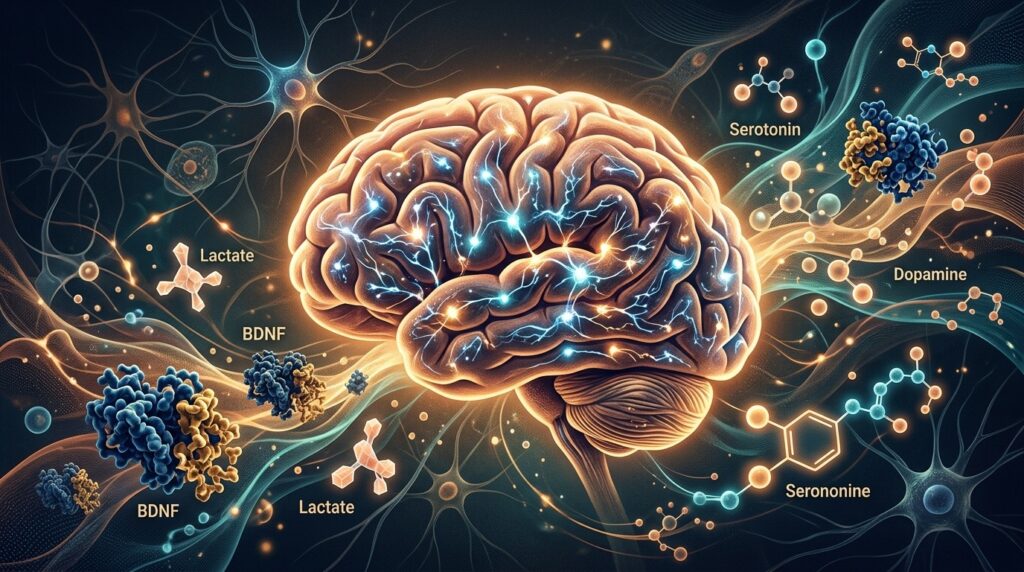
The brain “listens” to muscle signals and responds by strengthening neural connections
Irisin, for example, raises BDNF levels in the hippocampus — a brain region critically important for forming memories. Cathepsin B promotes neuron regeneration and improves cognitive functions. This is precisely why physically active people on average better maintain mental clarity with age and are less likely to suffer from anxiety and depression. Interestingly, research shows that one type of sport guarantees ideal sleep, and quality sleep is another powerful factor in brain protection.
The image researchers propose is very apt: the brain “listens” to what muscles “say” when they contract and responds by adapting and becoming stronger.
How Exercise Helps Burn Fat and Protects Against Diabetes
During physical activity, IL-6 plays a key role in mobilizing fatty acids from adipose tissue — primarily from visceral fat (the kind that accumulates around internal organs in the abdominal cavity and poses the greatest health risk). This triggers the fat-burning process and helps maintain normal blood glucose levels.
IL-6 also regulates insulin sensitivity, allowing muscles to absorb glucose more efficiently. This mechanism explains why regular exercise helps prevent type 2 diabetes — one of the most common metabolic diseases in the world.
Researchers call muscles a “metabolic thermostat.” This thermostat determines when the body needs to mobilize energy, when to store it, and when to expend it. And it only works correctly with regular physical activity. If a person sits all day, the thermostat essentially “breaks down.”
How Physical Activity Protects the Heart and Bones
Physical activity triggers the release of exerkines that dilate blood vessels, improve vascular wall function, and reduce arterial stiffness. This explains why active people are less likely to face hypertension, coronary heart disease, and heart failure. Of course, for those with existing heart conditions, an exercise program should be designed by a doctor — a cardiologist or physical therapist.
Muscles also work closely with the skeleton. Myokines stimulate osteoblasts — cells that build bone tissue — and help maintain bone mineral density at normal levels. Chemical signaling adds to the mechanical load on the skeleton, and together they play an important role in osteoporosis prevention.

Muscles have a positive comprehensive effect on the body.
A separate and perhaps most impressive topic is the connection between movement and tumor suppression. An article in The Lancet Oncology indicates that a sedentary lifestyle is a risk factor for more than 10 types of cancer. Myokines released during exercise inhibit the spread of cancer cells and reduce DNA damage in potentially malignant cells. Additionally, exercise mobilizes immune cells capable of recognizing and destroying tumor cells at early stages. Remarkably, even a single workout significantly raises the levels of myokines that suppress cancer cell growth, and even brief physical activity is associated with a reduced risk of certain cancers.
Why the Body Needs Movement Every Day
All the accumulated data leads to one conclusion: muscles are a full-fledged endocrine organ. Every contraction sends signals that regulate the body’s internal balance. Whether a person moves or not directly affects the functioning of the immune system, brain, metabolism, heart, bones — and even the body’s ability to resist tumors.
This is not a call to immediately run a marathon. But if you understand that physical activity is not just a way to lose weight or “get toned,” but a fundamental condition for the body’s normal functioning, your attitude toward an ordinary walk or morning stretching routine will change completely.