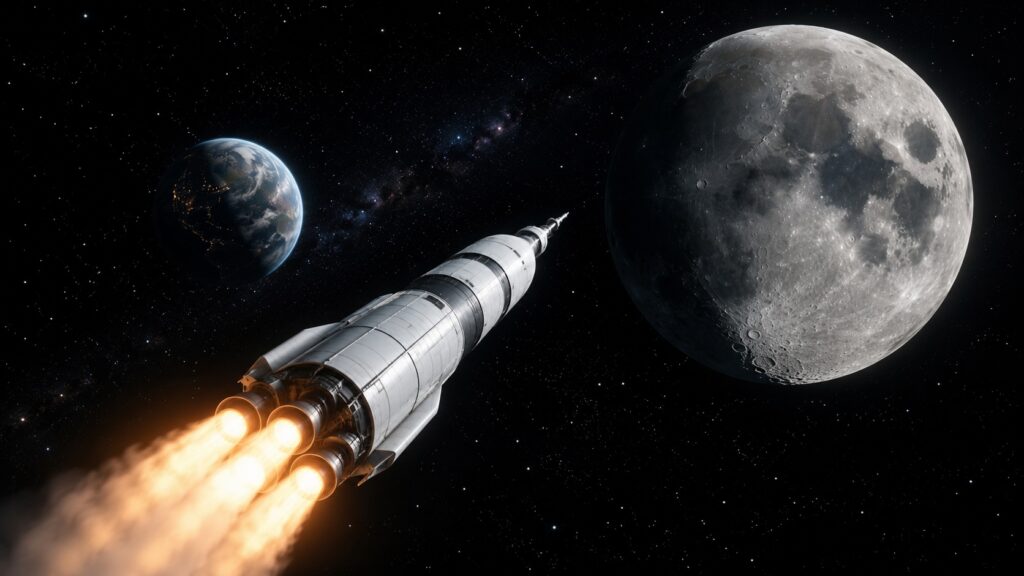
The next Moon flight will not only be complex but will also cost billions of dollars
NASA is preparing to return humans to the Moon in 2026, for the first time in half a century. But this time, the agency is not building the landing module itself — instead, it has entrusted this task to private companies. Two American corporations have received contracts to create spacecraft that will deliver astronauts from orbit to the surface. How will they share this mission, and how do their approaches differ? And yes, sending people to the Moon will cost billions of dollars.
How SpaceX and Blue Origin Are Building the Lunar Module
The lunar module is being developed by SpaceX and Blue Origin. Each partner has taken its own engineering path to meet NASA’s strict requirements for mission safety and efficiency.
SpaceX is developing a lunar version of its super-heavy Starship spacecraft. This approach relies on creating a massive space vehicle designed for deep space operations. The use of reusable launch vehicle technologies allows for enormous payload capacity, but requires complex preparatory stages, including refueling directly in Earth orbit.
In turn, Blue Origin is designing the Blue Moon module. Their concept is closer to the classic understanding of a landing craft: it is a specialized system created exclusively for lunar landing, astronaut support, and future research needs.
Since the Orion spacecraft flew to the Moon as part of the first test launch, it became clear that the success of subsequent stages would require perfect coordination of all commercial and government systems.
Why Test Flights of Lunar Modules Are Necessary
Before people step aboard the new modules, NASA requires extensive testing. During testing, researchers want to gain real-world experience and identify potential problems in the early stages.
The upcoming demonstration missions by SpaceX and Blue Origin will take place without human participants. Engineers will test the capabilities of the spacecraft, practice mission procedures, and work through the complex interplay between launch complexes, orbital stations, and surface operations systems.
As Steve Creech, manager of the Human Landing System program at Marshall Space Flight Center, notes, both companies have set aggressive goals for their uncrewed flights. This is necessary to collect as much data as possible, build confidence in the reliability of the launch vehicles, and refine prototypes before crewed missions begin. This was reported by the authors of the Daily Galaxy website.
Why Artemis III Will Be NASA’s Most Complex Mission
The path to a crew landing requires incredible synchronization. Unlike in past years, modern lunar missions depend on a broad network of technologies that must function as a single mechanism to accomplish one landing.
Jeremy Parsons, manager of the Artemis program, compared the upcoming mission to a carefully choreographed dance. The Artemis III mission will include several critically important stages:
- Sequential launches from multiple launch pads on Earth;
- Rendezvous and precision docking of spacecraft in orbit;
- Crew transfer from the main spacecraft to the lunar landing module;
- Descent to the lunar surface and conducting research;
- Liftoff from the Moon, re-docking, and return of astronauts to Earth.
This is precisely why uncrewed tests are critically important. They will show how the landing modules behave in space, allowing engineers to resolve all technical issues before astronauts’ lives are at stake.
It is said that the partnership between government and private business represents a very significant shift in space exploration. Competition and diversity of technological solutions create a solid foundation for future flights to Mars and beyond.