Scientists believe in aliens but not in UFOs, and there is no contradiction
Radio astronomers have no doubt that extraterrestrial life exists, and we’re talking not about bacteria but intelligent civilizations. At the same time, they categorically deny that aliens have ever visited Earth. Why are scientists so confident, and why have they been listening to space for half a century hoping for an answer?
Scientists Are Confident That Aliens Exist
When Emma Chapman, author of the book “The Echoing Universe: How Radio Astronomy Helps Us See the Invisible Cosmos,” is asked whether she believes in aliens, her answer is always the same:
Absolutely. I have not the slightest doubt.
Chapman is a radio astronomer and astrophysics lecturer at the University of Nottingham. In her new book, which has not yet been translated into Russian, she explains why this question has long been settled among her colleagues.
The argument is simple and based on statistics. In our Galaxy alone, the Milky Way, there are hundreds of billions of stars, and most of them have planets.
Discoveries of recent decades related to exoplanets have shown that worlds similar to Earth are found in space regularly. Even if habitable planets are rare and the origin of life on them is even rarer, the number of planets in the Universe is so enormous that the idea of Earth’s uniqueness looks far less convincing than the assumption that other civilizations exist.
The Search for Extraterrestrial Life and UFO Stories
The main confusion that prevents serious discussion about extraterrestrial life is the mixing of two completely different questions.
“Do aliens exist?” — is one question.
“Have they come to visit us?” — is an entirely different one.
There is not a single credible piece of evidence that aliens have ever come to Earth. They did not build the pyramids, flying saucers did not make crop circles, and no secret government conspiracies exist. Most UFO sightings turn out to be Venus shining above the horizon, optical illusions, or simply poor camera footage.
According to statistics, the number of UFO reports has not grown proportionally with the spread of smartphones. If alien ships were really flying over our heads, billions of cameras in people’s pockets would have long ago captured it.
It is precisely because of this mixing of scientific inquiry and conspiracy theories that many people are skeptical about the idea of extraterrestrial life. But professional astronomers clearly separate these topics.
What Is SETI and How Does It Work
SETI (Search for Extraterrestrial Intelligence) is a program for searching for extraterrestrial intelligence, primarily conducted by radio astronomers.
If a technologically advanced civilization exists somewhere in space, it most likely uses radio waves, just as we do. Radio signals from television, mobile communications, and radars inevitably leak into space. If aliens have similar technologies, their signals also spread in all directions.
SETI’s task is to intercept such a signal. Scientists point radio telescopes at star systems and look for unusual, clearly artificial radio signals, also known as technosignatures. It’s like tuning into the right radio station, except instead of music you’re trying to hear another civilization.
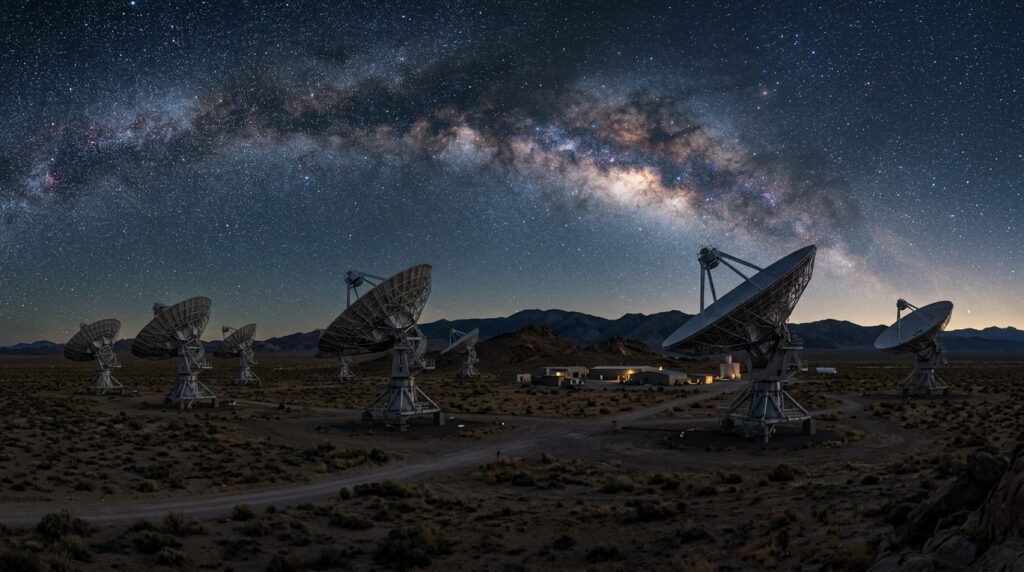
An array of radio telescopes scans the sky searching for signals
Why radio waves specifically? Because the laws of physics are the same across the entire Galaxy. No matter what another planet is like, radio waves remain the most efficient and cheapest way to transmit information over enormous distances.
The Arecibo Message: Humanity’s First Letter to Space
SETI is primarily about listening. Scientists listen to space and wait for signals. But in 1974, astronomer Frank Drake decided that waiting was not enough and sent a message himself for the first time.
Drake used the giant 305-meter antenna at the Arecibo Observatory in Puerto Rico. During a ceremony celebrating the telescope’s upgrade, he beamed a coded radio signal into space that lasted only three minutes but was 10 million times brighter than the Sun’s normal radio emission.
The message consisted of 1,679 binary digits — zeros and ones. The number was not chosen randomly: 1,679 is the product of two prime numbers, 23 and 73. Drake calculated that any intelligent recipient would figure out to arrange the sequence into a 23-by-73 rectangle. When this is done, an image emerges: a schematic depiction of a human, the structure of DNA, the Solar System, and the Arecibo radio telescope itself.

Visualization of the Arecibo message — a coded picture for aliens
The message was directed toward M13 — a dense globular cluster of hundreds of thousands of stars in the constellation Hercules. However, the choice of target was largely practical: the cluster simply happened to be above the antenna at the time of transmission. Moreover, by the time the signal reaches the intended coordinates, M13 may have shifted out of the narrow beam’s path.
By lunchtime after the transmission, the signal had already reached the orbit of Pluto. Now it has traveled more than 50 light-years from Earth.
Is It Dangerous to Send Radio Signals into Space
Drake sent the message without anyone’s permission, and it caused a storm. England’s Astronomer Royal, Sir Martin Ryle, wrote angry letters to the International Astronomical Union demanding a ban on such transmissions.
But Drake and most SETI researchers considered this debate pointless. Electromagnetic radiation has been leaking from Earth’s atmosphere ever since humans invented radio and television. We are already making our presence known in space, whether we want to or not.
And the real threat of invasion depends on two things: whether aliens can create interstellar transport and whether they would consider the journey worth the colossal energy expenditure.
Why a Response from Space Could Take Decades
Far more likely than any invasion is contact with aliens via radio signal. But even in that case, our conversation would be agonizingly slow.
Take, for example, the TRAPPIST-1 system, one of the most promising for the search for life. Seven rocky, Earth-sized planets orbit this star, and several of them are in the habitable zone where liquid water is theoretically possible. The distance to TRAPPIST-1 is about 40 light-years.
This means a message sent there today would reach its recipient in 40 years. And the reply would take another 40 years to return. In total, that’s 80 years for a single exchange of messages.
Most likely, after the initial shock, humanity would fairly quickly get used to the fact that aliens exist, since they have long been part of our culture through movies, books, and TV series.

Earth’s radio signals travel into space for dozens of light-years
What Will Happen If We Find Aliens
Imagine that 40 years ago someone on planet TRAPPIST-1e turned on a radio telescope and began sending signals to nearby stars. Then all it takes is pointing our antennas at the right spot in the sky at the right moment, and we would hear that message. This could happen in a hundred years. Or it could happen tomorrow.