
Doctors are shocked: even small doses of alcohol harm the brain — here’s what a new study shows
For a long time, it was believed that a glass of wine at dinner or a couple of beers a week was a safe amount of alcohol. However, a new study by scientists calls into question the very idea of a “safe dose” of alcohol for the brain. Even in people who drink moderately and have never abused alcohol, alarming changes in brain blood supply and cortical thickness were discovered.
How Alcohol Affects the Brain According to MRI Data
A group of researchers from the United States studied 45 healthy adults aged 22 to 70. None of the participants had been diagnosed with alcohol dependence, and none had gone on binges in the past year. These were ordinary people with ordinary habits, with consumption ranging from 1 to 54 drinks per month.
Participants were asked about how much they drank over the past year, over three years, and over their lifetime. The data was then compared with brain MRI scan results. For 27 of the 45 participants, perfusion — the intensity of blood flow in brain tissue — was also measured.
The result was clear: the more alcohol a person consumed on average per month, the lower the blood flow in their brain and the thinner the cortex — the outer layer of the brain responsible for thinking, memory, speech, and decision-making. All participants remained within what is traditionally considered “moderate” consumption — up to 60 drinks per month for men and up to 30 for women. One “drink” in this case is approximately a bottle of beer, a glass of wine, or a shot of hard liquor (14 grams of pure ethanol).
Why Alcohol Reduces Brain Blood Supply
To understand the seriousness of these findings, it’s worth understanding what brain perfusion is and why thick cortex matters.
The brain consumes about 20% of all oxygen in the body, despite weighing only 2% of total body mass. Blood flow is its supply system: blood delivers oxygen and nutrients while carrying away waste products. If perfusion decreases, neurons begin receiving fewer resources, creating conditions for tissue damage.
The cerebral cortex (cortex) is the outer layer of gray matter only a few millimeters thick. This is where most of the brain’s “higher” work takes place: analysis, planning, speech, and creativity. Cortical thinning is one of the markers of brain aging and neurodegenerative diseases. This is why it’s especially important that in people who quit drinking, the brain can recover.
An important detail: the link between alcohol consumption and reduced perfusion turned out to be stronger than the link with cortical thickness. This may mean that alcohol primarily strikes at blood supply, and through it — at the brain tissue itself.
How Age Amplifies Alcohol’s Harm to the Brain
One of the most alarming conclusions of the study was the discovered relationship between the amount consumed, age, and brain condition. Scientists found a correlation: the negative impact of alcohol on perfusion and cortical thickness increased with participants’ age.
This is logical when you consider how the cumulative effect works. Imagine that every day you slightly scratch a wooden table. One scratch is invisible. But over decades, the surface will become noticeably damaged. Researchers suggest that something similar may happen with the brain: years of even small alcohol exposure can gradually reduce blood flow and thin the cortex.
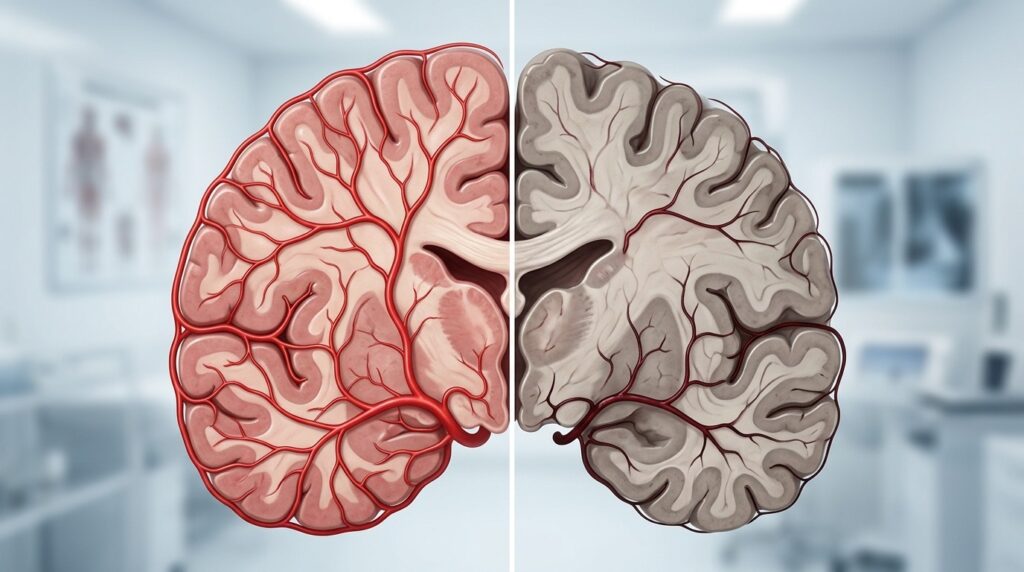
Schematic comparison of normal brain blood flow and reduced blood flow
Among the likely mechanisms, the study authors cite oxidative stress — cell damage by aggressive molecules (free radicals), the production of which alcohol stimulates. Over the years, the body’s ability to cope with such stress decreases, and the consequences accumulate.
Limitations of the Alcohol and Brain Study
Before putting down an unfinished glass, several important caveats should be considered.
- The study identified a correlation, not a cause-and-effect relationship. MRI was performed once — participants were not observed over time for years.
- Alcohol consumption data was obtained from self-reports. People often underreport how much they drink, so actual figures may have differed.
- The study did not account for factors such as diet, physical activity, and sleep quality, which also affect brain health.
- The sample size was small — only 45 people, and perfusion was measured in only 27.
All of this means that drawing categorical conclusions from a single study is premature. However, the work is valuable because it fits into a growing body of data pointing in the same direction.
Why There Is No Safe Dose of Alcohol
This study is far from the first to challenge the concept of a safe level of alcohol consumption. In recent years, a whole series of scientific papers has shown that every serving of alcohol increases the risk of cancer, and the link between moderate consumption and heart protection turned out to be much weaker than previously thought.
Notably, the updated dietary guidelines released in early 2026 for the first time do not specify a specific “safe” alcohol consumption level. Instead of the familiar “no more than two drinks a day for men,” the guidelines now sound simpler: “drink less for better health.”

More and more studies are forcing a reassessment of the ‘harmless’ glass of wine
The study authors themselves emphasize that additional research is needed — primarily long-term observations of large groups of people to “better understand the functional neurobiological consequences of ‘low-risk’ alcohol consumption in adults.”
Nevertheless, the overall trend is quite clear: science is increasingly confident that there is no amount of alcohol that can be called completely harmless for the brain. This is not a reason for panic, but a compelling argument to honestly reassess your habits — especially with age, when the brain becomes more vulnerable.