
The true meaning of the angel number 666
The number 666 is commonly considered a bad omen, but its real meaning in numerology has nothing to do with demons and misfortune. The concept of so-called “angel numbers” offers a completely different interpretation: 666 is a signal about the need to restore balance in life. Let’s explore where this idea came from, what’s behind it, and whether it’s worth assigning special meaning to numbers at all.
How Angel Numbers Came About and What They Mean
Angel numbers are repeating sequences of digits like 111, 333, 444, or 777, to which modern spiritual practice attributes symbolic meaning. The term itself appeared in the 1990s thanks to American author Doreen Virtue, who worked in the New Age genre. She proposed viewing such numerical coincidences as “messages” — hints worth paying attention to.
The idea, however, is not new. The connection between numbers and deeper meanings can be traced back to the cultures of Babylon and Ancient China, where, for example, people can still literally fear the number 4. Pythagoras — the ancient Greek philosopher and mathematician — considered numbers the foundation of the world order and attributed specific qualities to each of them. Modern numerology grew out of this very tradition, although it has been significantly transformed under the influence of pop culture and social media.
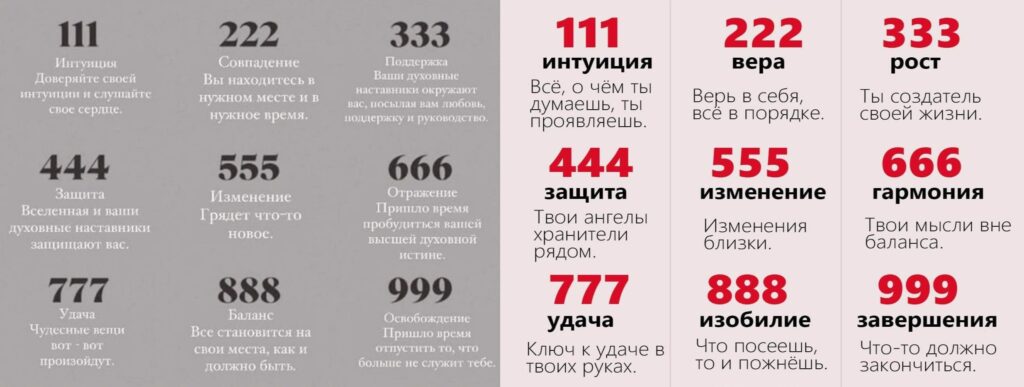
Angel numbers and one interpretation of their meaning. Image sources: ru.pinterest.com, uk.pinterest.com
Not everyone, of course, is inclined to look for hidden messages in numerical coincidences. Psychologists explain this phenomenon quite prosaically: our brain is wired so that after noticing the first coincidence, it begins to pick out repetitions from the general flow of information. This is called the frequency illusion effect, or the Baader-Meinhof phenomenon. You saw 666 once, paid attention — and now you notice this number everywhere, even though it appears no more frequently than others.
What the Number 6 Means in Numerology and Why It Matters
To understand why 666 is interpreted the way it is, you need to start with the single six. In numerology, the number 6 is associated with harmony, balance, and gradual improvement. It is sometimes called the “mother number” because it is associated with care, family, and responsibility for loved ones.
The key idea of the six is that consistency is more important than perfection. You don’t need to do everything perfectly right now; it’s enough to move in the right direction and maintain balance between different aspects of life.
When a digit is repeated three times, numerologists believe its meaning is amplified. The triple repetition of six is not tripled evil, but rather a tripled emphasis on those very themes: balance, priorities, caring for yourself and those around you.
Why the Number 666 Is Considered the Number of the Beast in the Bible
The reputation of the number 666 as something sinister originates from the Book of Revelation (Apocalypse) — the last book of the New Testament. There it is mentioned as the “number of the beast.” This association has become so deeply embedded in Western culture that for many people, 666 automatically means something dark and dangerous.

The Book of Revelation — the source of the dark reputation of the number 666
However, modern interpretations in numerology completely diverge from the biblical interpretation. For those who work with angel numbers, 666 is not a warning of trouble, but rather a reminder: it’s time to stop and reconsider what you’re spending your energy on. Two completely different traditions, two completely different readings of the same number.
It’s worth remembering that angel numbers are not science or religion in the strict sense, but rather a form of belief in the supernatural, which helps some people organize their thoughts while seeming unfounded to others. Both reactions are perfectly normal.
What the Number 666 Means in Numerology
If you strip away the mystical aura, the interpretation of 666 in numerology comes down to several specific themes:
- Reassessing priorities. The number appears (in the logic of numerology) when a person is too fixated on details, material things, or the pursuit of perfection — and loses sight of what’s truly important.
- Balance between work and personal life. 666 is often associated with career and relationships, but not in the sense of “expect success” — rather as a reminder: don’t sacrifice one for the other.
- Returning to self-care. If you’re constantly anxious, overworking, or going in circles in relationships, 666 is interpreted as a signal — it’s time to step back and look at the situation from a broader perspective.
Essentially, 666 in numerology is not a curse, but an invitation to pause. Stop chasing minor things, remember what truly matters, and allow yourself not to be perfect.

The main message of the number 666 — stop and restore inner balance
Why We Often See 666 and Other Repeating Numbers
It’s important to understand: the concept of angel numbers has no scientific backing. Numerology is not a branch of mathematics or psychology, but rather a cultural and spiritual practice. No peer-reviewed study has shown that specific numerical sequences carry objective “messages.”
However, from a psychological perspective, there is something curious here. The brain’s tendency to notice patterns (apophenia) is well studied. Apophenia is the tendency to see meaningful connections where none exist. We are evolutionarily programmed to look for patterns even where they don’t exist, because for our ancestors, a false alarm was safer than a missed threat (and this still works: a vivid example is the fear of the dark). This is precisely why repeating numbers seem “non-random” to us — the brain literally highlights them from the flow of information.
There is also a practical side. For some people, angel numbers work as a kind of trigger for reflection. You see 666 — and you think: am I really doing what’s important to me right now? In this sense, numbers become not a mystical signal, but a simple reason to stop and think. And if this helps someone organize their thoughts — the mechanism, in the grand scheme of things, doesn’t matter all that much. It works in roughly the same way as when we believe in superstitions and start noticing confirmations of our expectations.
The most reasonable attitude toward angel numbers is to see them as a cultural phenomenon that can be useful for self-reflection, but shouldn’t be taken as literal guidance for action. The number 666 is neither a curse nor a divine hint. But if encountering it makes you think about balance in your life, perhaps that is its true value — regardless of whether you believe in numerology or not.