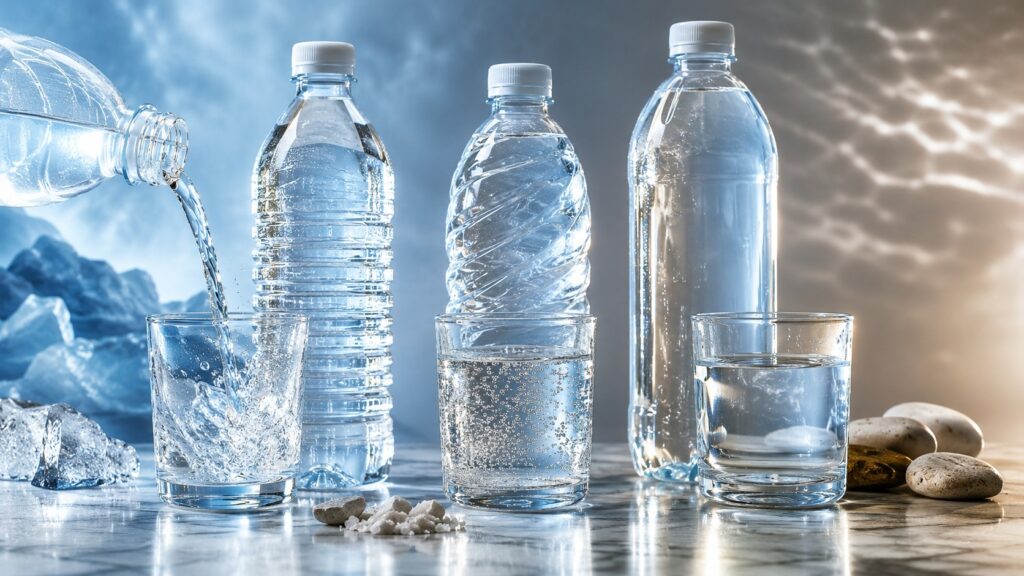
Bottled water has different tastes, and there are reasons for that
Water is seemingly the simplest wet substance — two hydrogen atoms and one oxygen atom. You’d think it wouldn’t matter which bottle you drink from. But if you’ve ever noticed that one water seems soft while another has a slight metallic or sour taste, you weren’t imagining it. There’s a perfectly concrete explanation for this, and it’s related not to marketing but to chemistry and geography.
What determines the taste of bottled water
Pure water truly has no taste — that’s true. But water from a bottle is never absolutely pure from a chemical standpoint. It always contains a small amount of dissolved minerals: calcium, magnesium, potassium, sodium, and other elements. These are precisely what create that barely perceptible aftertaste that distinguishes one brand from another.
Different manufacturers source water from different places: natural springs, wells, underground reservoirs, and so on. Each source passes through its own rocks and soil layers, meaning the set and concentration of minerals in the water will differ. Add different filtration technologies to that, and you get a product with a unique mineral composition.
Even if the mineral content seems negligible — just a few milligrams per liter — that can be enough for our tongue to detect the difference. Some waters taste slightly sour, others feel soft, and still others have a light metallic aftertaste.
What PPM and TDS mean on a water label
If you’ve ever examined the label on a water bottle, you may have noticed the mysterious abbreviations PPM and TDS. They sound complicated, but it’s actually quite simple.
TDS stands for Total Dissolved Solids — the total amount of dissolved substances. And PPM stands for parts per million, meaning parts per million. Essentially, it’s a unit of measurement: how many milligrams of minerals are contained in one liter of water.
For example, some water brands have a TDS of just 4 PPM — meaning each liter contains only 4 milligrams of mineral substances. That’s extremely low, and the water is nearly tasteless. Other brands may have TDS reaching hundreds of PPM, and such water will taste quite different.
The higher the TDS, the more noticeable the mineral taste. Water with low TDS feels clean, while water with high TDS can have a pronounced character: salty, bitter, or conversely, slightly sweet.
How the source affects water’s mineral composition
Each natural source is the result of water’s long journey through the depths of the earth. Rainwater seeps through soil, sand, clay, and rock formations, sometimes over the course of decades or even centuries. Along the way, it absorbs microelements from the rocks it passes through, like a sponge.
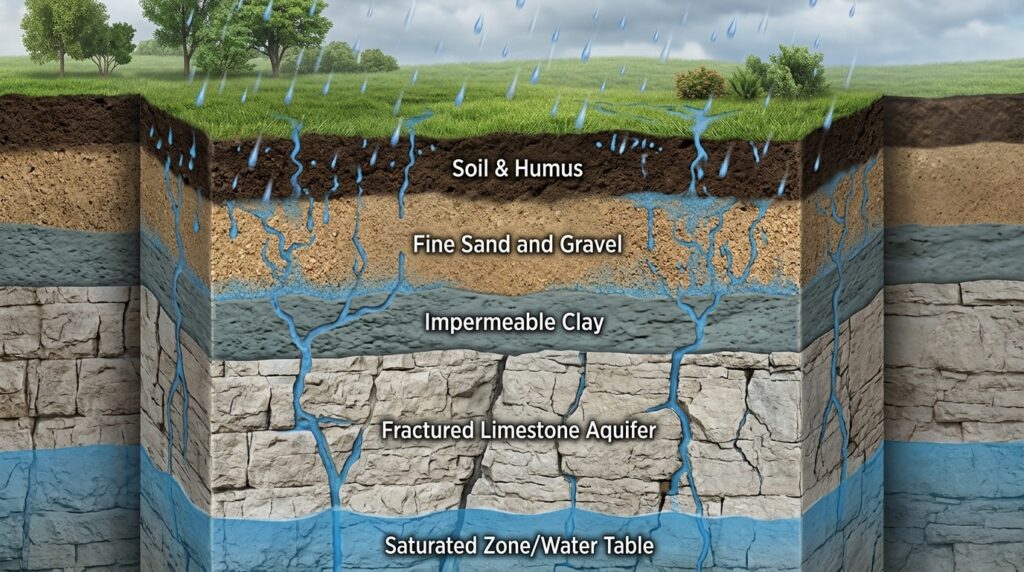
Water passes through layers of soil and rock, absorbing minerals
Here’s how it works in practice:
- Water that passes through limestone becomes enriched with calcium — hence its characteristic hardness;
- Water from granite formations contains more potassium;
- Sources in volcanic regions can produce water with elevated levels of silicon and magnesium;
- Water from deep wells is generally more mineralized than water from surface sources.
This is precisely why water from the Alps, the Caucasus, or from wells in Central Russia will differ in taste. Each region has its own composition.
Why is bottled water filtered
If minerals are a natural part of water, why remove them? The thing is, not all minerals and not in any amount make water tastier. Too high a concentration of calcium makes water hard and unpleasant, excess iron gives a rusty taste, and sodium in large quantities creates outright saltiness.
That’s why manufacturers use various purification methods, from standard carbon filters to reverse osmosis, which removes virtually everything. Some brands, after deep purification, add minerals back in precisely measured proportions to give the water its signature taste.
Others, on the contrary, try to preserve the natural mineral composition, removing only potentially harmful impurities. It is precisely the difference in filtration approaches that is one of the main reasons why two bottles of water from neighboring brands on the shelf can taste completely different.

A modern water bottling plant with a filtration system
Can you tell expensive water from cheap water by taste
The short answer is — sometimes yes, but far from always. The price of bottled water depends on many factors: logistics, branding, packaging, and marketing. Expensive water from a high-altitude Alpine source objectively has a different mineral profile than cheap water obtained through reverse osmosis from tap water. But whether you can tell them apart blindfolded is a matter of training.
There are even professional water tasters — water sommeliers. They can determine the source and composition of water by taste, much like wine sommeliers distinguish grape varieties and regions. For the average person, such precision is of course something out of reach, but most people will notice the difference between heavily mineralized and nearly empty water.
Here’s what you can tell about water by its taste:
- Soft taste — low mineralization, little calcium;
- Slight bitterness — elevated magnesium content;
- Metallic aftertaste — presence of iron or manganese;
- Salty undertone — high sodium;
- Sour aftertaste — low pH, increased water acidity.
So next time water from a new bottle seems somehow off to you, know that it’s all about the specific minerals dissolved in it. Water truly does taste different, and it’s not a marketing trick but simple chemistry and geology.