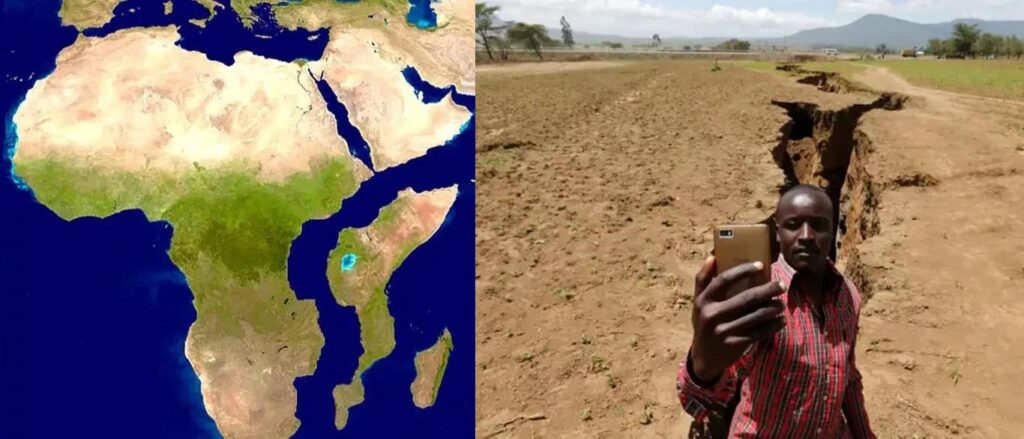
A sixth ocean is forming on Earth — a continent is splitting apart before our eyes
The African continent is slowly breaking in two, and a new ocean will eventually form at the site of the rift. This is not the plot of a disaster movie but a real geological process unfolding right now — just very slowly. For the first time, scientists can observe the birth of an ocean without descending to the ocean floor. So the question of how many oceans there are on Earth may once again become less obvious in the future.
The East African Rift — a crack thousands of kilometers long: where it is and how it formed
In 2005, a crack approximately 56 kilometers long, more than 15 meters deep, and up to 6 meters wide opened in the Ethiopian Afar Desert within a matter of days. According to geophysicist Cynthia Ebinger of Tulane University, this rupture was equivalent to several centuries of normal tectonic movement compressed into just a few days.
But this crack is just one manifestation of a far more massive process. The East African Rift System is a network of faults stretching from Ethiopia through Kenya, Tanzania, and further south, spanning more than 3,000 kilometers. Here, the Earth’s crust is literally pulling apart: the eastern part of Africa (the Somali Plate) is separating from the main part of the continent (the Nubian Plate).
The Afar region is one of the hottest places on the planet. Daytime temperatures here often reach 54 °C, and at night they only “drop” to 35 °C. Geophysicist Cynthia Ebinger once called this place “Dante’s inferno.” But for geologists, Afar is an invaluable natural laboratory.
How tectonic plates are diverging in East Africa
To understand what is happening, you need to imagine a point where the boundaries of three tectonic plates converge: the Nubian, Somali, and Arabian. This point is located precisely in the Afar region and is called a triple junction — one of the rarest places on Earth where three rifts — the Ethiopian, Red Sea, and Gulf of Aden rifts — meet together.
All three plates are moving away from each other. The Arabian Plate is moving away from Africa at a rate of about 2.5 cm per year. The Nubian and Somali Plates are diverging more slowly — from a few millimeters to one and a half centimeters per year. These numbers seem negligible, but over millions of years they will completely redraw the map — just as tectonic plate movement is already slowly shifting entire continents.
What makes the plates move? Beneath Afar lies a so-called mantle plume — a stream of superheated material rising from the depths of the Earth. It heats and thins the Earth’s crust from below, helping it crack and pull apart.
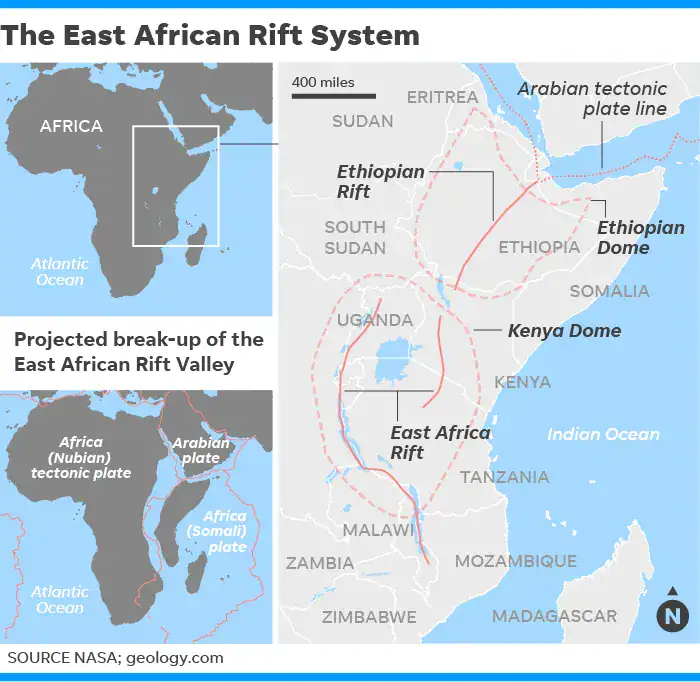
Diagram of the triple junction: three tectonic plates diverging, magma rising from below
A study published in Nature Geoscience revealed something unexpected: this mantle plume is neither uniform nor static. It pulsates — much like a geological “heartbeat” — and each pulsation carries its own chemical signature. These impulses affect all three rifts differently, depending on conditions in the lithosphere above them.
How oceanic crust is forming in the rift zone
The most astonishing thing about what is happening in Afar is not the rift itself, but what is appearing in its place. As the plates diverge, material rises from the depths of the Earth and forms new crust. And this crust already differs in composition and density from continental crust — it more closely resembles ocean floor.
Christopher Moore, a doctoral student at the University of Leeds who tracks the region’s volcanic activity using satellite radar, notes: this is the only place on Earth where you can study how a continental rift transforms into an oceanic one. Normally, such processes are hidden beneath kilometers of water — on the floors of existing oceans. But here, everything is happening right on the surface.
A study of the Turkana rift zone in Kenya and Ethiopia, published in April 2026, showed that the Earth’s crust in this area has thinned far more significantly than previously believed. Scientists describe a process of “necking” — when the crust stretches like taffy until it becomes so thin that it is on the verge of tearing apart. This is the first known active continental rift that has already reached this critical stage.
When a new ocean will appear in Africa according to scientists’ calculations
Scientists estimate that the complete flooding of the rift zone will occur in 5–10 million years. By that time, waters from the Red Sea and the Gulf of Aden will rush into the rift, forming a new ocean basin. The eastern part of Africa — present-day Somalia and parts of Kenya, Ethiopia, and Tanzania — will become a separate small continent.
A similar process once separated Africa and South America, creating the Atlantic Ocean. Geologist Christy Till of Arizona State University emphasizes that the East African Rift may be the earliest stage of the same scenario — it’s just happening extremely slowly.
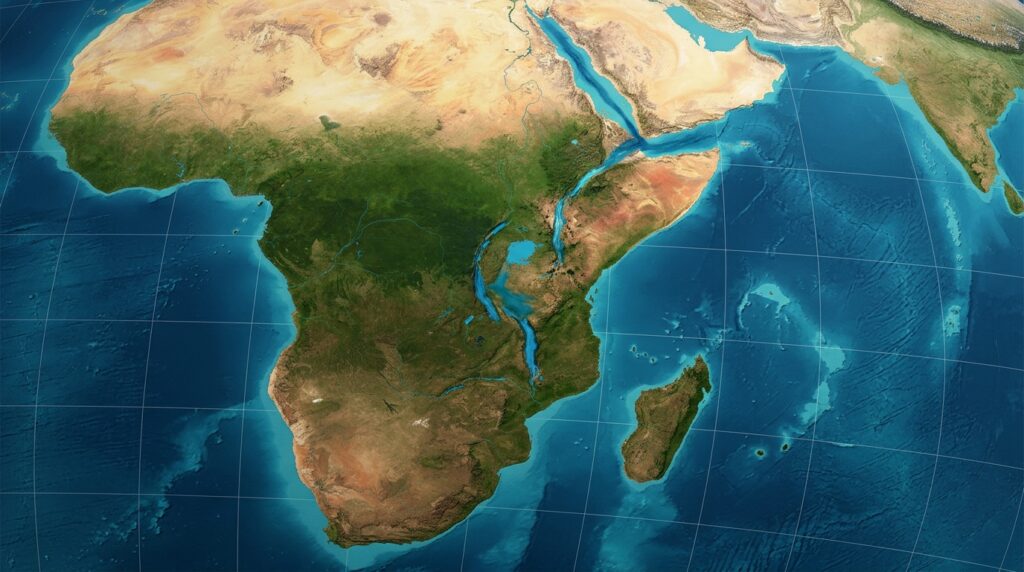
This is what Africa might look like in millions of years: the eastern part separated by a new ocean
It’s important to understand: the process is not guaranteed. Some continental rifts “stall” without ever becoming an ocean. A classic example is the Midcontinent Rift, which could have split North America in the Great Lakes region but stopped. However, in the case of East Africa, there are currently no signs of deceleration, and satellite measurement data show continued plate divergence.
How Africa’s splitting is already affecting climate and terrain
It might seem that an event millions of years away has no practical significance. But that’s not entirely true.
First, rifting is not a smooth process. Studies have shown that it can be accompanied by sudden, explosive events — when magma pressure builds up and at some point ruptures the crust. This means real seismic and volcanic risks for people living along the rift, especially considering how earthquakes occur in zones of active tectonics.
Second, Afar is a unique window into both the planet’s past and future simultaneously. The tectonic forces breaking the ground apart expose ancient layers of sedimentary rock up to 5 million years old. Some of the earliest remains of human ancestors were found right here. The rift is literally uncovering the history of our species.
Third, modern technologies — GPS, satellite radar, seismometers — allow tracking plate movement with an accuracy of just a few millimeters per year. As marine geophysicist Ken Macdonald of the University of California, Santa Barbara, notes, such precision was impossible just a few decades ago. Today, scientists can for the first time observe in detail how continental crust transforms into oceanic crust.
The East African Rift is a rare case where one of the most fundamental processes on the planet is occurring not somewhere on an inaccessible ocean floor, but on land, under open skies. We won’t see a new ocean in our lifetimes, but for the first time we can understand in real time exactly how one is born.