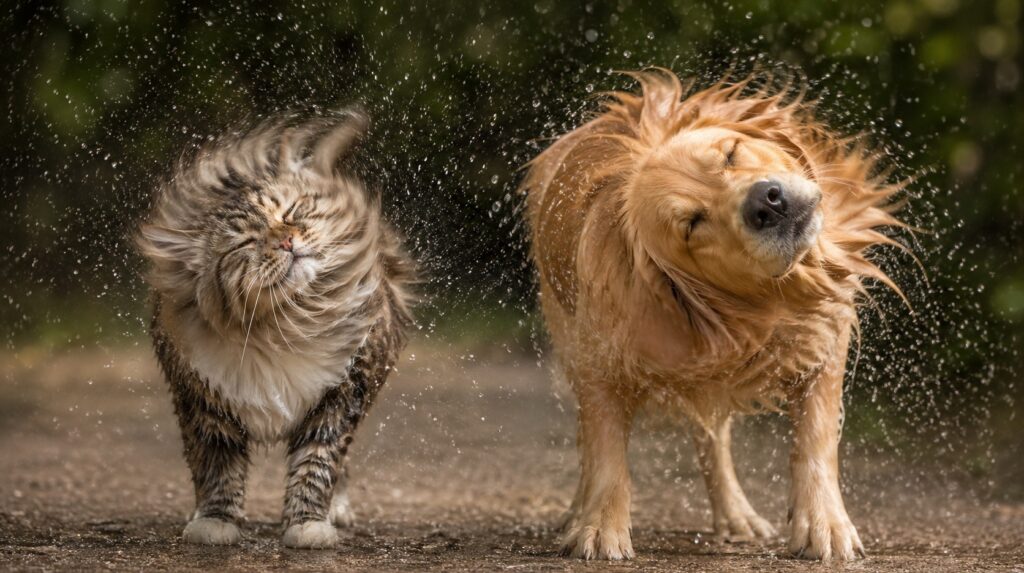
There is a scientific explanation for why cats and dogs often shake their heads
Cats sometimes shake their heads so abruptly, it’s as if they’ve been momentarily possessed. It’s one of the strangest habits of our beloved pets. Dogs do the same thing, and on top of that, they add their signature full-body shake that splatters bathroom walls. Scientists have been studying this reflex for a long time, and the explanation turned out to be far more interesting than simply “something got in the ear.”
The Head-Shaking Reflex in Mammals
Rapid side-to-side head shaking isn’t a quirk of any particular pet — it’s a reflex shared by many mammals. It has been observed in cats, dogs, mice, rats, and even lions. According to zoologist Katherine Crowley, this reflex is triggered when something irritates the ear area or gets inside the ear canal: an insect, a blade of grass, a drop of water, or dust.
The mechanics are simple: a rapid rotational movement of the head creates centrifugal force that ejects the foreign object outward. It’s essentially a built-in self-cleaning system. Different species and breeds operate at different frequencies, and there are reasons for that.
Why Dogs with Erect Ears Shake Their Heads More Often
If you have a German Shepherd, you’ve probably noticed how often it shakes its head after a walk. A Cavalier King Charles Spaniel, on the other hand, does this noticeably less often. The difference lies in ear shape.
Breeds with vertically erect ears are more vulnerable to small objects like grass seeds, gnats, and grains of sand entering directly into the open ear canal. Floppy ears act as a natural barrier: they cover the entrance and reduce the chance of something flying inside. That’s why “prick-eared” dogs shake their heads more often — they simply need to more.
By the way, animals typically don’t experience dizziness from this head shaking. As animal behavior specialist Mili explains, the vestibular system of mammals (including humans) responds much more strongly to full-body circular rotation than to rapid side-to-side head turns.
How Dogs Shake Off Water
Dog owners know this move: after a bath, the dog starts shaking, and a wave passes from head through the entire body to the tip of the tail. It’s a full-body shake that starts at the head and rolls down to the tail in a fraction of a second. The efficiency is impressive: a dog can shake off a significant amount of water from its fur in just a couple of these cycles.
But water isn’t the only trigger. One study showed that a full-body shake can signal a transition between emotional states. For example, after a tense or very active play session with another dog, both dogs often stop, shake off, and then switch to something else.
According to Mili, this kind of “shaking off” helps the animal release tension and reset — both physically and emotionally. Crowley adds that this often happens after an intense play session: both dogs finish playing, both shake off, and then calmly go about their business.
Predatory Head Shaking in Cats and Dogs
There’s another type of shaking that’s easy to recognize: a dog grabs a toy and violently shakes its head from side to side, as if trying to “kill” its prey. This is known as predatory shaking — an echo of hunting behavior.
In the wild, predators use this technique to break the neck of small prey. In domestic dogs, it has been preserved as a play pattern — the dog isn’t hunting, but the reflex still works. If your Labrador enthusiastically “dispatches” a plush duck, it’s simply following an ancient behavioral program hardwired into its nervous system.
When Head Shaking Is a Reason to Visit the Vet
In most cases, head shaking is perfectly normal behavior. But there are situations when it indicates a problem. You should be concerned if your pet:
- shakes its head noticeably more often than usual;
- does it in atypical situations, without an apparent irritant;
- simultaneously scratches its ear or tilts its head to one side;
- appears restless or reacts painfully when its ears are touched.
Frequent and compulsive head shaking can indicate an infection, parasites, skin irritation in the ear canal, a lodged foreign object, or even a neurological problem. In such cases, it’s best not to wait and have the animal examined by a veterinarian.
And blowing into a cat’s or dog’s ear “for fun” is a bad idea. Animals do react to this with a sharp shake, but not because they find it amusing: it’s a reflexive response to an irritant, and it’s unpleasant for the pet.
So next time your cat suddenly shakes its head with a possessed look, know this: most likely, it’s just cleaning its ears. And if your dog shakes off after a boisterous game in the park, it’s not wet — it’s simply switching modes from “fun” to “calm.” Evolution has built remarkably sophisticated mechanisms into our pets — from self-cleaning to emotional self-regulation.