I never liked washing windows. When you live on the first floor, it’s just a boring chore, but on the ninth floor it turns into an acrobatics exercise: you can’t reach half the window panel, the other half is only visible from the outside, and every time you have to choose between streaks and risk. So I’ve been eyeing robot window cleaners for quite a while and finally got my hands on the HUTT DDC55PRO. This is the kind of case where a device does exactly one task, but does it so well that you never want to go back to a rag.
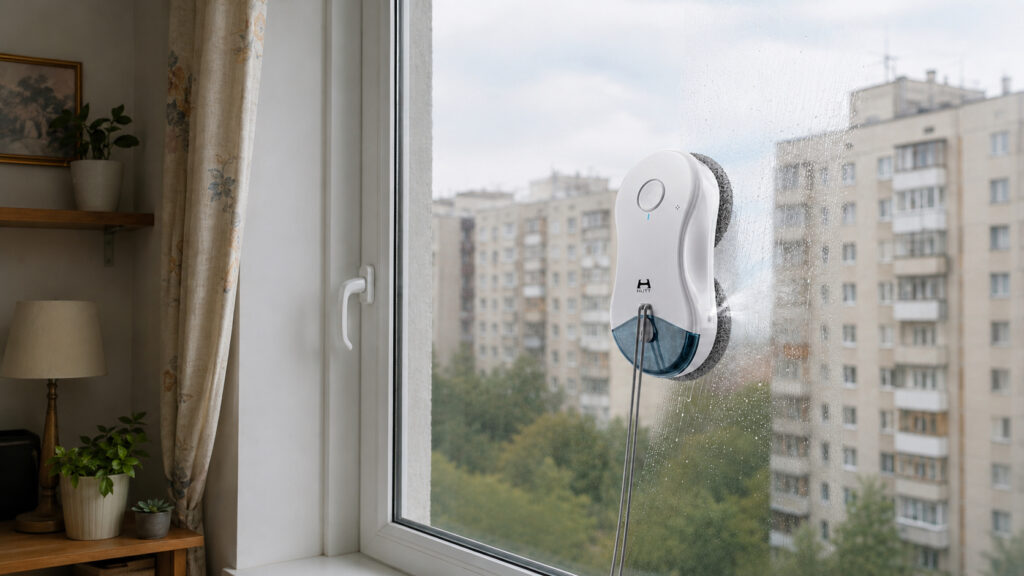
The robot will perfectly clean windows on any floor
How a Window Cleaning Robot with Water Spraying Works
On the outside, the device looks like a small box. You press it against the glass, turn it on, and the robot suctions onto the surface and holds itself in place. Then it starts moving along its trajectory, wiping the glass with cloths attached to the bottom. No buckets, stepladders, or wet elbows.
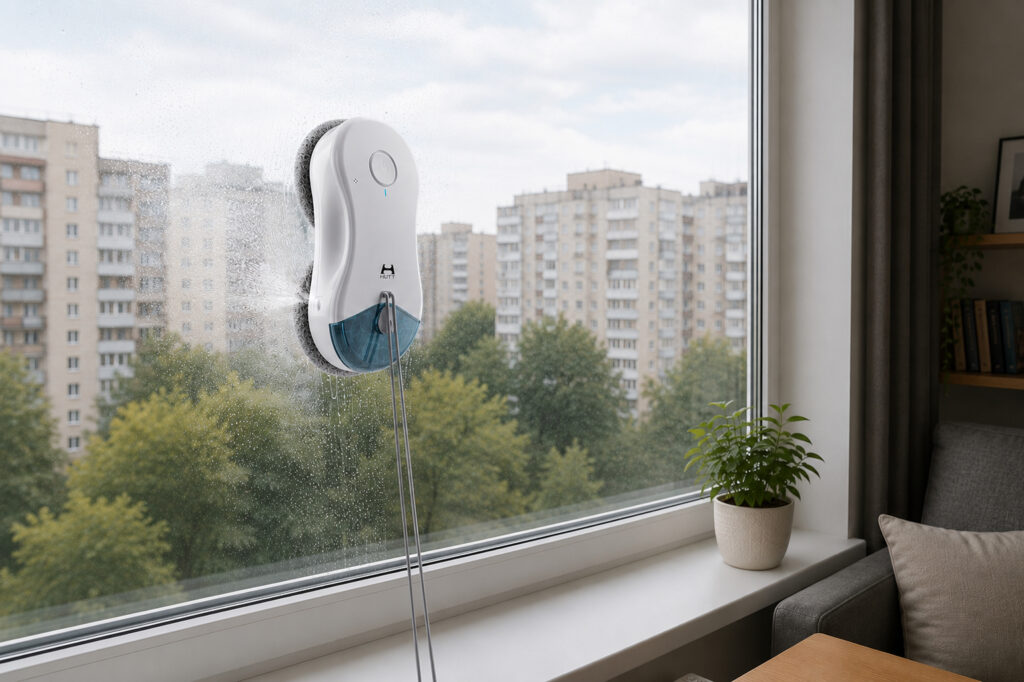
The robot can spray water, meaning you won’t need to intervene in the cleaning process
The main difference between the DDC55PRO and the simplest models is that it doesn’t just drag a cloth across dry glass. Inside there’s a reservoir and nozzles, so automatic water spraying happens right during cleaning. The liquid softens the dirt, and the cloth immediately picks it up. Thanks to this, dust, streaks, and rain marks disappear on the first pass, not after the third lap.
In my experience, the difference between dry and wet glass cleaning is enormous. A dry cloth just smears dust in a thin layer, and you can see it in sunlight. Here, the glass comes out truly transparent, without a cloudy film.
Suction Power of the Window Cleaning Robot and Cleaning Quality
The number in the specs looks abstract, but in practice everything depends on it. Powerful intelligent suction up to 6,500 Pa determines whether the robot will stay on a vertical surface or not. The stronger the press, the tighter the cloth contacts the glass and the better it scrubs off dirt.
What’s interesting here is something else: the suction isn’t constant. The robot automatically adjusts suction power depending on how dirty the area it encounters is. On clean glass it conserves resources and runs quieter, while on dried-on spots it presses tighter and goes over the area with more force. The user doesn’t need to configure anything — everything happens automatically.
For comparison: a regular handheld vacuum cleaner for the home outputs roughly the same values, except there the suction is needed for debris, while here it’s needed to hold the device’s weight on a vertical surface. That’s exactly why cheap models with ratings of 2,500–3,000 Pa often fall off the glass halfway through a window.
How the Robot Cleaner Handles Frameless Windows
The first window cleaning robots moved chaotically: bumped into a corner, turned around, went back. As a result, part of the glass remained untouched, and you stood nearby watching to make sure the device went where it needed to. The DDC55PRO works differently. It builds an optimal route on its own, covers the surface in strips, and doesn’t leave missed areas.

The robot is perfectly suited even for narrow glass panels
It’s worth separately noting the edge detection for frameless windows. This was a real headache for older models: there’s no frame, the sensor doesn’t understand where the glass ends, and the robot simply drives past the edge. Here, the sensors track the edge and stop movement in time. Panoramic windows and glass partitions can now be cleaned without stress.
Time-wise, one standard window takes just a few minutes, and during that entire time you can go about your business. I usually place the robot on a window panel, go have coffee, and come back to a finished result. The feeling is almost like having a robot vacuum, only vertical.
Will the Window Cleaning Robot Fall If the Power Goes Out
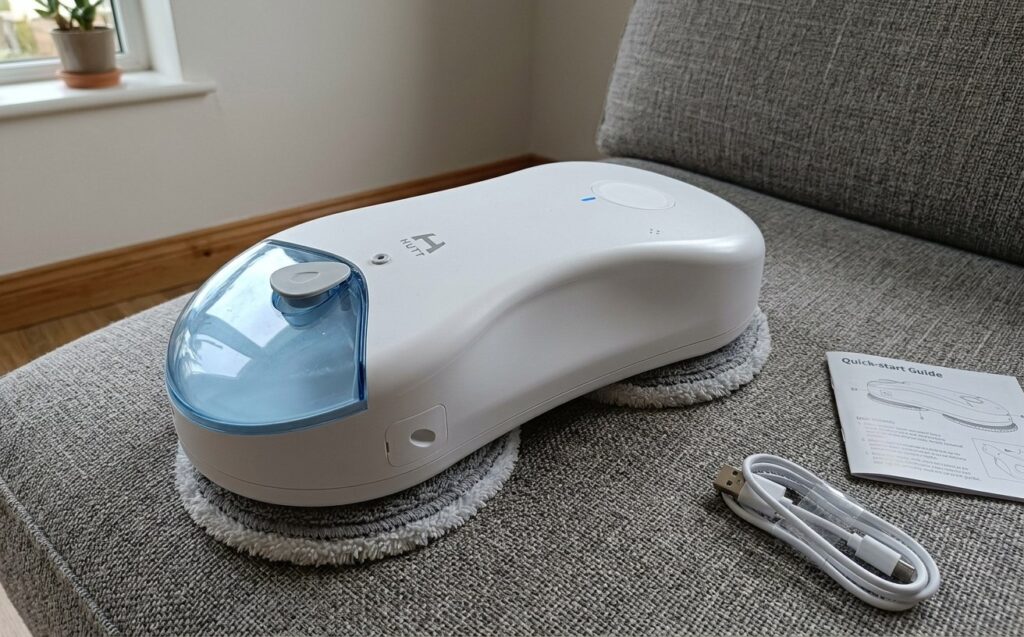
And don’t forget that a safety rope is included, so nobody’s falling anywhere
This is the first question anyone asks when they see a robot on the glass of a ninth-floor window. The manufacturer has a well-thought-out answer. First, the kit includes a safety rope that attaches to the device and is secured inside the room. Even if the worst happens, the robot will hang on the rope rather than fly down.
Second, there’s a built-in battery for power outages. When power is lost, the device doesn’t fall: the battery keeps it on the glass for up to 30 minutes. In half an hour, you’ll definitely have time to come over and remove the robot manually. This isn’t a marketing gimmick but a basic safety requirement for any gadget that operates at height.
I’ll also say a word about common sense. The rope should always be secured, even when you’re cleaning a window on the first floor and it seems unnecessary. The habit forms after a couple of uses, and the cost of a mistake is too high. My wife, by the way, was skeptical about the device right up until the moment she saw the result on the balcony door.
Robot Cleaner for Mirrors, Tiles, and Glass Doors

The manufacturer claims the robot can handle even complex surfaces