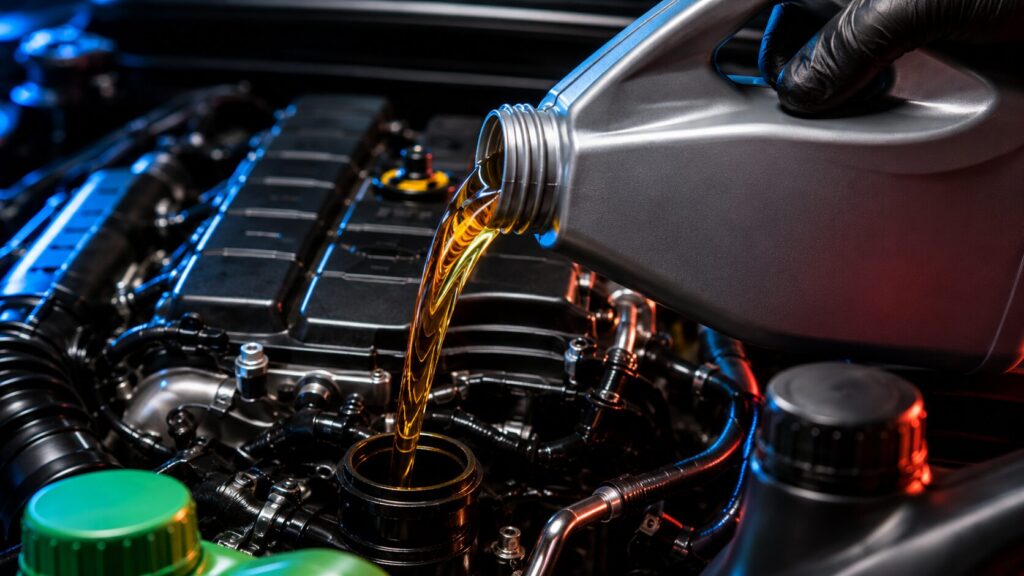
Which motor oil to buy so your car doesn’t break down? This question concerns every car owner.
Roskachestvo (Russian Quality) has completed a large-scale test of 5W-30 motor oils — one of the most popular grades on the Russian market. Out of 20 tested brands, only two fully passed all tests. The remaining 85% of samples showed deviations that could shorten your engine’s life. Let’s break down what exactly the experts found and how to choose an oil that will truly protect your engine.
What Roskachestvo Tested and Why It Matters
Motor oil is one of the most popular categories for consumer inquiries to Roskachestvo. At the initiative of the Ministry of Industry and Trade, the organization purchased 20 brands of 5W-30 oil (both domestic and foreign) and tested each one across 112 parameters. These included safety, physicochemical properties, and labeling accuracy.
Why specifically 5W-30? It’s a universal oil suitable for most modern gasoline and diesel engines. It performs well in both cold and hot conditions, which is why it’s the most commonly used grade.
An important point: mandatory requirements in Russia (under technical regulation TR CU 030) primarily concern safety — fire hazard, toxicity, and harmful impurity content. However, oil quality and service life are barely regulated by mandatory standards. That’s precisely why Roskachestvo introduced its own advanced standard that tests what matters for real-world use.
Rapid Additive Degradation — The Main Problem with Motor Oils
The most widespread deficiency turned out to be unexpected for many: 17 out of 20 oils lose their total base number (TBN) too quickly after artificial oxidation. What does this mean?
The total base number is the oil’s reserve of “anti-acid protection.” Inside a running engine, acids are constantly forming from fuel combustion and from the aging of the oil itself. Alkaline additives neutralize these acids, preventing them from corroding metal. When this reserve is depleted, the oil stops protecting the engine — carbon deposits, varnish, and sticky residues begin to form, and the oil filter starts working under increased strain.

Laboratory testing of motor oil samples
According to Roskachestvo’s standard, after simulating prolonged use, the total base number should not drop by more than 50%. But in the vast majority of oils, it dropped further. This means that in real life, such oils may lose their detergent properties before the scheduled oil change interval.
The reason, according to the study, lies in additive packages. In 2022, Western additive suppliers left the Russian market, and manufacturers quickly switched to Chinese alternatives. Some of these packages contain so-called “rapidly degrading components” — additives that are consumed too quickly.
Which Motor Oils Passed the Roskachestvo Test and Which Did Not
The study results can be divided into three groups (Roskachestvo ratings in parentheses):
1. Meet all requirements (both mandatory and advanced) — only 2 brands:
- Elf (5.00),
- NGN (5.00).
2. Meet mandatory requirements but fell short of advanced standards — 16 brands:
- Shell Helix (4.25),
- G-Energy (4.04),
- Gazpromneft (4.04),
- Liqui Moly (4.04),
- Rosneft (4.04),
- Zic (4.04),
- Lukoil (3.80),
- Taif (3.80),
- Kixx (3.74),
- Rolf (3.74),
- Sintec (3.74),
- Taneco (3.74),
- Kazhdiy Den (3.74),
- Teboil (3.54),
- VMPAvto (3.50),
- Takayama (3.24).
3. Do not meet mandatory requirements — 2 brands:
- Total Energies (3.24) — no information in Russian,
- Motul (2.90) — excessive water content.
It’s important to understand: being in the middle group doesn’t mean the oil is dangerous. These 16 brands met mandatory safety requirements. But in terms of resource characteristics — aging resistance, API classification accuracy, water content — they didn’t reach the higher bar.
It’s worth noting separately: 8 brands failed to confirm their declared API classification level. This means the label on the canister promises one thing, while the oil’s actual properties are different. For car owners, this creates the risk of using oil that doesn’t suit their engine. These brands are:
- Kixx (3.74),
- Rolf (3.74),
- Sintec (3.74),
- Taneco (3.74),
- Kazhdiy Den (3.74),
- VMPAvto (3.50),
- Takayama (3.24),
- Total Energies (3.24).
What Else to Look for When Choosing Motor Oil
Beyond the total base number, the study revealed other weak points:
- Water content. Water in oil causes corrosion of parts, accelerates oxidation, and forms emulsion. Motul oil failed even the mandatory requirements. Three more brands (Shell Helix, Takayama, Teboil) exceeded the advanced standard for water content.
- Cold start. One brand (Total Energies) showed viscosity readings at low temperatures that didn’t meet the advanced requirements. This can cause problems starting the engine in freezing weather — the starter simply won’t be able to turn over the thickened oil.
- Pour point. Shell Helix didn’t meet the advanced requirements for this parameter. For 5W-30 oil, the standard pour point should be no higher than minus 35 °C.
On a positive note, all 20 brands tested within normal range for viscosity index — a measure of oil stability across temperature fluctuations. This is good news: the baseline properties of oils on the market generally meet expectations.
How to Avoid Buying a Counterfeit: “Chestniy Znak” and Other Verification Methods
Since April 1, 2026, Russia has implemented per-unit tracking of motor oils through the “Chestniy Znak” (Honest Mark) system. This means the journey of every canister — from production to the cash register — is now tracked. You can scan the Data Matrix code on the packaging through the app and find out where, by whom, and when the oil was produced.

Checking motor oil through the “Chestniy Znak” app
This is a serious step in fighting counterfeits, which are plentiful on the market. However, the marking confirms authenticity, not quality. Lab test results aren’t printed on the label — only identification data. So for actual quality guidance, you should rely on independent studies like this one.
Incidentally, the Ozon marketplace has already hidden product listings for oils found to violate mandatory requirements. Work with other manufacturers continues.
How to Choose Motor Oil Without Damaging Your Engine
Here’s what experts recommend and what the study results suggest:
- Check the specifications on the packaging. Make sure it lists current API and ACEA classes that match your car manufacturer’s recommendations. Remember: 8 out of 20 brands failed to confirm their declared API level.
- Prefer oils that list a normative document — GOST, STO, or TU on the label. Out of 20 oils tested, only 10 had a production standard listed.
- Look at the production date. The fresher the oil, the better — additives can degrade over time even in a sealed canister.
- Buy from official distributors. Brand stores, authorized retail points, and major chains — there’s less chance of encountering a counterfeit. Scan the “Chestniy Znak” code when purchasing.
- Check the packaging integrity. Any signs of tampering, blurry printing, or missing security features are reasons to refuse the purchase.
- If you drive in city traffic — change oil more frequently. Traffic jams and frequent acceleration speed up oil degradation. In such conditions, the engine operates at maximum load up to 50% of the time, and additives are consumed faster, so believing in a single oil change interval for all cars is not advisable.
And one more non-obvious tip: don’t choose oil solely by price or brand recognition. As the study showed, expensive doesn’t always mean better, and popular doesn’t mean tested.
There are currently no mandatory requirements for motor oil quality (as opposed to just safety) in Russia. There is also no unified methodology for determining service life properties. The Roskachestvo study is currently one of the few independent benchmarks available. The two brands that passed all tests — Elf and NGN — currently appear to be the most reliable choice for those who want maximum confidence. But most importantly — keep track of your oil change intervals.