Scientists discovered a revolutionary way to weigh planets — the results will amaze you
Despite the fact that no cosmic scales exist, Earth’s scientists have long learned to determine the weight of planets in space. For this, the law of universal gravitation was used, which allowed measuring gravitational attraction between bodies and the motion of satellites. However, researchers from the University of Warwick, MIT, and McMaster University have found a fundamentally new method that works even when the planet itself is too dim or too deeply hidden in a cloud. That is, we don’t see the planet, but we can tell how much it weighs.
What Are Protoplanetary Disks
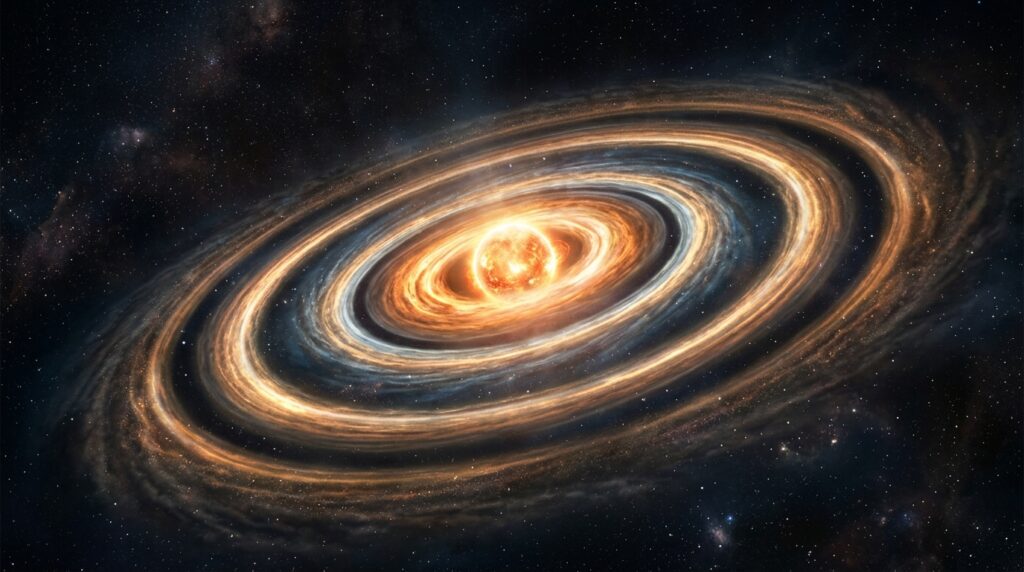
When a new star is born, it is surrounded by a protoplanetary disk. This is a gigantic cloud of dust and gas slowly rotating around the star. Such disks were first photographed back in the 1990s, but the images were blurry at that time and showed almost nothing.
With the development of telescopes, the picture became clearer — and it turned out that these were not uniform dust vortices at all. These are structured formations of concentric rings separated by empty gaps. Something like a dartboard target or tree rings, only on a cosmic scale.
It is precisely in such disks that planets form. As the planetary embryo grows, its gravity clears the space around it, sweeping dust and gas into distinct bands. Thus, a single growing planet literally “slices” the disk into rings and gaps.
How Much Does a Planet Weigh — How to Find Out
Most previous studies focused on the gaps — the empty spaces between rings. However, a new study published in The Astrophysical Journal shifted attention to the bright rings themselves.
These bright rings are not just beautiful structures; they are essentially planetary fingerprints, — explains the lead author of the study, Amena Faruqi, a graduate student in the astronomy and astrophysics group at the University of Warwick.
According to her, by learning to “read between the rings,” the team found a way to determine the masses of planets, even if they are invisible directly.
This fundamentally changes the approach. Previously, planets around distant stars were most often detected indirectly — by faint fluctuations in light. Now, the very structure of dust rings can reveal the mass of a hidden planet.
How the Brightest Point of a Ring Reveals a Planet’s Mass
To understand which specific ring features depend on the planet’s mass, the researchers built two-dimensional hydrodynamic simulations — computer models of gas and dust behavior. They tested three parameters of each ring:
- the width of the ring
- the amount of dust captured in it
- the position of the brightest point of the ring
Of these three characteristics, the most reliable turned out to be the position of the brightest point of the ring. As the planet’s mass increases, this point shifts in a predictable manner — the heavier the planet, the more noticeable the shift.
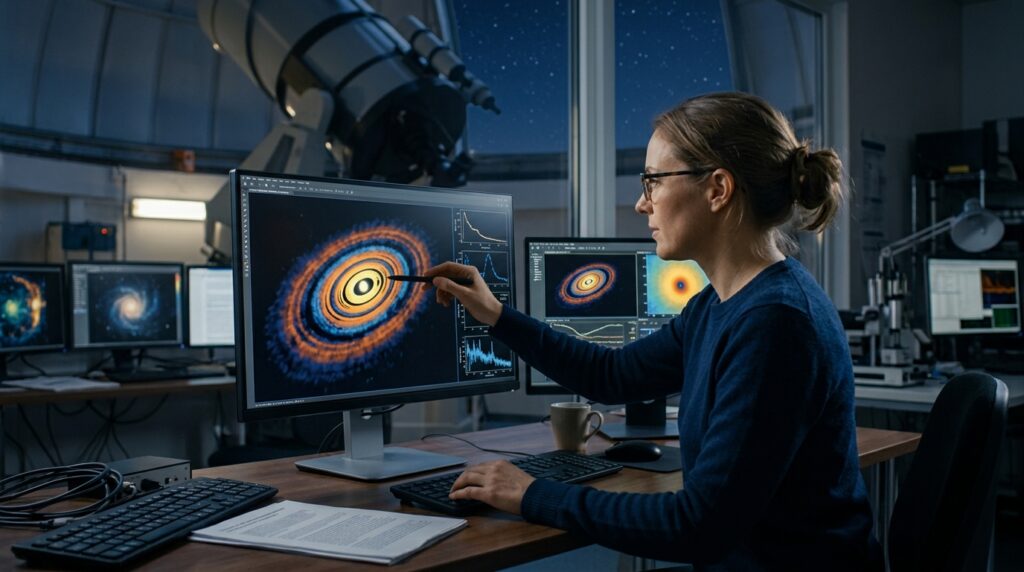
Researcher analyzes a model of dust rings on screen
The main advantage of the method is that this pattern holds even when dust grain sizes vary. This is a serious advantage over previous methods: they relied on the size of dust grains, which usually nobody knows precisely. Here, the uncertainty about dust size no longer interferes with the estimate.
When a Ring in a Disk Stops Growing Along With the Planet
With the ring width and dust mass, the story is more complex. At first, everything is logical: the more massive the planet, the more distinct the ring becomes and the more dust it captures. But at some point, this growth plateaus and stops.
The reason is a threshold that astronomers call the pebble isolation mass. Once a planet reaches this mass, it becomes an effective barrier and stops allowing material from the outer part of the disk to pass through. After that, the ring no longer changes, even if the planet continues to grow.
This leads to a simple rule: planets lighter than this threshold create wider rings with less dust mass, while planets heavier than the threshold create narrower and more compact rings. From the shape of the ring alone, one can already estimate which “weight class” the invisible planet falls into.
Testing the Planet-Weighing Method on the Real PDS 70 System
A theory is only as good as it works on real observations. So the team applied their method to the PDS 70 system — one of the most studied planet-forming disks. And the results matched independent measurements made earlier by other methods.
One of the strengths of this work is that it doesn’t remain in the realm of pure theory — we were able to take the simulation results and apply them directly to real observed systems, — notes MIT astrophysicist Jessica Speedie.
The approach was then tested on a broader sample of disks imaged by the ALMA observatory. It turned out that the shape of rings, combined with gap measurements, helps estimate two things at once: planet masses and the properties of the disk itself.
Limitations of the Planet-Weighing Method and What Remains to Be Refined
The described model, however, has honestly stated assumptions. It assumes that planets do not migrate through the disk, that dust does not affect gas, and that dust grains neither grow nor fragment. In real life, all of this can quite possibly happen.
Additionally, rings can shift, blur, and split. Sometimes a single planet generates multiple rings — especially in disks with low viscosity. So not every ring neatly corresponds to a separate planet, and this needs to be taken into account.
Still, the direction chosen is important. Telescopes are becoming ever more precise, meaning astronomers are gradually transitioning from indirect detection of planets to more detailed study of them.
The main conclusion is simple: dust rings around young stars hold far more information about the planets forming them than previously thought. If the method is confirmed by new observations, we will have a way to “weigh” worlds that we cannot even see yet — and better understand how planets are born, including once upon a time our own.