Icebergs are reshaping the ocean: what happens in the depths
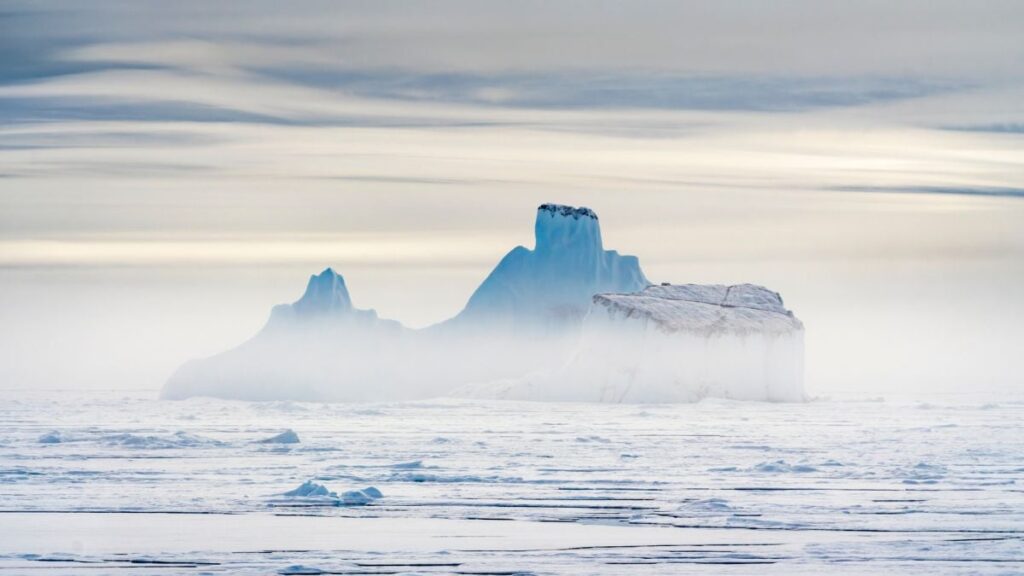
Greenland’s glaciers are releasing four times more icebergs into the ocean than a quarter of a century ago, and the consequences have turned out to be far deeper than just rising sea levels. Scientists from the Technical University of Denmark have discovered that icebergs transport rocks and sediments to the deep ocean floor, effectively creating new habitats for marine organisms that could change the course of our planet’s development.
How Many More Icebergs Have Appeared in the Arctic Over 25 Years
The main figure from the study sounds almost unbelievable: in the Fram Strait, the number of icebergs has quadrupled since 2000. This strait lies between northeastern Greenland and Svalbard, and a significant portion of the Arctic’s ice discharge passes through it.
The reason is straightforward and directly linked to warming that is changing Earth’s climate. The faster Greenland’s glaciers melt, the more actively they “break off” chunks of ice. This process, by the way, is called glacier calving. And it’s not just about quantity: scientists have noticed that icebergs are increasingly traveling in large groups. The share of clusters containing more than five icebergs (from both Greenland and the Russian Arctic) is growing by approximately 4.5% per decade.
How Icebergs Transport Rocks to the Ocean Floor
The most unexpected aspect of the study is a mechanism that was previously almost never accounted for. Icebergs function as natural cargo barges: frozen inside the ice are rocks, pebbles, and sedimentary material that the glacier once scraped off the land.
When an iceberg calves and drifts into the open sea, it carries this cargo with it — sometimes for several hundred kilometers from shore. Gradually the ice melts, and all the rocky ballast falls to the bottom. As a result, hard rock ends up where normally only soft silt would lie.
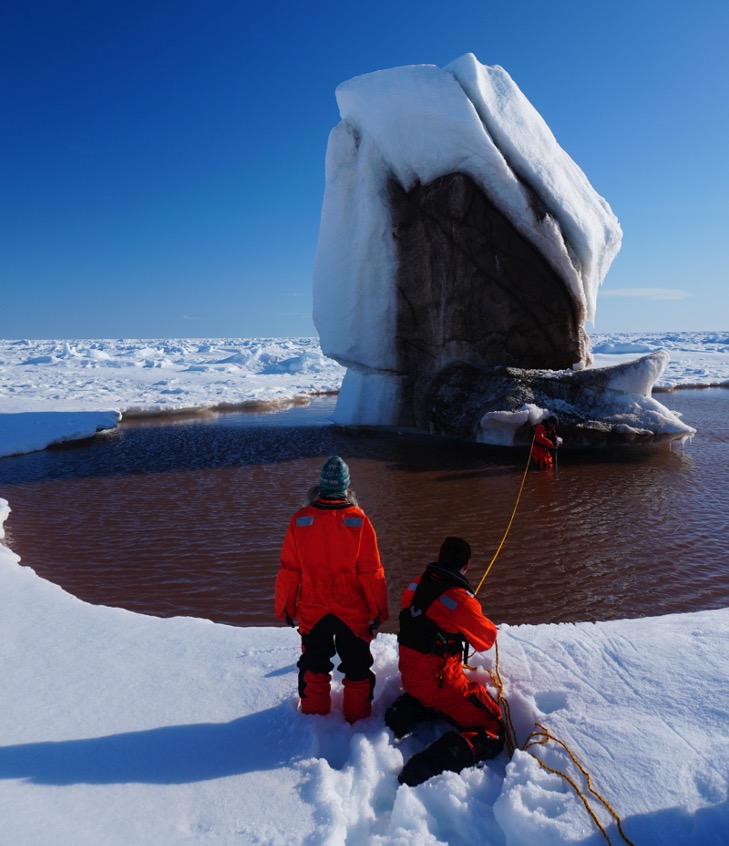
Pools like these form right on the glaciers
The researchers collected samples during an expedition on the icebreaker Polarstern in the summer of 2025. Expedition photographs show how meltwater pools form at the base of frozen icebergs, tinted brown by the very sediment trapped inside the ice.
How Rocks at Depth Create New Life
To understand the importance of this finding, you need to picture what the deep ocean floor looks like. It is mostly a monotonous soft plain of silt where there is literally nothing to cling to. Yet many marine organisms need a hard surface: corals, sponges, mollusks, and other creatures that attach to surfaces and filter water.
That is precisely why large rocks dropped by icebergs turn into islands of life. Scientists call these “hard bottom habitats” — essentially new anchor points where life can take hold in the middle of a silty desert.
According to the authors, there is a direct climatic chain: changes on the glacier surface intensify the flow of icebergs, which in turn increases the amount of hard substrate on the deep seafloor. In other words, ice melting on land is restructuring ecosystems hundreds of kilometers from shore.
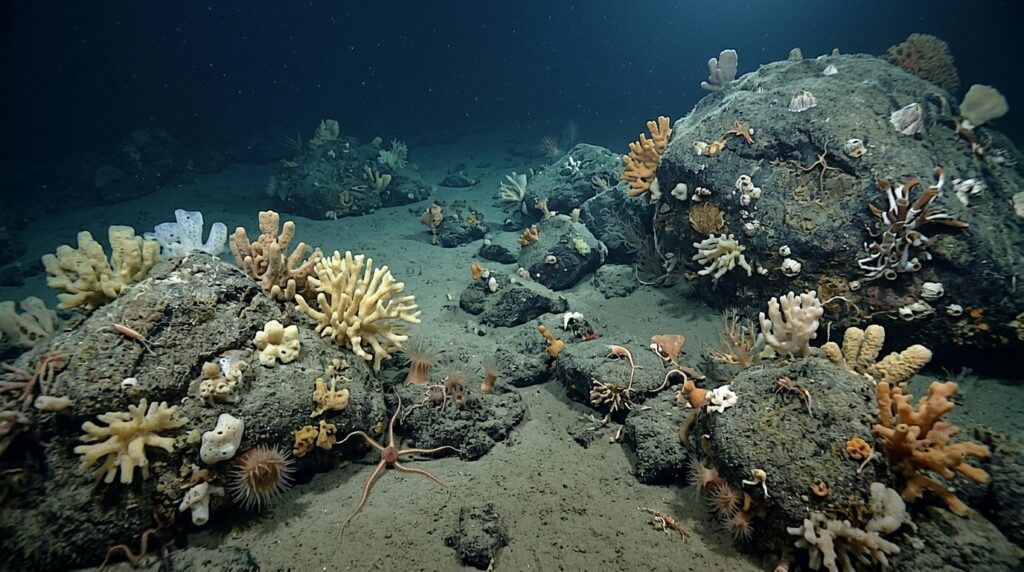
Rocks on the bottom become anchors for benthic organisms
Why the Growing Number of Icebergs Is Dangerous for Shipping
This story also has a strictly practical side. As the Arctic warms, new shipping routes are opening — where there used to be solid ice, ships can now pass through. This attracts cargo and commercial vessels, for which the shorter northern route saves time and fuel.
But the more icebergs drift in these waters, the higher the risk of encountering one directly in the ship’s path. A collision with an iceberg is far from an abstract threat, and the story of the Titanic still serves as a reminder. So the increase in ice traffic directly affects the safety of future Arctic navigation.
What This Changes in Our Understanding of Glacier Melting
Usually, when people talk about the melting of Greenland’s ice, they primarily think of rising sea levels. And that is indeed true: ice melts, water rises, and coastlines come under threat.
But this new study shows that the consequences are not limited to ocean levels. One and the same process simultaneously changes life on the deep ocean floor and complicates shipping. This is a good example of how climate change links phenomena that at first glance seem completely unrelated.
It is important to understand that this is not about “saving” the ocean: the emergence of new habitats is neither a positive nor a negative — it is a restructuring of established ecosystems. Exactly what will grow on these new rocky islands and how it will affect Arctic food chains is something scientists still need to figure out. But the very fact that icebergs act as life-delivery vehicles to the ocean floor significantly changes the picture of what is happening in the northern seas.