Several mummies were found inside a mysterious sarcophagus in Egypt
In Egypt, near the famous Aga Khan Mausoleum, archaeologists descended a narrow staircase underground and found themselves in a tomb that had not been disturbed for over two thousand years. At the bottom, a stone sarcophagus nearly two meters long covered in hieroglyphs awaited them, and nearby were several mummies, including those of children. The find turned out to be just a small part of a vast ancient cemetery stretching underground over hundreds of thousands of square meters.
How the Ancient Tomb Was Discovered in Egypt
The entrance to the tomb, given the working name “Tomb No. 38,” begins with a staircase. Nine steps lead downward, underground, to a small subterranean chamber carved directly into the rock.
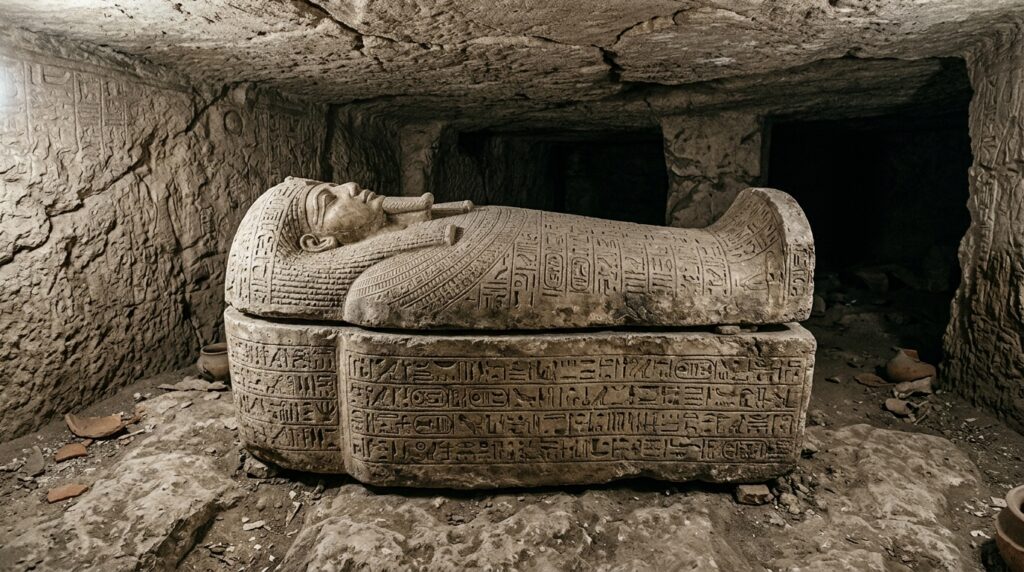
According to Daily Galaxy, on both sides of the staircase archaeologists found mudbrick benches. These were apparently used to place offerings for the deceased during funeral rites. And at the very bottom, on a platform carved directly into the stone, stood a limestone sarcophagus about 1.8 meters long. Essentially, the staircase led not to a grand entrance but to a stone box with a person inside, hidden deep beneath the surface.
Who Did the Mysterious Sarcophagus in Egypt Belong To
The most fascinating part is the inscriptions. Vertical columns of hieroglyphs on the sarcophagus contain prayers to local gods and name the tomb’s owner. This was a certain Ka-Mesiu, a high-ranking official of his time.
In other words, the hieroglyphs here serve simultaneously as a tombstone and an identity document: they both ask the gods for protection over the deceased and state who he was during his lifetime. For archaeologists, this is a tremendous stroke of luck, because not every ancient burial allows them to learn the name and status of the person lying inside.
The sarcophagus lid deserves special attention. It is shaped like a human figure with a neatly sculpted face, a wig, and preserved traces of paint. After millennia, one can still make out the facial features that the craftsman carved for a specific individual.
Why Children’s Mummies Were Found Next to the Sarcophagus
The tomb turned out not to be a single burial. In addition to Ka-Mesiu’s sarcophagus, several mummies were discovered inside, including those of children. Researchers have not yet specified whether all the bodies were placed inside the sarcophagus itself or whether some were buried alongside it.
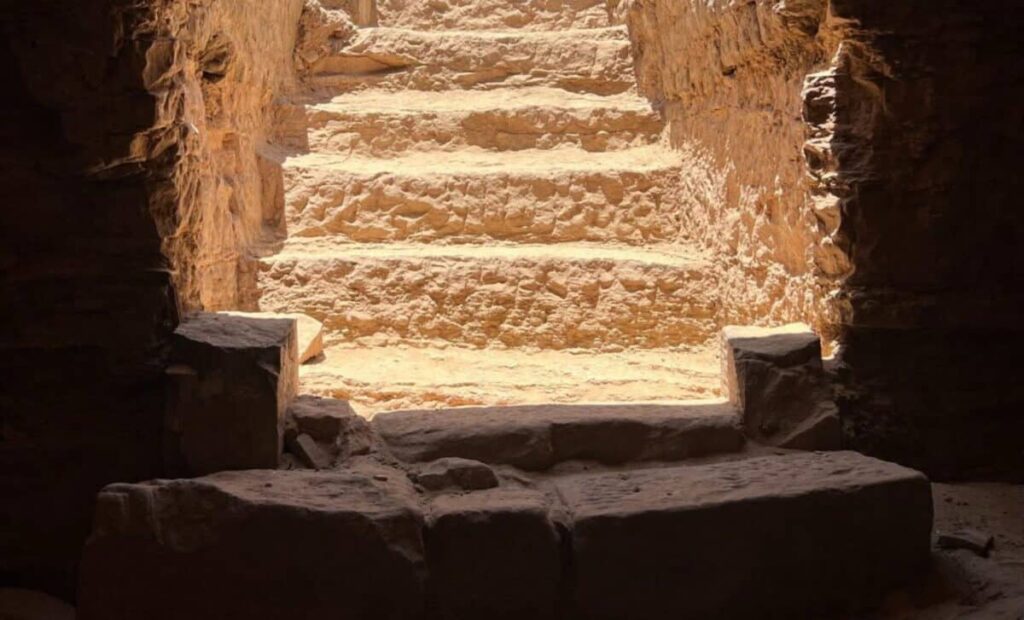
The staircase leading to the chamber with the mummies
It sounds somber, but for ancient necropolises this is a common sight — family tombs were used for generations, and relatives of various ages were buried in them. Child mortality in those times was very high, so children’s mummies in family burials are found quite frequently.
Why the Ancient Cemetery in Aswan Turned Out to Be Much Larger
The sarcophagus is impressive, but it is only a tiny fragment of a much larger picture. Tomb No. 38 belongs to the so-called Aga Khan Necropolis, a gigantic cemetery that served the population on the southern border of ancient Egypt for centuries.
The scale is staggering. More than 400 tombs have already been mapped across an area exceeding 75,000 square meters. Researchers initially counted over 500 tombs and estimate the entire cemetery could extend to approximately 200,000 square meters. So far, only about 25,000 square meters have been studied in detail, meaning the majority of the necropolis still awaits excavation.
In those times, Aswan was a multinational place. Egyptians, Nubians, Persians, Phoenicians, Greeks, and Romans lived here, and all of them buried their dead in this shared cemetery near the ancient cities of Elephantine and Syene. According to Egypt’s Minister of Tourism and Antiquities Sherif Fathy, the new tombs help to better understand the social life of the region during the Ptolemaic and Roman periods and confirm that Aswan was a major cultural center of the country’s south.
How Old Is the Tomb and How Are Mummies Studied with CT Scans
The cemetery was used for a very long time and was organized according to social hierarchy. Noble families were buried at the top of the plateau, while middle-class burials were located on the slopes closer to the Aga Khan Mausoleum.
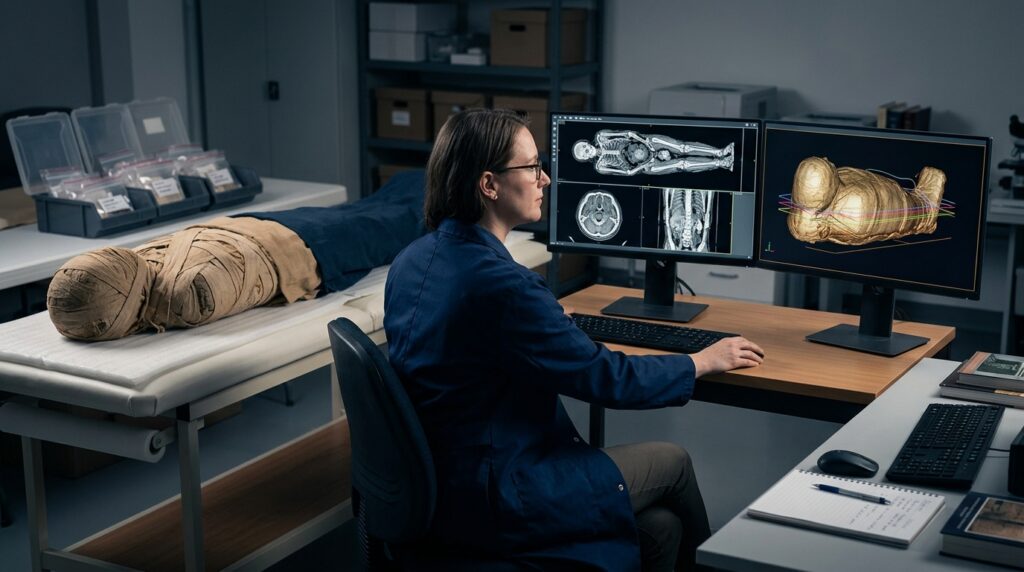
CT scanning helps study mummies without unwrapping them
To determine the age of the finds, scientists use dating of artifacts and mummies. Finds from tombs AGH038 and AGH039 date to the period from the 3rd century BCE to the 2nd century CE — meaning some of them are over two thousand years old. And to look inside mummies without unwrapping them, archaeologists use computed tomography. This is the same method that hospitals use to see bones and internal organs without performing surgery.
Sometimes such scans overturn previous assumptions. Two mummies from tomb AGH026 were previously thought to be a mother and child, but CT scanning revealed they were two children: one approximately four to six years old, the other eight to nine. Without scanning, this mistake would have been nearly impossible to detect.
What Secrets Still Lie Hidden in the Ancient Egyptian Cemetery
The most fascinating aspect of this entire story is that only a small portion of the cemetery has been studied. If the estimates of 200,000 square meters are confirmed, hundreds of unopened tombs may still be hidden underground near the Aga Khan Mausoleum — along with new names, inscriptions, and everyday objects of people who lived on the southern border of Egypt two thousand years ago.
The tomb of Ka-Mesiu helps piece together the broader picture of how different peoples coexisted in one city, how burial customs evolved, and how modern technologies like CT scanning allow us to learn things about ancient people that previously would have remained hidden forever. And judging by the scale of the necropolis, the greatest discoveries in Aswan may still lie ahead.