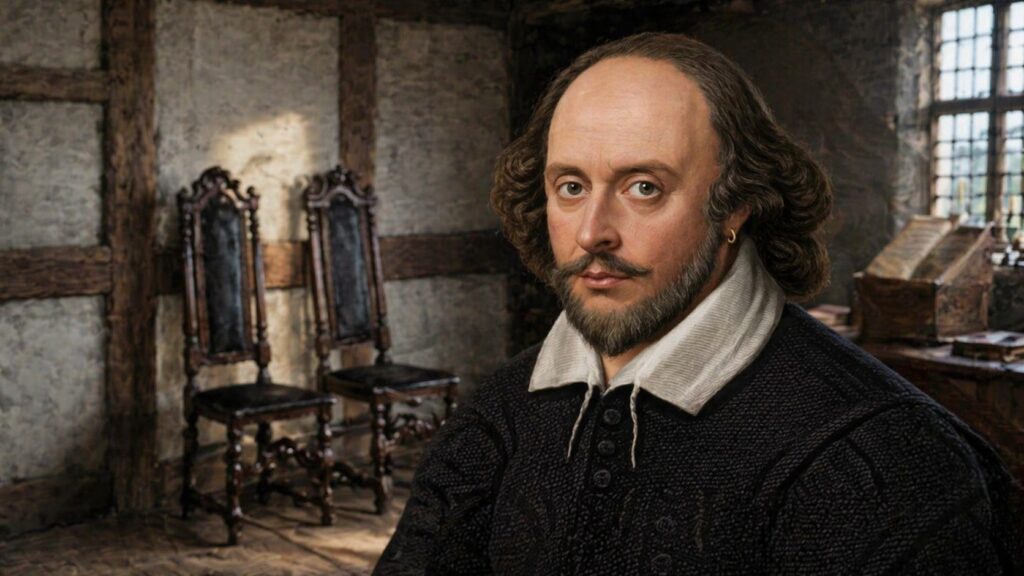
The great writer’s house had been in plain sight all along
For four centuries, historians knew that Shakespeare owned property in London but couldn’t say exactly where his house stood. A chance find in an archive solved a mystery that had puzzled scholars since the 18th century, and at the same time forced a reassessment of the final years of the greatest playwright’s life.
Where Shakespeare Was Born and Lived
Although Shakespeare’s name is inseparable from London’s theatrical scene, his personal life was tied to the town of Stratford-upon-Avon. He was born there in 1564 and died there in 1616. It is believed that Shakespeare began traveling to London as early as the 1580s, around the same time he married and became a father of three children. His family stayed home while he traveled to the capital to write and stage plays.
For most of that time, he preferred to rent rather than buy, right up until 1613. It was then, three years before his death, that Shakespeare made a purchase that would puzzle historians for centuries to come.
In March 1613, Shakespeare, along with three partners, purchased a house at the gate of the former Dominican priory in London’s Blackfriars district for 140 pounds. A substantial sum for the time, but the exact location of this house remained unknown, and historians could only point to the approximate area.
Scientists Found Shakespeare’s House in London
The exact location of Shakespeare’s only London property was established thanks to the discovery of a previously unknown building plan. The discovery was made by Professor Lucy Munro of King’s College, a specialist in Shakespeare and early modern literature. The discovery was reported by the authors of the Mental Floss website.
According to her, a plan of the Blackfriars district dated 1668 caught her eye while she was working in the London Archive on a project about local theatres. She called the find a “pleasant surprise.”
Munro was not looking for Shakespeare’s house. She was studying an entirely different subject and stumbled upon the document by chance, as often happens with major historical discoveries. In total, she found three documents — two in the London Archive and one in the National Archives of the United Kingdom.
One of the documents, a plan of part of the Blackfriars area drawn up in 1668, after the Great Fire of London, confirmed the exact location and dimensions of Shakespeare’s house. Until then, the building at 5 St Andrew’s Hill bore a plaque with cautious wording: Shakespeare acquired a dwelling “near this site.” Now it can be confidently stated that the plaque hangs not “near” but precisely on the site of the former house.
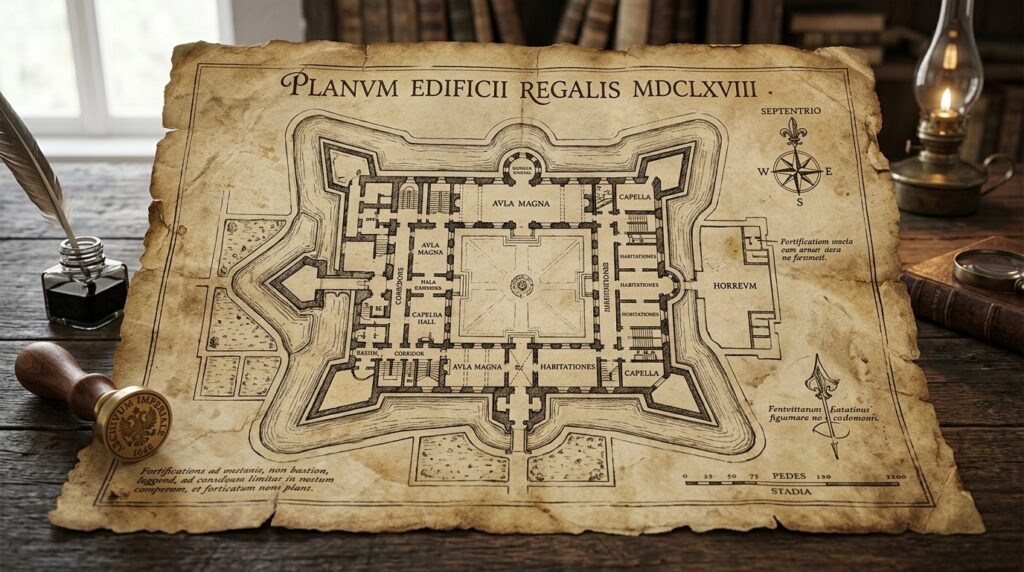
An old building plan similar to the one the researcher discovered
What Kind of House Did Shakespeare Live In
The discovered map showed that Shakespeare’s house was a fairly spacious L-shaped building. The ground floor measured about 14 meters from east to west. Part of the house was situated above the priory gates themselves. According to Munro, the building was “not enormous, but quite impressive” — so much so that it was later divided into two separate dwellings.
The location is particularly important. The house stood less than a five-minute walk from the Globe Theatre, where most of Shakespeare’s plays were staged. Additionally, the Blackfriars Theatre, which Shakespeare partly owned, was located nearby.
When Shakespeare bought the house, Blackfriars was considered a prestigious district, though it was becoming increasingly socially diverse. Many nobles lived in the area, but so did merchants. Munro notes that the district was slowly losing its status partly because of people like Shakespeare — wealthy, but connected to the “somewhat ignoble” world of the stage.
What Were Shakespeare’s Final Years Like
Until now, it was believed that after 1613, Shakespeare essentially retired and returned to Stratford to be with his family. In the same year of 1613, the Globe Theatre burned down — the fire started during a performance of “Henry VIII,” when a cannon shot on stage ignited the wooden roof. Shortly after, Shakespeare was thought to have ended his career.
Munro believes that the find calls into question the version that Shakespeare simply withdrew to Stratford. For a long time, it was assumed that the London house was merely an investment, but this has not been proven.
Munro’s logic is straightforward: if Shakespeare were buying property for income, he could have chosen any district in London. But he bought a house near the theatre where he worked. Moreover, it is known that later in 1613, Shakespeare co-wrote the play “The Two Noble Kinsmen” with John Fletcher, and the very fact that the house was spacious enough does not rule out that some of the work could have been done right there. It is also known that in November 1614, Shakespeare visited London, and it is logical to assume he stayed in his own house.
A study from Shakespeare’s era — perhaps the playwright wrote his last plays in just such a place
The Fate of the House After Shakespeare’s Death
Shakespeare died in 1616 at the age of 52. He left the London house to his daughter Susanna, and the property remained in the family for about half a century more. Munro also discovered documents that showed for the first time how and when the house passed out of the playwright’s descendants’ hands: his granddaughter Elizabeth Hall Nash Barnard sold it in 1665. Just one year later, the building was destroyed by the Great Fire of London.
The fire of 1666 destroyed 13,200 houses, 87 parish churches, the Royal Exchange, and St Paul’s Cathedral — it wiped a significant portion of medieval London off the face of the earth. Shakespeare’s house became one of countless losses.
Today, at the site of the former house, at 5 St Andrew’s Hill, stands an unremarkable 19th-century building. Of Shakespeare’s London, all that remains in this area, which is now part of the financial district, is a fragment of the old priory wall and the name of a small lane — Playhouse Yard — a reminder of the theatre that once stood here.
What Else Is Unknown About Shakespeare’s Life
To this day, it is not definitively known whether Shakespeare lived in the London house or simply rented it out. But the size of the house and its location five minutes from the theatre suggest that he spent more time in London than is commonly believed. This is not proof but a well-founded hypothesis, yet it significantly adjusts the familiar image of the “tired playwright in retirement.”
Munro believes the find shows that much can still be learned about the life of the most famous English-language writer. According to her, there is often a feeling that Shakespeare’s biography has been studied inside and out, but in reality, pieces of the puzzle are still waiting to be found.
The story of Shakespeare’s house is a good example of how important answers sometimes lie in plain sight — it’s just that no one looks in the right box of documents. For four centuries, a plaque on the wall said “somewhere around here.” Now we know it hangs exactly where it should.