There is no single altitude where Earth’s atmosphere abruptly stops and space begins. The atmosphere thins gradually, which creates a practical problem: without a defined boundary, it is impossible to register aircraft, classify satellites, or certify spaceflight records. Scientists, engineers, and governments have therefore agreed on specific altitudes — but they disagree on the number.
What you need to know
- The Kármán line, at 100 km above sea level, marks the altitude where aerodynamic lift requires orbital velocity (~7.9 km/s), making wings unnecessary.
- The U.S. military and some historians place the boundary at 80 km, where aerodynamic control becomes completely ineffective.
- Earth’s outermost hydrogen envelope (the geocorona) extends roughly 640,000 km from the surface — well beyond the Moon’s average distance of 384,000 km.
- No UN treaty specifies the exact altitude at which national airspace ends and outer space begins.

Judging by its atmosphere, Earth is much larger than it appears
Why the Kármán line sits at 100 kilometers
The most widely cited boundary is named after Theodore von Kármán, a Hungarian-born American physicist. The reasoning is rooted in aerodynamics rather than the disappearance of air.
An aircraft’s wings generate lift by pushing against air molecules. As altitude increases, air density drops, and the aircraft must fly faster to stay aloft. At 100 kilometers above sea level, the air is so thin that maintaining minimum lift requires a speed of roughly 7.9 km/s — about 28,000 km/h. That figure equals the first cosmic velocity, the speed needed to maintain a circular orbit around Earth. At that point, wings are irrelevant: the craft can simply “fall around” the planet. This physical coincidence made 100 km a convenient engineering threshold.
Why some say space starts at 80 kilometers
The atmosphere does not vanish at the Kármán line. The 100 km mark actually falls inside one of Earth’s atmospheric layers. Pressure there is millions of times lower than at sea level, and air density is negligible — effectively a vacuum for human purposes — yet sparse gas particles still exist and create drag.
Because of this, there is no absolute consensus on the precise boundary:
- The U.S. military and aviation historians have traditionally placed the start of space at 80 kilometers, the altitude at which aerodynamic control surfaces lose all effectiveness.
- The Fédération Aéronautique Internationale (FAI) uses the classic 100 kilometers for certifying spaceflight records.
- Canadian researchers proposed in 2009 shifting the boundary to 118 kilometers, based on the behavior of charged particles at that altitude.
Suborbital flight vs. true orbit
Crossing the chosen boundary does not automatically make a vehicle an orbiting satellite — a common misconception when evaluating commercial space missions.
A capsule can be launched vertically to 110 km. Passengers experience several minutes of weightlessness, see the curvature of the horizon against a black sky, and then the craft inevitably falls back to Earth. This is a suborbital flight.
Staying in space requires enormous horizontal speed, not just altitude. Practical low-Earth orbits generally begin at 160–200 km. Below that range, even the ultra-thin remnants of oxygen and nitrogen create enough drag to slow a satellite and eventually cause it to re-enter and burn up in the denser atmosphere.
The Moon orbits inside Earth’s atmosphere
If air does not fully disappear even at the altitude of the International Space Station, where does the atmosphere truly end? Above the thermosphere lies the exosphere, whose atoms are spaced enormously far apart and regularly escape into interplanetary space.
In 2019, researchers identified a vast shell of neutral hydrogen surrounding Earth, known as the geocorona. In July 2026, specialists at Russia’s Space Research Institute (IKI RAN) confirmed the staggering scale of this structure: the hydrogen trail extends approximately 640,000 kilometers from Earth’s surface.
The Moon’s average distance from Earth is only about 384,000 km. The implication is striking: the Moon literally orbits within the outermost traces of Earth’s atmosphere.
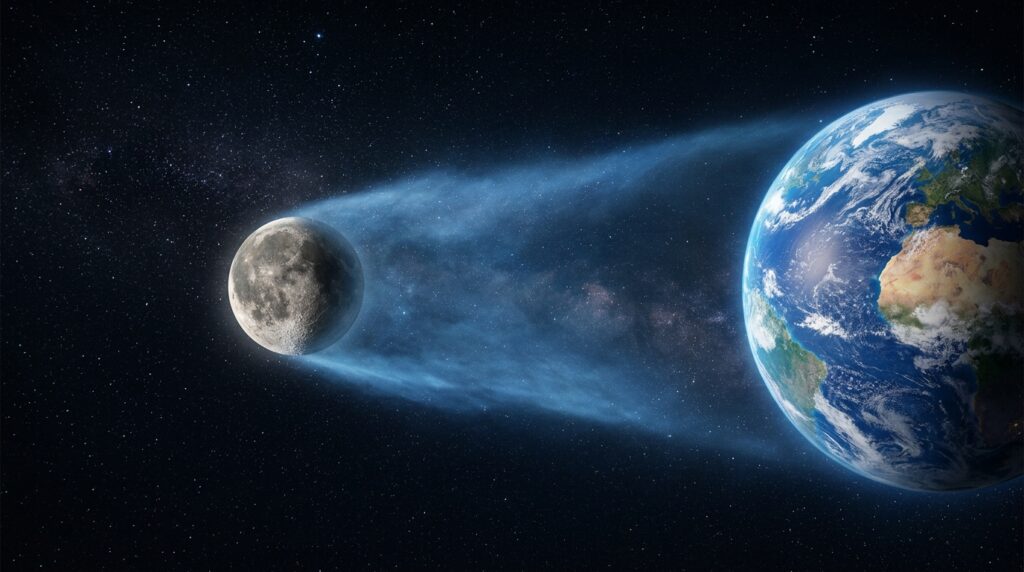
The Moon effectively moves within the outermost hydrogen trail of our planet
No legal boundary exists
Despite advances in astrophysics, there is still no legally defined edge of the sky. A nation’s airspace is sovereign territory, while outer space is open to all and cannot be claimed. The paradox is that no UN treaty specifies the exact altitude at which national airspace ends.
Countries have used the Kármán line for decades as a convenient technical standard, but a universal law binding the entire planet simply does not exist. Earth’s atmosphere dissolves into the void so gradually that any boundary will always remain a human convention rather than a real physical barrier.