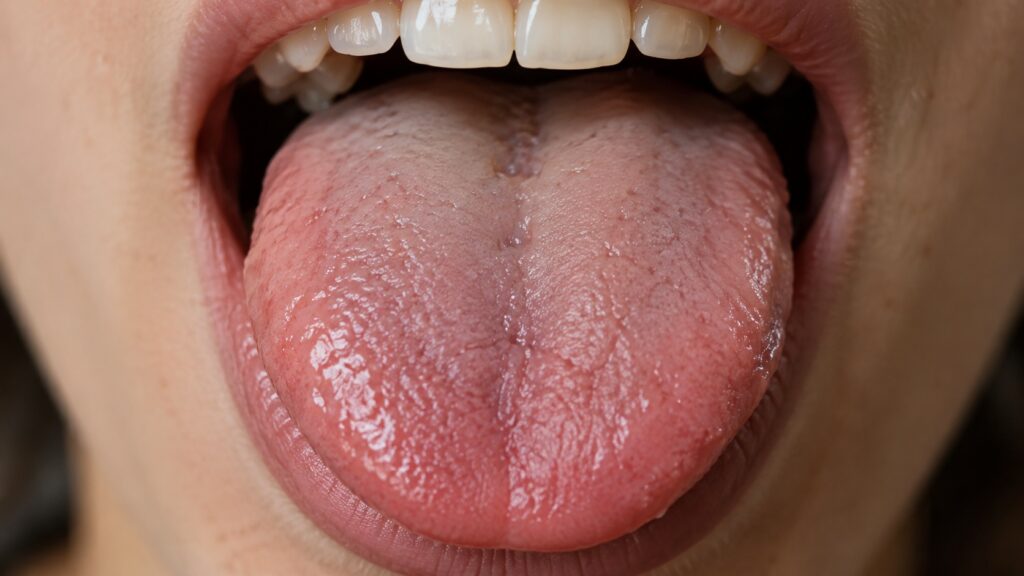
Close-up of a human tongue
People with more of certain bacteria on their tongues responded faster on some cognitive tasks, according to an exploratory study of 60 healthy volunteers in the UK and Belgium. Researchers compared the makeup of each participant’s tongue microbiota with results from tests of memory, attention and reaction speed. The link was noticeable, but the authors stress that the study does not show that mouth bacteria speed up or slow down thinking.
The work was carried out by a team led by Joanna L’Heureux of the University of Exeter, together with colleagues from the Free University of Brussels. They wanted to see whether patterns previously observed in older people with mild cognitive impairment would also appear in fully healthy people of different ages from two countries. The results were published in the journal PLOS One.
What you need to know
- In both countries, volunteers with more Prevotella histicola on the tongue reacted faster in some tasks, although the tasks showing this advantage differed between the UK and Belgium.
- Results for Haemophilus parainfluenzae were mixed: it was associated with faster responses in some tests but slower emotion recognition in the British group.
- Age was the most reliable indicator: older participants on average scored lower and answered more slowly, and 17 bacterial species differed in abundance between age groups.
- With 30 people per country and no correction for multiple comparisons in part of the analysis, the findings could partly reflect chance.
Why beetroot and blood vessels come into it
Scientists look for a connection between the mouth and the brain because of a chemical pathway that starts with ordinary food. When a person eats a nitrate-rich food such as beetroot, some of those nitrates are absorbed into the bloodstream and then return to the mouth in saliva.
Bacteria living on the tongue convert dietary nitrates into nitrites. The body then uses these to produce nitric oxide, a molecule that helps blood vessels widen and improves blood flow. The same mechanism is studied in sports medicine to explain why beetroot juice boosts endurance. Now researchers are testing whether it is also linked to how quickly the brain works.
Who was tested, and how
In both the UK and Belgium, the researchers recruited two groups of volunteers: 15 young adults (around 20 years old on average) and 15 older adults (aged 60 to 70). All participants were screened beforehand. None reported problems with memory or thinking, none smoked, none had oral diseases, and none had recently taken antibiotics.
Participants completed tasks measuring working memory, attention, emotion recognition and information-processing speed. The researchers also measured their blood pressure and collected blood, saliva and tongue swabs so they could compare the composition of the oral microbiota with test performance.
Which bacteria matched faster responses
One association appeared in both countries: people with more Prevotella histicola on their tongues reacted faster in some tasks. However, the specific tests in which this advantage appeared were not the same for the British and Belgian participants.
The picture for another species, Haemophilus parainfluenzae, was even less clear-cut:
- in Belgium, higher levels of this species coincided with faster responses in emotion recognition and visual learning, as well as more accurate working memory;
- in the UK, the same species was associated with fast responses in some tasks but slower emotion recognition;
- blood chemistry in the British group also gave mixed results: high plasma nitrate levels coincided with success in one test and errors in another, while higher nitrite levels were associated only with slower reactions.
Age was the clearest factor
As expected, age proved the most reliable indicator. In both countries, older participants on average scored lower and responded more slowly than younger ones. Comparing the age groups showed differences in the abundance of 17 bacterial species. Members of the genera Treponema and Tannerella, which are usually linked to gum disease, were more common in the older group.
Younger participants had more of one of the nitrate-converting bacterial species. But a “younger” microbiota on its own did not guarantee strong test results.
Limitations and what remains unproven
The authors emphasize that the study is exploratory and does not prove that bacteria directly make thinking faster or slower. A sample of 30 people per country is too small to confidently separate genuine biological patterns from chance statistical findings.
A woman in blue lab clothing examines a test tube of liquid
The results may also have been influenced by factors that the study did not strictly control:
- participants’ usual diet, physical activity levels and sleep quality;
- geographic differences in oral microbiota between people living in the UK and Belgium;
- sample storage conditions: samples were collected between 2017 and 2019, and the Belgian samples were transported to the UK in liquid nitrogen;
- the lack of a statistical correction for multiple comparisons in part of the analysis, which raises the risk of chance findings when dozens of hypotheses are tested.
A snapshot, not a timeline
The researchers compared different people at a single point in time rather than tracking how one person’s microbiota and memory change over the years. As a result, the findings do not mean that tongue scraping, mouthwash or other attempts to change the bacteria in the mouth will improve memory, protect against dementia or slow brain aging.
For now, the study only shows that certain microbes accompany differences in reaction speed among healthy people. Whether they cause those differences or simply reflect broader lifestyle factors will have to be determined by larger studies.