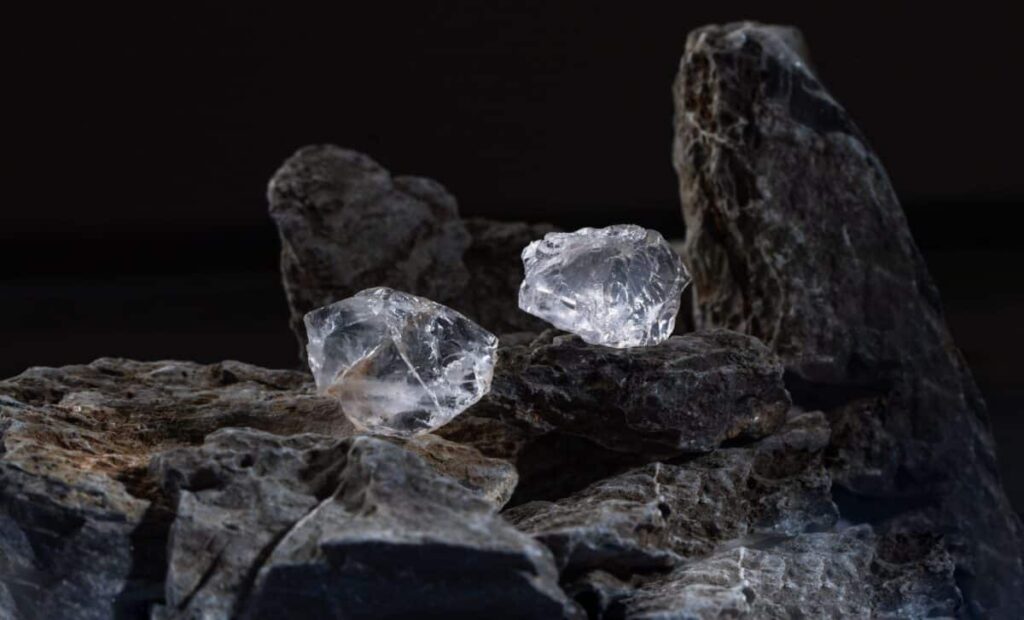
Top 10 countries with the highest diamond production: where the most expensive stones on the planet are mined
Every year, between 24 and 36 tons of diamonds are extracted from the earth’s depths. Sounds impressive, right? Until you learn that only a small fraction of them are suitable for jewelry. In 2020, global production amounted to about 142 million carats, and nearly all of that volume was provided by just ten countries. Some mine diamonds in permafrost, others on the ocean floor, and still others from river deposits. And if the diamond map of the world seems predictable, this ranking quickly breaks expectations.
Russia — the World Leader in Diamond Mining
Russia confidently holds first place in the world, having mined 23 million carats in 2020. The main deposits are concentrated in the Republic of Sakha (Yakutia), home to the famous “Mir” open-pit mine and the “Udachny” mine.
The main industry player is the company Alrosa, which is partially state-owned. Alrosa accounts for about 27% of global diamond production, and its proven reserves are estimated at 650 million carats. In terms of production volume, the company consistently remains the largest on the planet.
Interestingly, the history of industrial mining in Yakutia began back in the 1950s, when geologists discovered the first kimberlite pipes — vertical geological formations through which diamonds rise from the depths of the mantle to the surface. The harsh climate and remoteness make working in these areas a real challenge, but the scale of reserves more than justifies the costs.
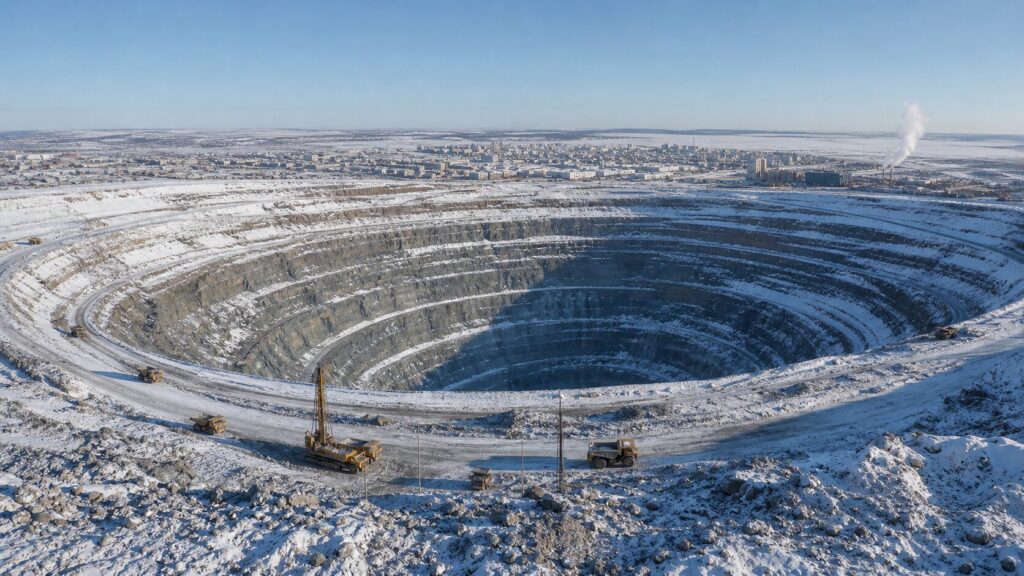
The Mir open-pit mine in Yakutia
Botswana and the World’s Largest Diamond Mine
In second place is Botswana with 16 million carats. The country’s main pride is the Jwaneng mine, which operates jointly with De Beers. Jwaneng produces 12 to 15 million carats annually and is considered the most valuable diamond mine in the world by the value of the stones extracted. Its reserves are estimated at 310 million carats. Botswana itself regularly makes the news thanks to discoveries of some of the largest diamonds found in recent decades.
For Botswana, diamonds are not just a business but the foundation of the national economy. Revenue from mining has been directed toward infrastructure, healthcare, and education for decades, making the country one of the most stable economies in Africa.
Canada: How the Country Entered the Top Diamond Producers
Canada mined 13 million carats in 2020, although industrial diamond mining in the country only began in 1998. In just over two decades, the country firmly established itself among the top three leaders.
However, working conditions at Canadian mines are extreme: deposits are located in remote northern regions, where miners face harsh weather, isolation, and high logistics costs. Some mines have already been forced to close precisely because of these factors.
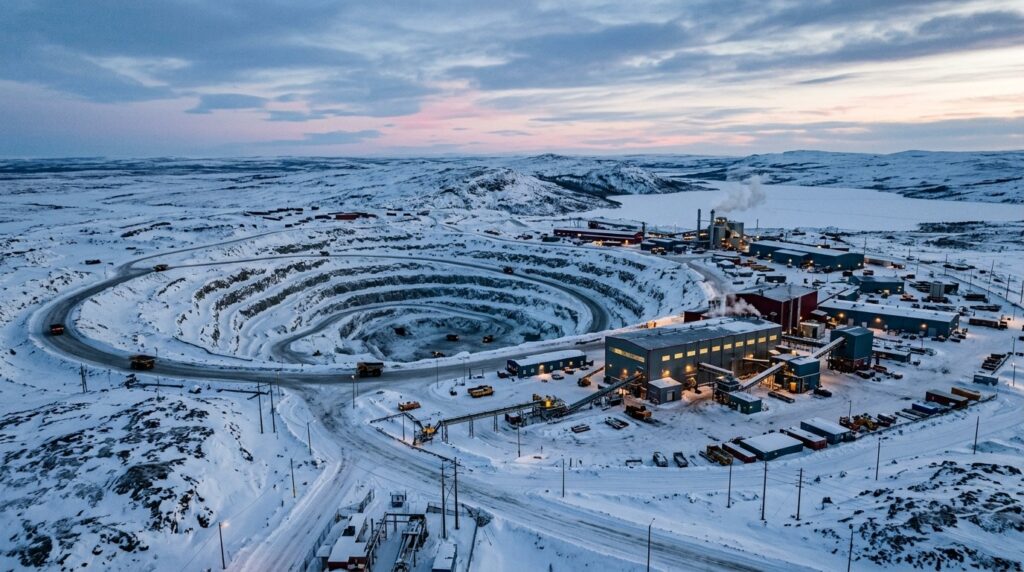
A diamond mine in the Canadian Arctic — mining is conducted in permafrost conditions
Angola and South Africa: History and Diamond Mining in Africa
Angola took fourth place with a result of 8.5 million carats. The main mining is carried out at alluvial (river) deposits, such as Lulo, where stones are collected from river sediments rather than from deep mines. At Lulo, more than 16 diamonds weighing over 100 carats have been found, indicating the exceptional potential of the region. However, political instability hinders the full development of reserves and the growth of the industry.
South Africa produced 7.7 million carats. This country is forever inscribed in the history of diamond mining thanks to the famous Cullinan diamond — the largest gem-quality rough diamond ever found. Its uncut weight was 3,106 carats, and it was discovered back in 1905. Today, mining in South Africa is carried out at the Finsch and Venetia mines, although the country long ago ceded its leadership to Russia and Botswana.
Why Diamonds Are Used in Industry Rather Than in Jewelry
The DR Congo officially mined 3.7 million carats, but only about 20% of Congolese diamonds are of gem quality. Widespread artisanal mining makes the actual production volume difficult to measure.
This situation reflects a general pattern: about 80% of all mined diamonds are used in industry — for making drills, saws, abrasive powders, and cutting tools. It is precisely their hardness that makes diamonds so valuable not only for jewelers but also for technology, where the search for the hardest materials is ongoing.
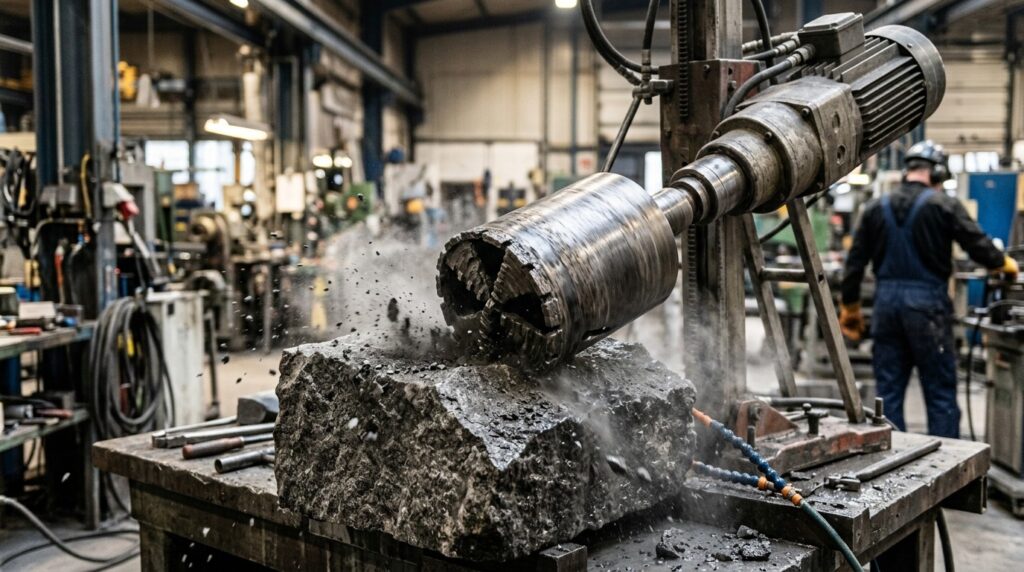
Industrial diamonds are used in drill bits and cutting tools
In other words, most diamonds on the planet end their life not on a finger but on the tip of a drill bit. This is an important nuance that is often overlooked when talking about the “diamond market.”
Namibia, Lesotho, Australia, and Tanzania — Smaller Diamond Producers
The remaining four countries on the list produce significantly less, but each is interesting in its own way.
Namibia produced 1.9 million carats, with most mining conducted not in traditional mines but along the coast and at sea. It is believed that these diamonds were carried by rivers from neighboring regions millions of years ago. The state-owned company Namdeb is increasingly developing offshore mining.
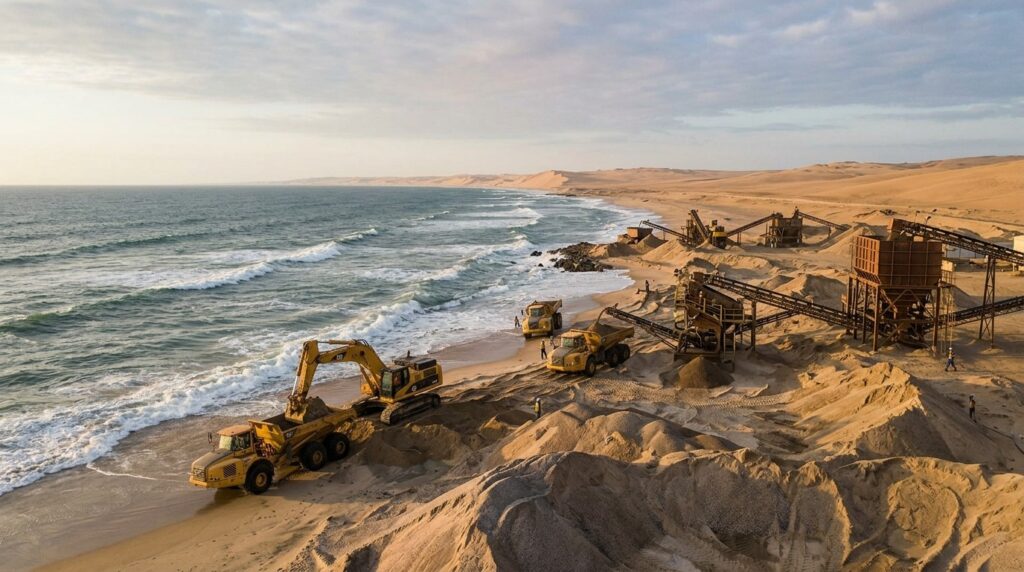
Diamond mining on the coast of Namibia — stones are extracted from coastal deposits
Lesotho, with a volume of 1.1 million carats, stands out for the quality and size of its stones. At the Letšeng mine, diamonds weighing over 300 carats have been found, including the legendary “Lesotho Legend” weighing 910 carats and a yellow diamond of 442 carats discovered in 2020.
Australia mined only 340 thousand carats — a sharp decline after the closure of the Argyle mine. Argyle was once one of the largest producers in the world and was famous for its rare pink diamonds (and scientists were only recently able to explain the secret of pink diamonds). After the mine’s closure, Australia’s presence in the global diamond market has significantly diminished.
Tanzania rounds out the top ten with 260 thousand carats. Nearly all production comes from the Williamson mine, located approximately 100 km from Lake Victoria. Opened in 1940, it remains one of the oldest continuously operating diamond mines on the planet.
The diamond map of the world clearly shows how unevenly these resources are distributed. Russia, Botswana, and Canada together account for more than half of global production, and working conditions range from Arctic tundra to African deserts and the ocean floor. At the same time, the future of the industry depends not only on mines: synthetic diamonds are becoming increasingly accessible and are gradually changing the market.