If you fill a volcano with concrete, it definitely won’t get better
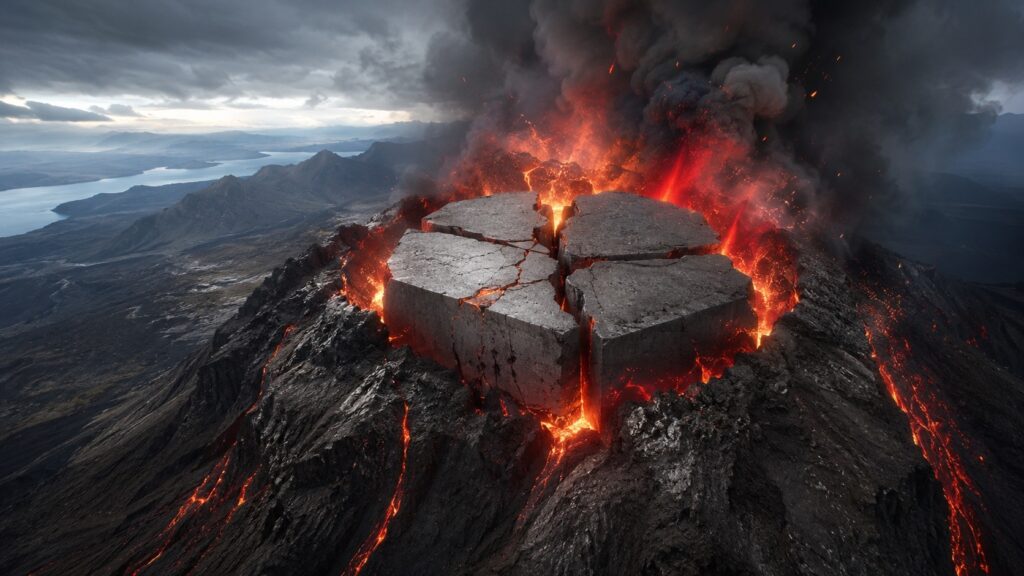
A simple question is gaining popularity on the internet: why can’t you fill a volcano with concrete to stop an eruption? The idea seems reasonable because concrete is strong, heat-resistant, and cheap. But if you understand how volcanoes work, it becomes clear that such a plug could turn even a relatively peaceful eruption into a catastrophic explosion.
How Concrete Withstands Heat
At first glance, concrete is quite capable of holding back lava. The melting point of concrete is about 1,500 degrees Celsius, while lava heats up to 871 degrees. This means that lava simply cannot melt a concrete “plug,” and theoretically, filling a crater with concrete seems feasible. This was discussed by the authors at IFL Science.
But things aren’t so straightforward because concrete doesn’t melt — it breaks down. Some of its components evaporate, while others remain solid even at extreme temperatures. But even if we assume the concrete plug withstands the volcano’s heat, that doesn’t mean the idea is a good one.
Why Volcanoes Erupt
Volcanic eruptions occur when pressure builds up beneath the Earth’s surface. Magma, molten rock, contains dissolved gases. What happens during an eruption depends on the viscosity of this magma.
If the magma is liquid and fluid, gases escape easily, and lava flows calmly from the volcano. This is what we see, for example, in Hawaii: rivers of molten rock move slowly and predictably. It’s quite possible to outrun such lava.
But if the magma is thick and viscous, like in volcanoes such as Mount St. Helens, gases become trapped.
If the magma is thick and sticky, gases cannot easily escape. Pressure builds until an explosion occurs, — explains the United States Geological Survey (USGS), citing Mount St. Helens as an example.
Imagine a bottle of carbonated water. If you slowly unscrew the cap, gas escapes with a gentle hiss. But if you shake the bottle for a long time and then suddenly open it, you’re guaranteed a fountain. If you fill a volcano’s crater with concrete, that plug would work like a cap screwed on tight on a bottle that’s being shaken non-stop.
The Explosive Eruption of Mount St. Helens
To understand the scale of the threat, it’s enough to recall the eruption of Mount St. Helens on May 18, 1980. The explosion destroyed about 600 square kilometers of forest and claimed the lives of 57 people.
Magma had been rising inside the mountain for weeks, creating a massive bulge on the northern slope. When a landslide exposed the superheated magma, pressure dropped instantly, and gases exploded within seconds. The volcano essentially fired sideways.
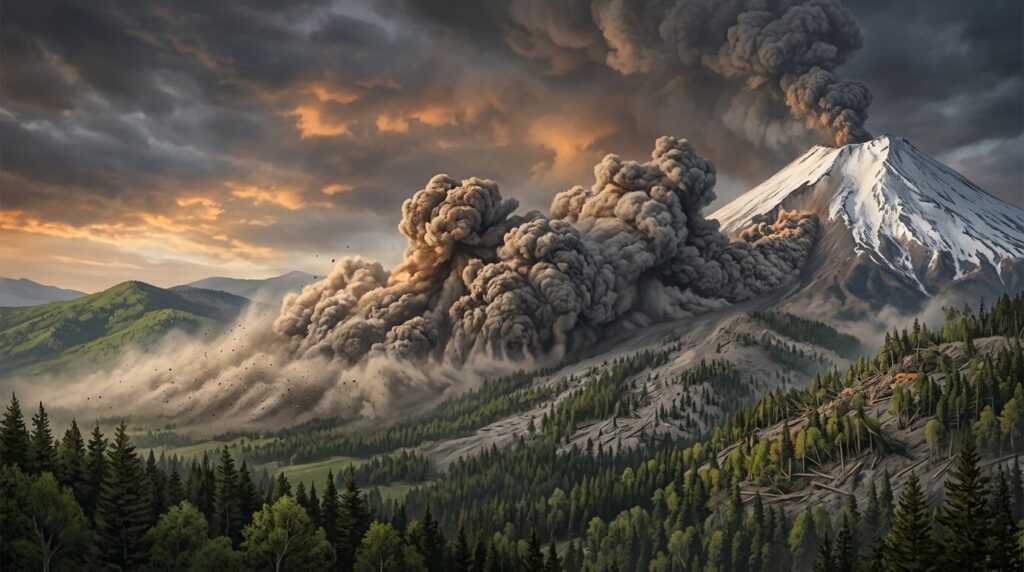
The eruption of Mount St. Helens — one of the most powerful disasters in US history
The directed steam blast released energy equivalent to 20 million tons of TNT and flattened forest across an area of about 400 square kilometers in six minutes. If there had been another obstacle blocking gas release inside the volcano, the accumulated pressure could have been even more devastating.
Why You Can’t Fill a Volcano’s Crater With Concrete
If you fill the crater with concrete, the volcano won’t stop “breathing.” Magma will continue to rise, gases will continue to be released. But the natural path for pressure relief will be blocked.
What would happen next:
- A volcano that could have simply slowly poured out lava would lose its “valve” and begin accumulating pressure;
- When the pressure exceeds the strength of the plug or surrounding rocks, an explosion will occur — a more powerful one than without the concrete;
- Fragments of the concrete itself would become deadly projectiles during the explosion.
There’s another problem that few people think about. Concrete dust after an explosion is extremely dangerous because it causes severe lung diseases and increases the risk of cancer. Adding thousands of tons of concrete to a potential eruption zone means creating a toxic cloud for kilometers around.
Simply put, a concrete plug doesn’t eliminate the cause of the eruption. It merely blocks the exit and makes the inevitable explosion stronger and more dangerous.
How Concrete Helped During the 1992 Etna Eruption
Interestingly, concrete actually did help during an eruption once. But it was nothing like what the authors of the “plug” idea imagine.
During the eruption of Etna in 1991–1993, lava threatened the town of Zafferana Etnea. Italian rescuers, supported by US military helicopters, dropped concrete blocks to redirect the lava flow.
Volcanologists consider the intervention on Etna in 1992 one of the most successful attempts to divert lava in history. But the key word here is divert, not stop. Concrete blocks were used as barriers to channel lava into a safe path, not to seal the volcano.
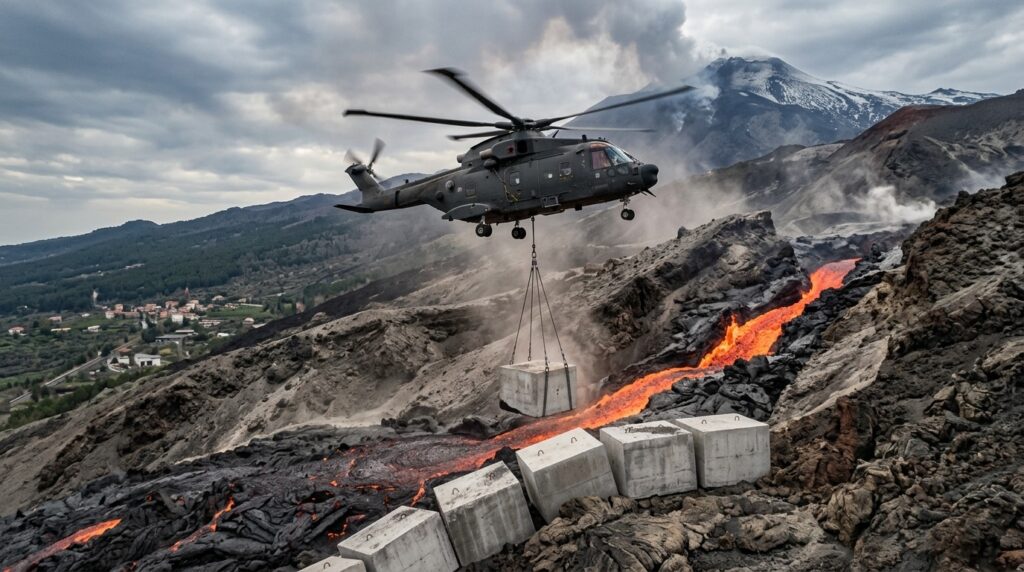
Military helicopters drop concrete blocks to divert lava on the slopes of Etna
Why Simple Solutions for Stopping Volcanoes Don’t Exist
A volcano is not a water pipe that can be plugged. Beneath the crater lies a reservoir of molten rock measuring tens of cubic kilometers in volume. Pressure in this system is created by the movement of tectonic plates and processes in the Earth’s mantle. No engineering structure can withstand such forces.
Moreover, many volcanoes don’t have a single strictly defined crater. Magma can find its way out through cracks in the slopes, through lateral vents, or even create new ones. By blocking one channel, we don’t control the rest — we merely redirect pressure in an unpredictable direction.
Modern volcanology focuses not on fighting volcanoes but on monitoring and early warning. Seismographs, satellites, gas analyzers, and laser instruments track the slightest changes in a volcano’s shape, gas composition, and underground activity. This allows for timely evacuation of people — the only truly reliable survival strategy.
The idea with concrete is understandable and even elegant in its own way. But volcanoes are systems governed by forces of planetary scale. Trying to seal a crater is roughly like taping over a crack in a dam. It won’t solve the problem, but it could make the disaster far more catastrophic.