
Helium is disappearing: the global crisis of this element threatens medicine and technology
A third of the world’s helium supply has been blocked due to conflict in the Middle East — and the consequences are already being felt by chip manufacturers, medical centers, and research laboratories around the world. Helium isn’t just about balloons at children’s parties. Without it, key technologies that modern life depends on literally come to a halt.
Why Helium Is Rare on Earth and Disappearing Fast
Helium is the second most abundant element in the Universe after hydrogen. It’s everywhere: in stars, in interstellar space, in the atmospheres of giant planets. But on Earth, things are the opposite — we have very little helium.
Helium forms deep within the Earth’s crust as a result of the radioactive decay of uranium and thorium. It slowly accumulates in natural underground reservoirs, but once it reaches the atmosphere, it escapes into space. Helium is so light that Earth’s gravity simply cannot hold onto it for long. Moreover, it’s an inert (noble) gas — it doesn’t enter into chemical reactions and doesn’t get “locked” inside minerals or molecules like other elements.
Helium can only be extracted as a byproduct — during the processing of natural gas. Dedicated “helium mines” don’t exist. That’s precisely why its supply is so tightly linked to the oil and gas industry and to the political stability of regions where the largest deposits are located.
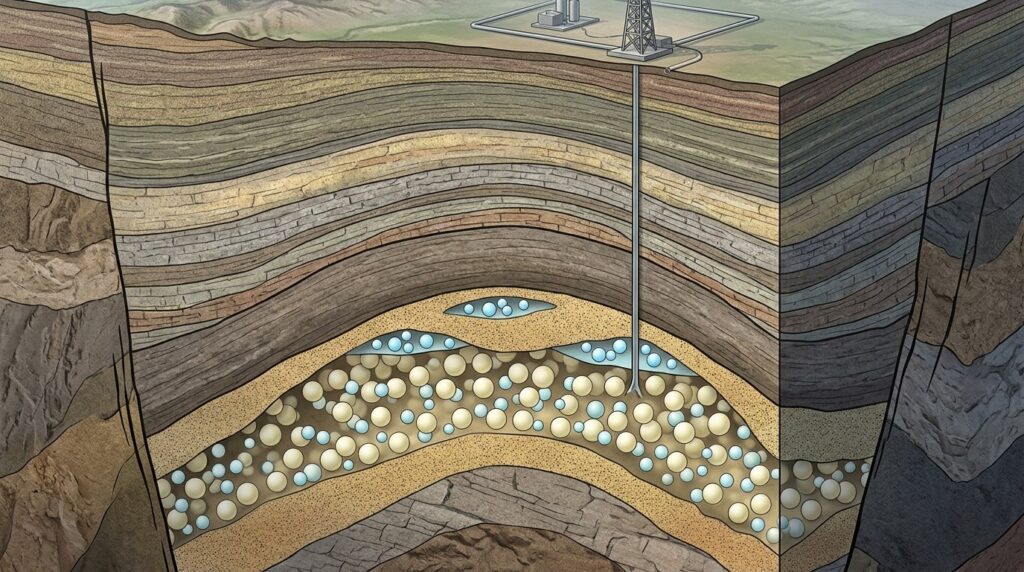
Helium accumulates in underground reservoirs along with natural gas
Where Helium Is Used: Medicine, Chips, and Space
Helium has a unique property: in its liquid state, it reaches ultra-low temperatures close to absolute zero (approximately -273.15 °C). No other coolant can provide such extreme cold. This makes it indispensable across a whole range of industries.
Medicine. MRI (magnetic resonance imaging) machines operate on superconducting magnets that generate a powerful magnetic field to produce detailed 3D images of the body. For the magnets to become superconducting — that is, to conduct current without resistance — they need to be cooled to minus 269 °C. The only substance that can achieve this is liquid helium. Without it, an MRI machine simply stops working.
Microelectronics. In computer chip manufacturing, helium is used to displace oxygen and moisture from production chambers, as well as to cool silicon wafers during etching — the process in which microscopic circuits are formed on the chip. Without stable helium supplies, semiconductor fabrication plants are forced to slow down or halt their production lines. And this is no exaggeration: supply disruptions have already threatened chip production worldwide on multiple occasions.
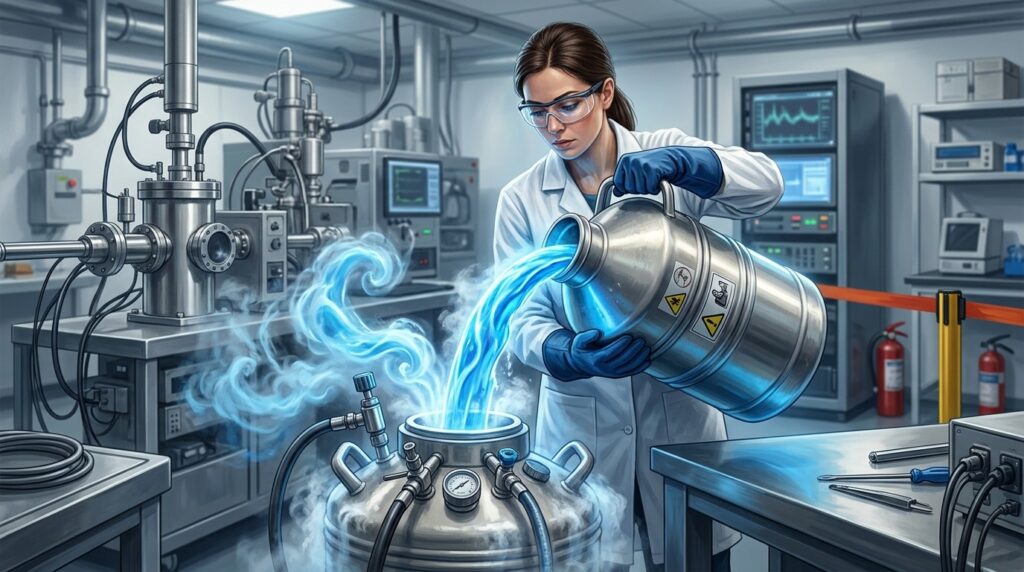
Liquid helium in a cryogenic container — a key coolant for high technology
But that’s far from all. Helium is also used:
- in nuclear magnetic resonance (NMR) spectrometers, which help determine the composition of medicines and food products;
- to cool magnets in particle accelerators — for example, in the Large Hadron Collider at CERN;
- as a coolant in certain nuclear reactors;
- to cool rocket fuel during launch;
- in fiber optic manufacturing — to create a protective atmosphere;
- by deep-sea divers — helium is added to breathing mixtures to prevent decompression sickness.
Simply put, helium is an invisible but critically important element without which a huge portion of modern infrastructure cannot function.
Why a Helium Shortage Emerged in 2026
Global helium production is extremely concentrated. About a third of all global helium is supplied by Qatar — from the massive Ras Laffan industrial complex, the world’s largest liquefied natural gas plant. The other major producers are the USA, Algeria, and Russia.
In March 2026, Iranian missile strikes on Qatar knocked out approximately 17% of its liquefied natural gas production capacity. QatarEnergy was forced to halt production. Simultaneously, Iranian control over the Strait of Hormuz — the key maritime route through which Qatari gas and helium exports flow — effectively blocked deliveries.
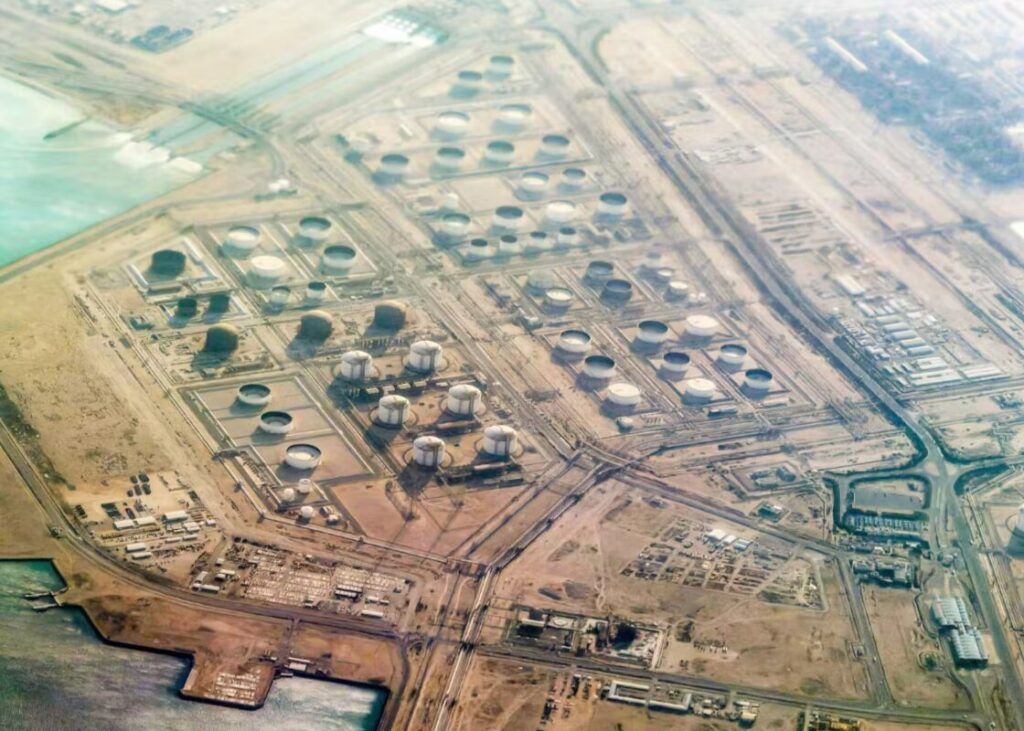
Qatari helium is produced at the world’s largest liquefied natural gas plant in Ras Laffan.
According to analysts’ estimates, the closure of the strait removed approximately 27–30% of the world’s helium supply from circulation. Spot prices for helium surged by 40–100% in just a few weeks. Around 200 specialized cryogenic containers for transporting liquid helium were stranded in the Middle East, with each container worth approximately one million dollars.
South Korea and Taiwan — the world’s largest semiconductor manufacturers — proved especially vulnerable. In 2025, South Korea imported 55% of its helium from Persian Gulf countries, while Taiwan imported 69%. For Samsung, SK Hynix, and other chip-making giants, helium disruptions pose a direct threat to their production lines.
Why Helium Cannot Be Replaced in Technology
It might seem like if helium is so important, why not switch to alternatives? The answer is simple: for most applications, alternatives don’t exist. Liquid helium is the only substance capable of cooling MRI magnets and particle accelerator magnets to the required temperatures. No other gas can reach such values. As experts note, this is a “fundamental physical limitation” — not a matter of technology or budgets, but a property of nature itself.
In chip manufacturing, helium is also virtually irreplaceable: the semiconductor industry is already operating with minimal helium consumption following optimizations made during previous crises. Helium recycling technologies exist, but they are still in early stages and cannot compensate for the loss of a third of global production.
An important detail: liquid helium during transport is stored in special containers that can maintain temperature for only 35–48 days. If a container gets stuck in transit for longer, the helium warms up, turns into gas, and simply escapes through pressure relief valves. Some of the supplies stranded in the Strait of Hormuz risk being lost in exactly this way.
Global Helium Reserves and Where New Sources Are Being Sought
It might seem like the problem has a simple solution — tap into the strategic helium reserve. The United States holds the world’s largest helium reserve, located near the city of Amarillo, Texas, in an underground geological storage facility. However, back in 2013, the U.S. Congress passed the Helium Stewardship Act, which effectively launched the process of selling off this strategic reserve.
By the 2020s, a significant portion of the reserve had been sold, and the assets themselves were put up for auction. The strategic reserve, which for decades served as a safety cushion for the global market, is virtually depleted.
What can be done? Experts point to several directions:
- Preserving remaining reserves for critically important needs — medicine and semiconductors.
- Restricting helium use in applications where its unique properties are not strictly necessary (for example, balloons).
- Developing recycling technologies, although they cannot yet fully solve the problem.
- Searching for new deposits — China is already conducting such work, and promising reserves have been discovered in Tanzania.
- Expanding production in other countries — Canada and Australia are ramping up extraction.
But none of these measures will yield quick results. Reconfiguring supply chains, relocating cryogenic containers, launching new production facilities — all of this takes months.