
Scientists still don’t know exactly what caused Mozart’s death
In December 1791, one of the greatest composers in history was bedridden with fever, swelling, and agonizing pain. Two weeks later, Wolfgang Amadeus Mozart was gone — he was only 35 years old. No autopsy was performed, no precise diagnosis was made, and his remains were lost. Since then, scientists have proposed over 130 theories about his death, but none has become universally accepted.
What Were Mozart’s Last Days Like
Mozart died at the peak of his creative activity. In the final months of his life, he completed the score of the opera “The Magic Flute,” conducted its premiere, wrote the Clarinet Concerto in A major, and began work on the famous Requiem in D minor — a piece he was never destined to finish.
The illness developed rapidly. Eyewitnesses described high fever, severe swelling of the hands and feet, pain, and weakness. Mozart was so swollen that he could not turn over in bed. His attending physician, Thomas Franz Closset, recorded the cause of death as acute miliary fever. In essence, this meant only that the patient had a rash and fever — a rather vague formulation even for the 18th century.
It is important to note that the most detailed description of the composer’s final days comes from a letter by his sister-in-law Sophie Haibel, written 34 years after his death. Direct medical records that would meet modern standards simply do not exist. It is precisely this uncertainty that has fueled dozens of hypotheses to this day.
Mozart’s Poisoning
The most famous theory — poisoning — owes its popularity not so much to science as to art. Peter Shaffer’s play “Amadeus” (1979) and its Oscar-winning 1984 film adaptation portrayed composer Antonio Salieri as a jealous villain who allegedly destroyed his brilliant rival.
Rumors of poisoning appeared literally a week after Mozart’s death, when a Berlin newspaper published a corresponding report. Mozart himself, according to accounts, told his wife shortly before his death that he had been poisoned, even naming the substance — aqua tofana, a slow-acting mixture of arsenic and lead.
As for Salieri, rumors later circulated that in his old age he confessed to the murder but then recanted his words. Most historians consider this version nothing more than gossip. Toxic substances were indeed widely used in medicine at the time, which lends the poisoning theory a degree of plausibility, but convincing evidence of deliberate poisoning has never been found.

The rivalry between Mozart and Salieri is a beautiful myth, but historians find no evidence to support it
Streptococcal Infection and Kidney Failure
The most medically substantiated theory appeared in 2009, when a team of researchers from Amsterdam, Vienna, and London published a study in Annals of Internal Medicine. The scientists examined Viennese death registers for November–December 1791 and January 1792, as well as the same periods in two adjacent years. In total, data on 5,011 deceased adults were analyzed.
The result was revealing: mortality from edema among young men in the weeks surrounding Mozart’s death was noticeably higher than in the preceding and following years. The researchers suggested that the city was experiencing a local streptococcal infection epidemic, possibly originating in a military hospital.
The mechanism the scientists describe works as follows: streptococcus (essentially the same pathogen that causes strep throat), in the absence of antibiotic treatment, can trigger post-streptococcal glomerulonephritis. This is an inflammation of the kidney’s glomeruli that leads to impaired filtration, fluid retention, and extensive swelling — exactly what eyewitnesses described.
The theory aligns well with the known symptoms, but it remains a reconstruction rather than a confirmed diagnosis. Without laboratory analyses and preserved remains, it is impossible to prove it conclusively.
Henoch-Schönlein Purpura in Mozart
Back in 1983, Australian physician Peter Davies proposed an alternative theory: Mozart may have suffered from Henoch-Schönlein purpura. This is an autoimmune disease in which the immune system attacks small blood vessels, causing inflammation, rash, joint pain, and — most importantly — kidney damage.
Henoch-Schönlein purpura often develops after infections, including streptococcal ones. Proponents of this theory point out that Mozart suffered from recurring illnesses throughout his life: as a child, he had scarlet fever, typhoid fever, smallpox, and rheumatic episodes. Such a medical history could have made him vulnerable to an immune malfunction.
Davies’s theory explains the wide range of Mozart’s symptoms — from swelling and fever to a possible cerebral hemorrhage in the final hours of his life. However, it has weaknesses: for example, the characteristic purple spots on the skin typical of this disease are not mentioned in eyewitness accounts.
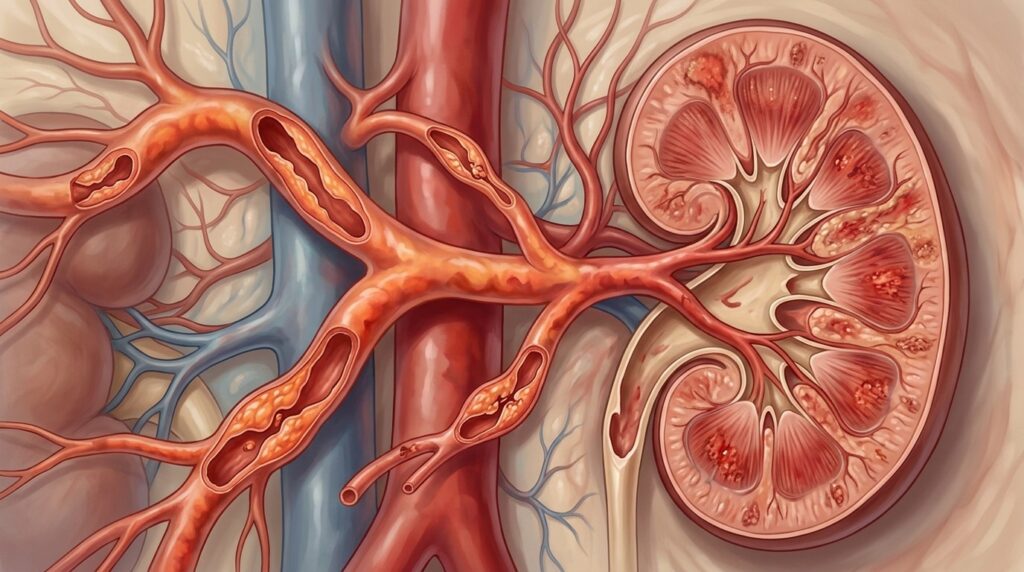
In Henoch-Schönlein purpura, inflammation affects small blood vessels and can lead to kidney damage
Mozart May Have Died from Bloodletting
The fourth theory concerns not so much the illness itself as its treatment. Bloodletting was a standard medical procedure in 18th-century Europe — doctors believed in the theory of “humors” (bodily fluids), whose balance supposedly determined health. For any fever, it was considered necessary to “let out the bad blood.”
According to Sophie Haibel’s account, when a doctor was called for Mozart, he prescribed bloodletting and cold compresses on the head. After the procedure, the composer’s strength quickly faded; he lost consciousness and never regained it. Mozart died approximately two hours after his last bloodletting.
Some researchers believe that during the last two weeks of his illness, the procedure may have been performed up to three times. For a person dehydrated by fever and vomiting, losing a significant volume of blood could have been critical — potentially leading to systemic shock.
However, bloodletting was unlikely to have been the sole cause of death. Most likely, it was the factor that hastened the demise of an already gravely ill person. This is perhaps the most bitter aspect of the entire story: the medicine meant to save Mozart may have brought his end closer.

Bloodletting was a routine procedure in European medicine until the end of the 19th century
Why Scientists Cannot Determine Mozart’s Cause of Death
Modern medical analysis leans toward the conclusion that Mozart most likely died from an infection that led to kidney failure, rather than from poison administered by a jealous colleague. But even the most convincing theories rely on incomplete records and recollections written down decades later.
Mozart’s grave has been lost — like most people of his social standing, he was buried in a communal grave. Without preserved remains, conducting genetic or toxicological analysis is impossible. Each of the four theories offers a logical explanation, but none resolves all contradictions.
Perhaps the truth lies at the intersection of several theories: a chronic predisposition to kidney disease, an acute streptococcal infection during an epidemic, and aggressive bloodletting treatment — together, these factors could have created a lethal combination. But confirming this for certain will most likely never be possible. Like one of his final masterpieces, Mozart’s story remains unfinished.