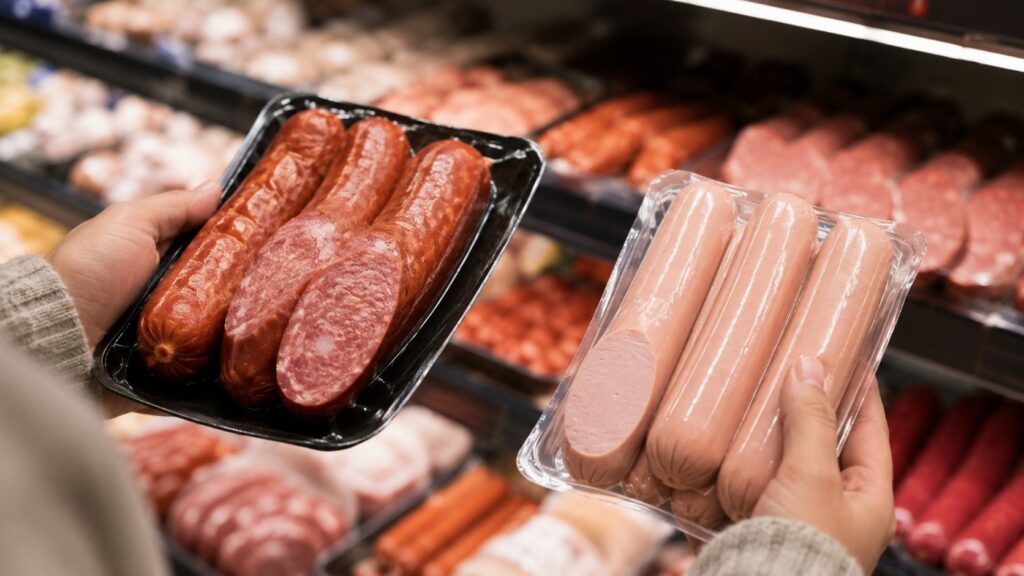
If you know a few rules, you can buy the tastiest sausages
As a child, you loved sausages. Your mom would boil them for breakfast, you’d dip them in ketchup and be happy. Then you grew up, read a couple of articles online, and now every sausage seems suspicious to you, stuffed with dangerous E-additives. We’re told they’re made of plastic, toilet paper, or whatever was left after butchering carcasses. In reality, the sausage recipe is precise, and in some ways so simple that you’ll be surprised: why doesn’t anyone talk about this? Well, they stay silent because… But let’s not get ahead of ourselves. Let’s break down the composition step by step.
What sausages are actually made of according to GOST
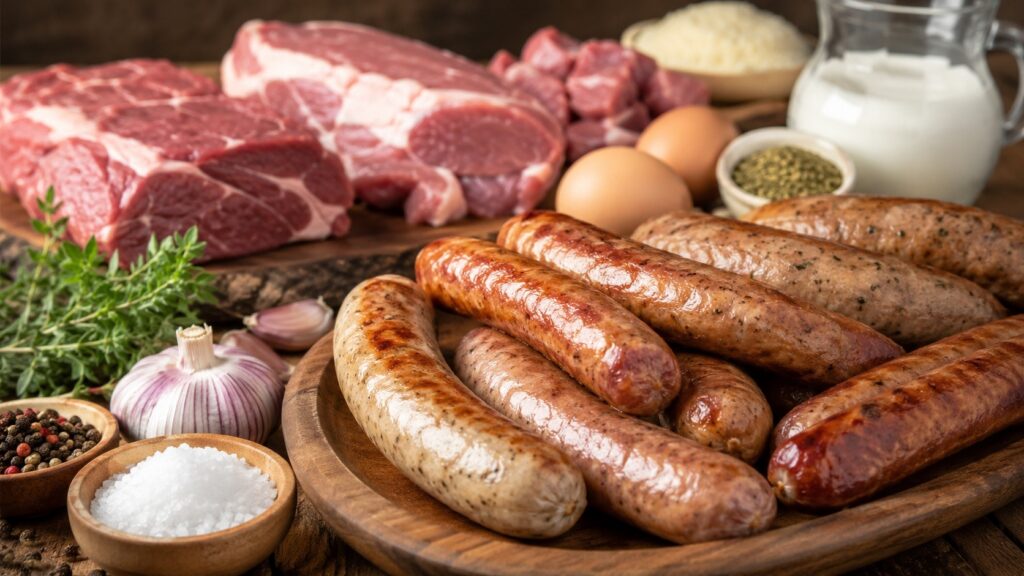
The main ingredient of real sausages is ground meat. Typically, it’s a blend of beef and pork in various proportions depending on the specific type. For example, beef sausages according to GOST have a meat content of 80% — that’s 80 kg of first-grade meat per 100 kg of finished product. Milk sausages also contain a lot of meat, but in a different ratio: 35% beef and 60% pork, plus powdered milk, a blend of yolks and whites without shells, and spices.
All of this is detailed in the document GOST 23670-2019. It specifies the recipes for each type of sausage: exactly which meat, which spices, and in what quantities. Fatback, cream, eggs, salt, food additives — each ingredient has its own permitted ratio.
So saying that sausages are made from waste is simply untrue when it comes to products labeled with GOST. It’s a different story with sausages produced according to technical specifications (TU), where the manufacturer determines the recipe themselves. We’ll talk about that a bit later.
Categories A and B on sausages
On sausage packaging, you can see a letter — “A” or “B.” This is not a quality grade or a school mark. The sausage category indicates the proportion of muscle tissue in the product, meaning how much actual meat it contains. This is explained on the Roskachestvo website.
- Category A sausages contain at least 60% muscle tissue. These are the “meatiest” sausages;
- Category B sausages contain 40 to 60% muscle tissue. These sausages are softer and more delicate, and cream or milk is more often added to them.
If the packaging shows category “A,” you have a product with a high meat content. Category “B” doesn’t mean “bad” — it just has less meat and a more delicate texture. Both categories are permitted by GOST.
It’s important not to confuse these letters with markings that sometimes appear on sausages made according to TU. There, the manufacturer may use their own labeling system, and it doesn’t necessarily match the GOST system.
Phosphates and nitrite salt in sausages
If you read the ingredients of sausages, you’ll almost certainly encounter two scary-sounding words: phosphates and nitrite salt. They sound harmful, but in practice both additives serve specific and necessary functions.
Phosphates are a source of phosphorus, which our body already gets from meat, grains, nuts, and vegetables. In sausages, they’re needed for a uniform consistency and stable quality. Without them, the ground meat would separate, and the cross-section would look unappetizing. Phosphates are approved in the food industry, but their quantity is strictly limited. Problems only arise with an excess of phosphorus in the diet, and for that you’d need to eat exclusively processed food.
Nitrite salt is regular table salt with a small dose of sodium nitrite added. The substance itself is toxic, which sounds alarming. But in the quantities permitted by regulations, it’s safe. And its tasks are serious: sodium nitrite suppresses the growth of dangerous bacteria, including those that cause botulism, locks in the familiar pink color, and enhances aroma. In fact, nitrite salt makes sausages safer, not more dangerous. It’s a paradox, but that’s exactly how it works.
How cheap sausages differ from expensive ones by composition
The price difference between sausages on the same shelf can be twofold. And it’s not just about the brand. The main difference lies in the recipe and raw materials.
GOST sausages cannot contain poultry meat, soy, starch, pork skin, gum, or cellulose. All of these are permissible ingredients for sausages made according to TU, and they’re exactly what allows manufacturers to lower the cost. Beef and pork are more expensive than chicken, while soy protein and starch cost even less.
TU sausages are not always worse than GOST sausages
TU sausages aren’t necessarily bad. For example, a sausage with added chicken will be less fatty, which may suit those watching their calorie intake. Cheese sausages are also made according to TU, simply because GOST doesn’t include such a recipe. But more often, cheap TU sausages are a way to save on raw materials by replacing some of the meat with more affordable components.
The problem is that the manufacturer has the right not to disclose the details of their technical specifications. So when buying TU sausages, you’re largely trusting a particular brand.
How to read the ingredients and choose good sausages
To avoid buying a meat imitation instead of a real product, just remember a few simple rules.
- Look for the GOST 23670-2019 marking, and check that this number refers specifically to the composition, not just the packaging. Sometimes “GOST” is written in large letters on the label, but the fine print clarifies that the standard only applies to the container;
- Check the category. “A” means more meat, “B” means less, but it’s still acceptable;
- Read the ingredients: meat (beef, pork) should be listed first. If the first ingredient is poultry, starch, or soy protein, you’re looking at an entirely different class of product;
- Evaluate the appearance. Good sausages have a pinkish color, but not an unnaturally bright one. The surface should be uniform, without fatty streaks or signs of drying;
- Check the production date and expiration date. Sausages are a perishable product, and if this information isn’t on the packaging, it’s better to walk away.
Prefer packaged sausages over those sold by weight. The packaging always lists the full ingredient composition, the ratio of proteins, fats, and carbohydrates, and the calorie count. The leanest among GOST sausages are beef sausages with a fat content of about 16%. Cream, special, and Russian varieties are also relatively low in fat, though the meat flavor in them is less pronounced.
Can you eat sausages every day without harm
Sausages are neither a superfood nor a poison. They’re a convenient and tasty deeply processed product, and should be treated accordingly. According to GOST, they contain nothing dangerous: meat, milk, eggs, salt, spices, and strictly dosed additives. However, it’s still processed meat, and all healthy eating recommendations advise limiting the consumption of such products. Not eliminating them entirely, but simply not making them the basis of your diet.
Interestingly, the sausage recipe in Russia has changed little since 1936, when People’s Commissar Anastas Mikoyan launched their mass production. The Soviet GOST required natural ingredients, and the modern standard generally continues this tradition. The only changes are that whole milk has been replaced with powdered milk, and fresh eggs with egg mélange. The essence remains the same.
By the way, GOST sausages are a thermally processed product. They can be eaten without additional cooking — they’ll taste similar to boiled sausage. But if you heat them in hot water, they become juicier. The glossy (polymer) casing should be removed beforehand, while the matte (natural) casing can be left on. So the answer to the question of whether you need to remove the sausage casing before boiling can be considered found.
Stories about how established myths diverge from reality occur in the most diverse fields, from astronomy to food. The situation with sausages is the same: fears about ingredients are greatly exaggerated, but being attentive when choosing really doesn’t hurt. Read the label, choose trusted brands, and remember that even the highest quality product is best in moderation.