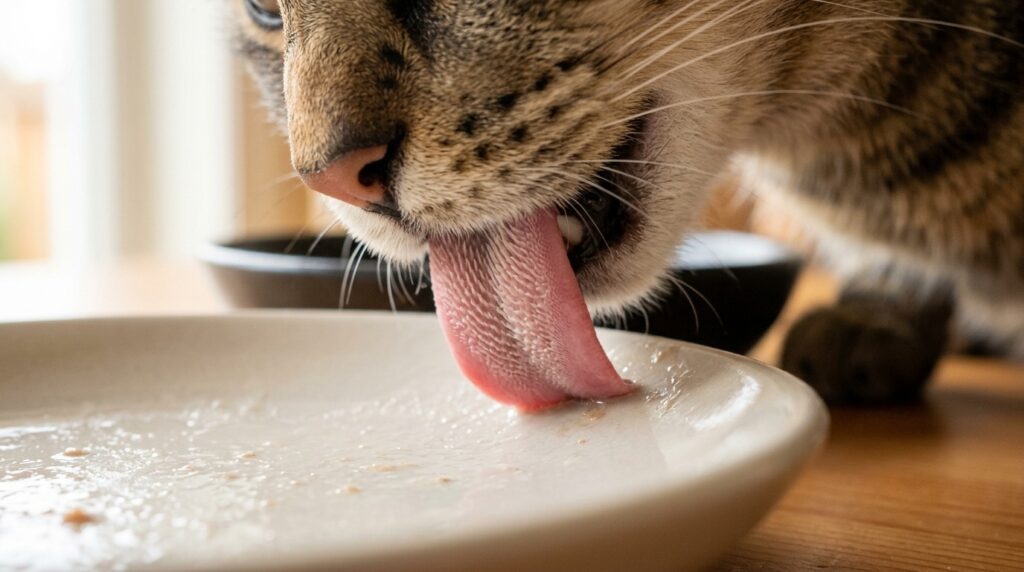
Can cats taste sweetness?
Cats can’t taste sweetness — this is the result of a genetic mutation that affected the entire feline family. In humans, sugar tastes sweet thanks to special receptors, but in cats this system simply doesn’t work. If your cat has ever licked ice cream or reached for a marshmallow, it was definitely sensing something — but not at all what you sense.
Why Cats Can’t Sense Sweetness
To perceive sweetness, the body needs a pair of receptor proteins: Tas1r2 and Tas1r3. They work in tandem — when sugar hits the tongue, both proteins activate and send a signal to the brain: “Here it is, quick energy!” In cats, the Tas1r2 gene turned out to be a pseudogene — meaning it exists but doesn’t work. Instead of two “sweet” genes, only one functions, and that’s not enough to perceive sweetness.
Put simply, the sweet receptor in cats is like an outlet without wiring: it looks like it’s there, but there’s no current. The T1R2 protein doesn’t function in cats, and for their taste receptors, sweet molecules essentially don’t exist. In humans, this system works differently: that’s exactly why sugar tastes sweet rather than just caloric or pleasant.
Why Cats Lost Their Sweet Taste
This all makes sense if you remember what cats are by nature. They are obligate carnivores — animals whose bodies are “built” for meat. Domestic pets still have a strong hunting instinct because their wild ancestors hunted rodents and birds rather than gathering berries.
Cats evolved as hunters, and their diet consisted almost entirely of meat. There’s no sugar in meat, so the ability to distinguish sweet taste simply turned out to be unnecessary. Over time, the body “switched off” the redundant function, and the gene gradually degraded without any harm to survival.

Most cats are indifferent to sweets — and that’s good for their health
For humans and other omnivores, sweetness is an important marker: it signals that food contains lots of carbohydrates, and therefore energy. For cats, however, energy is hidden in protein, and at a genetic level their body is tuned precisely to that. Nature simply removed what wasn’t needed.
What Tastes Can Cats Sense
The differences aren’t limited to sweetness alone. Cats have only about 470 taste receptors, whereas humans have 9,000 and dogs have 1,700. You’d think that with such a difference, cats would eat anything indiscriminately. But no — their few receptors work with great precision.
Here’s what cats can taste:
- Umami — the taste of meat and protein. This is a cat’s primary and favorite taste; it signals: “The food is nutritious, it’s safe to eat.” That’s why even not-so-great store-bought foods with a strong meaty smell can seem especially attractive to pets.
- Bitter — cats are particularly sensitive to it. That’s why bitter sprays effectively discourage cats from chewing on cords or licking wounds.
- Sour — they distinguish it fairly well, and many cats actually enjoy this taste.
- Salty — they can sense it, but less so than humans.
Additionally, cats may have a receptor for adenosine triphosphate (ATP) — a molecule found in every living cell. ATP provides energy to every cell, and this compound is present in meat — which explains why cats can detect its taste. Essentially, they have a built-in “fresh meat detector.”
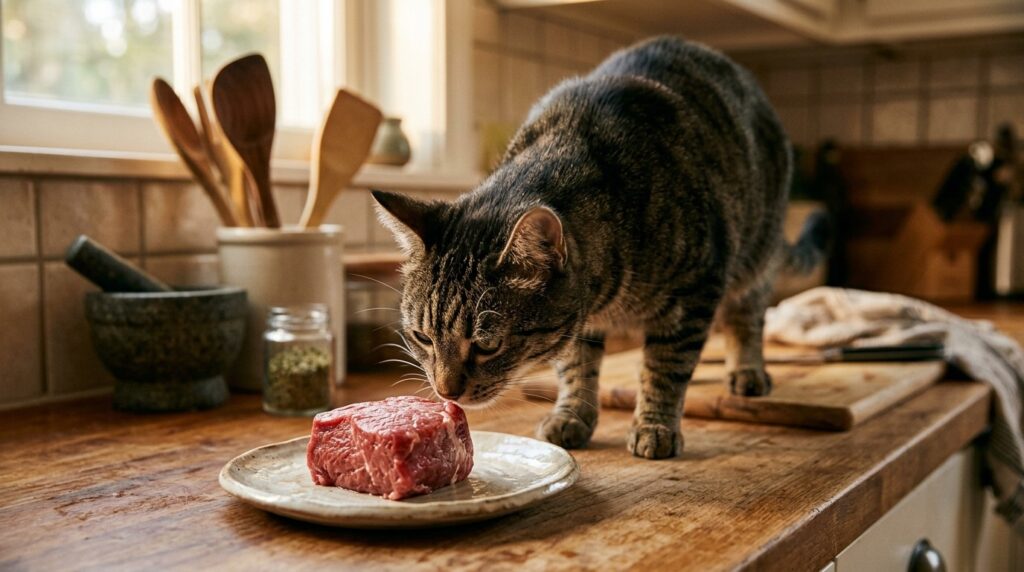
A cat sniffing meat — smell is more important than taste when choosing food
Why Some Cats Eat Sweet Things
If cats can’t taste sweetness, then why do some cats happily lick ice cream, marshmallows, or yogurt? The answer is simple: they’re attracted to something entirely different from sugar.
What might interest a cat in “sweet” products:
- Fat — ice cream, cream, and butter contain lots of fat, and cats can detect and love it.
- Animal protein — milk, cream, and yogurt contain casein and other proteins that trigger the umami taste.
- Texture and temperature — cats enjoy a soft, creamy consistency and warm food (roughly the temperature of freshly caught prey).
- Smell — a cat’s sense of smell is far more developed than its sense of taste, and it’s often smell that decides whether food is worth trying.
A cat’s possible enjoyment of such food is related not to sweet taste but to the fat and protein in the products or to the food’s texture. So when your cat licks your ice cream spoon, for them it’s more like “rich creamy fat” rather than “sweet dessert.”
Why Sweets Are Dangerous for Cats’ Health
The fact that cats can’t taste sweetness is, in a sense, a protective mechanism. Their bodies handle carbohydrates poorly. Regular consumption of sweet foods can lead to serious problems:
- Obesity — cats are not adapted to processing large amounts of carbohydrates, and excess sugar is quickly stored as fat.
- Diabetes — consuming sweets puts a heavy load on the pancreas, which can affect insulin production. If a cat is regularly fed sweets, the body begins to lose insulin sensitivity, which can lead to the development of diabetes.
- Chocolate poisoning — chocolate is dangerous for cats as it contains theobromine — a substance toxic to cats that even in small amounts can be fatal.
If your cat does reach for something sweet, you shouldn’t encourage it. It’s better to offer a meaty treat instead — they’ll be just as happy, and their pancreas will thank you.