Want to read more? Here are 5 life hacks for readers
Books are one of life’s greatest pleasures, and anyone who has ever spent hours immersed in a gripping plot knows this well. Beyond the enjoyment, reading improves memory, expands vocabulary, develops empathy, helps you sleep better, and as research shows, can even increase life expectancy. And that’s not even a complete list of benefits. But there’s a problem: in an era of endless notifications and short videos, many of us have simply lost the ability to read. The good news is that getting this habit back is easier than it seems. Below are five specific strategies that will help you actually read more, rather than just wanting to.
Read several books at once so you don’t give up
It sounds like advice for chaotic people, but in practice this is one of the most effective strategies. When you have several books going at once, you can easily switch between them depending on your mood. Stuck on a boring chapter of a detective novel? Pick up some light popular science. Don’t feel like reading a complex biography before bed? Open a novel.
Reading several books simultaneously helps you get through the “lulls” in the plot that exist in practically every book. Instead of abandoning reading altogether, you simply pick up another book and continue. Plus, different books suit different situations: motivating non-fiction in the morning, captivating fantasy on the evening commute.
Choose books you enjoy so you don’t quit halfway through
Choose books you actually want to read. This advice seems obvious, but this is exactly where most people stumble. Many force themselves to read “essential classics” or “important” books from lists — and end up abandoning reading entirely.
For some, the reading crisis may have arrived after university, where they had to read a lot of literature for their studies. For me, it crept up back in school because of mandatory summer reading lists (you know what I’m talking about). It wasn’t interesting, often wasn’t even fully understandable, just “you have to and that’s it.” And because of that, the desire to read disappeared completely, even though I had loved books since early childhood.

There’s nothing wrong with not finishing books if they weigh you down. By dropping books that aren’t right for you, you make room for ones you’ll enjoy.
The solution turned out to be simple — start with light and engaging books that you can devour in a couple of days. This restores the rhythm of regular reading, and after that it becomes easier to tackle more complex texts. And one more important point: if a book isn’t working for you — drop it without guilt. A wrong book that you’re “pushing through” kills the desire to read far more effectively than any smartphone.
The habit of reading every day: how to develop it without overdoing it
Any skill is formed through regularity, and daily reading is no exception. But the key is to start with a realistic goal: 20 pages or one chapter a day. That’s roughly 15–20 minutes — less than the average person spends scrolling social media in a single sitting.
Why do small goals work? Because they’re easy to achieve. A small goal that you actually accomplish every day is far more useful than an ambitious plan you’ll abandon after a week. And once the habit takes hold, you’ll notice on your own that you’re reading much more than your planned minimum.
Use apps for reading books, tracking progress, and setting goals
Services like Goodreads allow you to set annual book goals and track your progress. In 2024, for example, more than 9 million Goodreads users participated in the annual reading challenge. For some people, this is a powerful motivator — the element of competing with yourself helps prevent giving up.
Even if you don’t like the idea of a “numbers race,” a simple list of books you’ve read helps you see the real picture of your reading habits. And a list of books you want to read solves the eternal problem of “what should I read next?” — you always know what to pick up next, or you spot the right book at the library.
Always carry a book with you: an e-reader to the rescue
One of the simplest life hacks: the more accessible a book is, the more you read. If it’s always with you, any pause — in a queue, on public transport, waiting for a friend — turns into reading time.
This is where e-readers come to the rescue. Many fans of paper books resist the switch for a long time, but eventually admit: carrying a dozen books in one lightweight device is convenient. An e-reader lets you keep an entire library in your bag and switch between books at any moment. And you can save paper books for those editions you truly want to display on your shelf.
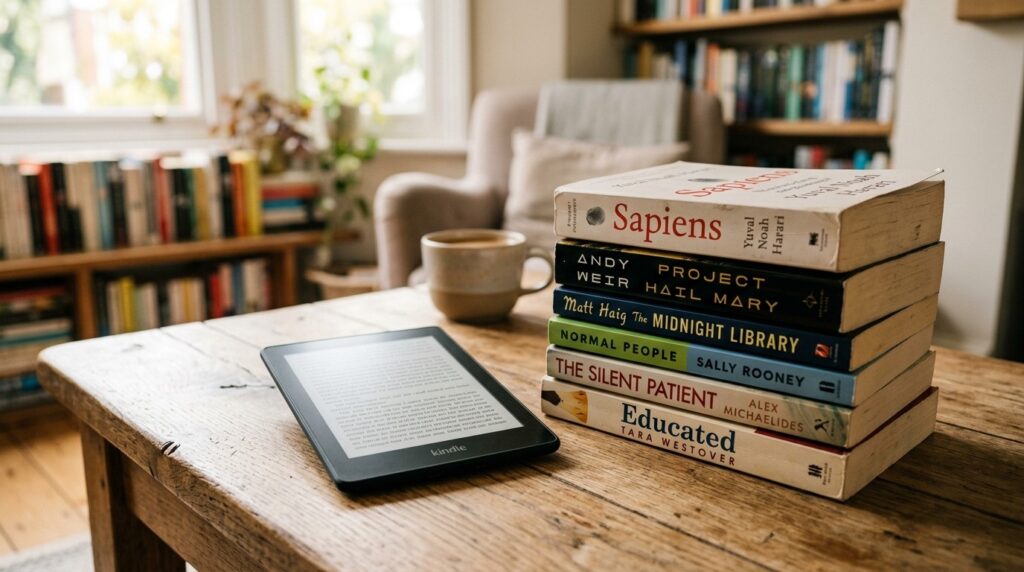
An e-reader and paper books are not competitors, but allies
A separate tip: sign up for a digital library — many public libraries today offer free access to e-books. This removes the financial barrier and makes reading even more accessible.
All five strategies share one idea: to read more, you don’t need to force yourself — you need to remove obstacles. Read what you enjoy. Start small. Keep a book always nearby. And don’t be afraid to drop what doesn’t grab you. These tips helped me, and now I’m a happy reader again (even if not every day yet). Remember: reading is not an obligation, but one of the most accessible pleasures that also makes us a bit smarter, calmer, and even healthier.